Q06263
Gene name |
VTA1 (YLR181C) |
Protein name |
Vacuolar protein sorting-associated protein VTA1 |
Names |
VPS20-associated protein 1 |
Species |
Yersinia enterocolitica |
KEGG Pathway |
sce:YLR181C |
EC number |
|
Protein Class |
|
Descriptions
The autoinhibited protein was predicted that may have potential autoinhibitory elements via cis-regPred.
Autoinhibitory domains (AIDs)
Target domain |
267-289 (VSE domain) |
Relief mechanism |
Partner binding |
Assay |
Deletion assay, Mutagenesis experiment |
Accessory elements
No accessory elements
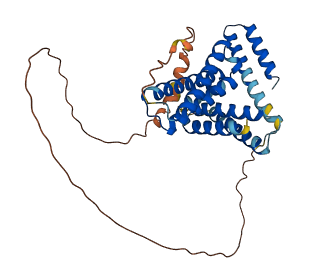
Autoinhibited structure

Activated structure
10 structures for Q06263
| Entry ID | Method | Resolution | Chain | Position | Source |
|---|---|---|---|---|---|
| 2LUH | NMR | - | A | 1-167 | PDB |
| 2RKK | X-ray | 290 A | A/B | 1-167 | PDB |
| 2RKL | X-ray | 150 A | A/B/C/D/E/F | 280-330 | PDB |
| 3MHV | X-ray | 310 A | A | 289-330 | PDB |
| 5H7P | NMR | - | A | 1-167 | PDB |
| 5UIE | EM | 570 A | H/I/J/K/L/M/N/O/P/Q/R/S | 1-330 | PDB |
| 5XMK | EM | 418 A | G/H/I/J/K/L/M/N | 1-330 | PDB |
| 6AP1 | EM | 320 A | H/I/J/K/L/M/N/O/P/Q/R/S | 1-330 | PDB |
| 6OO2 | EM | 440 A | H/I/J/K/L/M/N/O/P/Q/R/S | 280-330 | PDB |
| AF-Q06263-F1 | Predicted | AlphaFoldDB |
8 variants for Q06263
| Variant ID(s) | Position | Change | Description | Diseaes Association | Provenance |
|---|---|---|---|---|---|
| s12-517581 | 31 | A>V | No | SGRP | |
| s12-517450 | 75 | S>G | No | SGRP | |
| s12-517345 | 110 | D>N | No | SGRP | |
| s12-517116 | 186 | I>T | No | SGRP | |
| s12-517096 | 193 | H>Y | No | SGRP | |
| s12-517009 | 222 | D>N | No | SGRP | |
| s12-516898 | 259 | E>K | No | SGRP | |
| s12-516847 | 276 | H>N | No | SGRP |
No associated diseases with Q06263
1 regional properties for Q06263
| Type | Name | Position | InterPro Accession |
|---|---|---|---|
| domain | Histone H2A/H2B/H3 | 1 - 132 | IPR007125 |
3 GO annotations of cellular component
| Name | Definition |
|---|---|
| endosome | A vacuole to which materials ingested by endocytosis are delivered. |
| ESCRT IV complex | An ESCRT complex that has AAA-ATPase activity and is involved in ESCRT-mediated intralumenal vesicle formation and the final stages of cytokinesis. The complex catalyzes disassembly of the ESCRT III filament around the neck of the budding vesicle in an ATP-driven reaction, resulting in membrane scission and recycling of the ESCRT III components back to the cytosol. In yeast, it is formed by the AAA ATPase Vps4 and its cofactor Vta1. |
| multivesicular body | A type of endosome in which regions of the limiting endosomal membrane invaginate to form internal vesicles; membrane proteins that enter the internal vesicles are sequestered from the cytoplasm. |
2 GO annotations of molecular function
| Name | Definition |
|---|---|
| ATPase activator activity | Binds to and increases the activity of an ATP hydrolysis activity. |
| protein-macromolecule adaptor activity | The binding activity of a protein that brings together two or more macromolecules in contact, permitting those molecules to function in a coordinated way. The adaptor can bring together two proteins, or a protein and another macromolecule such as a lipid or a nucleic acid. |
4 GO annotations of biological process
| Name | Definition |
|---|---|
| late endosome to vacuole transport | The directed movement of substances from late endosomes to the vacuole. In yeast, after transport to the prevacuolar compartment, endocytic content is delivered to the late endosome and on to the vacuole. This pathway is analogous to endosome to lysosome transport. |
| late endosome to vacuole transport via multivesicular body sorting pathway | The directed movement of substances from endosomes to vacuoles by a pathway in which molecules are sorted into multivesicular bodies, which then fuse with the vacuole. |
| lipid transport | The directed movement of lipids into, out of or within a cell, or between cells, by means of some agent such as a transporter or pore. Lipids are compounds soluble in an organic solvent but not, or sparingly, in an aqueous solvent. |
| protein transport | The directed movement of proteins into, out of or within a cell, or between cells, by means of some agent such as a transporter or pore. |
No homologous proteins in AiPD
| UniProt AC | Gene Name | Protein Name | Species | Evidence Code |
|---|---|---|---|---|
| No homologous proteins | ||||
| 10 | 20 | 30 | 40 | 50 | 60 |
| MTTLHNLSYG | NTPLRNEHPE | IASSQIVNQT | LGQFRGESVQ | IVSGTLQSIA | DMAEEVTFVF |
| 70 | 80 | 90 | 100 | 110 | 120 |
| SERKELSLDK | RKLSDSQARV | SDVEEQVNQY | LSKVPELKQK | QNVSELLSLL | SNSPNISLSQ |
| 130 | 140 | 150 | 160 | 170 | 180 |
| LKAYLEGKSE | EPSEQFKMLC | GLRDALKGRP | ELAHLLHLVE | QALVSMVEEQ | EEAIVLGARI |
| 190 | 200 | 210 | 220 | 230 | 240 |
| TPEAYRESQS | GVNPLQPLRD | TYRDAVMGYQ | GINAIWSDLQ | KRFPNGDIDS | VILFLQKALS |
| 250 | 260 | 270 | 280 | 290 | |
| ADLQSQQSGS | EREKLEIVIS | DLQKLKEFRS | VSDQVKGFWQ | LFSEGITNGL | RPF |