Q06182
Gene name |
swi10 (SPBC4F6.15c) |
Protein name |
Mating-type switching protein swi10 |
Names |
|
Species |
Schizosaccharomyces pombe (strain 972 / ATCC 24843) (Fission yeast) |
KEGG Pathway |
spo:SPBC4F6.15c |
EC number |
|
Protein Class |
|
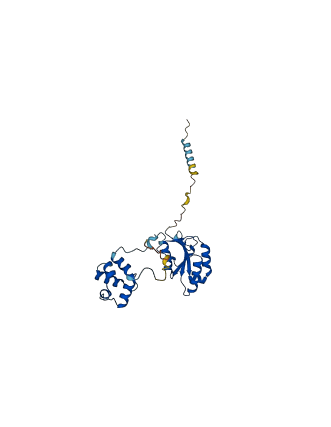
Descriptions
The autoinhibited protein was predicted that may have potential autoinhibitory elements via cis-regPred.
Autoinhibitory domains (AIDs)
Target domain |
|
Relief mechanism |
|
Assay |
cis-regPred |
Accessory elements
No accessory elements
Autoinhibited structure

Activated structure
1 structures for Q06182
| Entry ID | Method | Resolution | Chain | Position | Source |
|---|---|---|---|---|---|
| AF-Q06182-F1 | Predicted | AlphaFoldDB |
No variants for Q06182
| Variant ID(s) | Position | Change | Description | Diseaes Association | Provenance |
|---|---|---|---|---|---|
| No variants for Q06182 | |||||
No associated diseases with Q06182
5 GO annotations of cellular component
| Name | Definition |
|---|---|
| cytosol | The part of the cytoplasm that does not contain organelles but which does contain other particulate matter, such as protein complexes. |
| ERCC4-ERCC1 complex | A heterodimeric nucleotide-excision repair complex that has endonuclease activity specific for bubble structures characteristic of certain DNA lesions. The subunits are known as XPF/ERCC4 and ERCC1 in mammals, and Rad1p and Rad10p in S. cerevisiae. |
| nucleotide-excision repair factor 1 complex | One of several protein complexes involved in nucleotide-excision repair; possesses DNA damage recognition and endodeoxynuclease activities. In S. cerevisiae, it is composed of Rad1p, Rad10p, and Rad14p; in human the subunits are ERCC4/XPF, ERCC1 and XPA, respectively. |
| nucleus | A membrane-bounded organelle of eukaryotic cells in which chromosomes are housed and replicated. In most cells, the nucleus contains all of the cell's chromosomes except the organellar chromosomes, and is the site of RNA synthesis and processing. In some species, or in specialized cell types, RNA metabolism or DNA replication may be absent. |
| site of double-strand break | A region of a chromosome at which a DNA double-strand break has occurred. DNA damage signaling and repair proteins accumulate at the lesion to respond to the damage and repair the DNA to form a continuous DNA helix. |
4 GO annotations of molecular function
| Name | Definition |
|---|---|
| damaged DNA binding | Binding to damaged DNA. |
| endonuclease activity | Catalysis of the hydrolysis of ester linkages within nucleic acids by creating internal breaks. |
| polyubiquitin modification-dependent protein binding | Binding to a protein upon poly-ubiquitination of the target protein. |
| single-stranded DNA binding | Binding to single-stranded DNA. |
7 GO annotations of biological process
| Name | Definition |
|---|---|
| double-strand break repair via single-strand annealing, removal of nonhomologous ends | During DSBR via single-strand annealing, the removal of nonhomologous sequences at the broken 3' single-strand DNA end before DNA repair synthesis can occur. |
| gene conversion at mating-type locus | The conversion of the mating-type locus from one allele to another resulting from the recombinational repair of a site-specific double-strand break at the mating-type locus with information from a silent donor sequence. There is no reciprocal exchange of information because the mating-type locus copies information from the donor sequence and the donor sequence remains unchanged. |
| mating type switching | The conversion of a single-cell organism from one mating type to another by the precise replacement of a DNA sequence at the expressed mating type locus with a copy of a sequence from a donor locus. |
| meiotic mismatch repair | A system for the identification and correction of base-base mismatches, small insertion-deletion loops, and regions of heterology that are present in duplex DNA formed with strands from two recombining molecules. Correction of the mismatch can result in non-Mendelian segregation of alleles following meiosis. |
| mitotic recombination | The exchange, reciprocal or nonreciprocal, of genetic material between one DNA molecule and a homologous DNA region that occurs during mitotic cell cycles. |
| nucleotide-excision repair, DNA incision, 5'-to lesion | The endonucleolytic cleavage of the damaged strand of DNA 5' to the site of damage. The incision occurs at the junction of single-stranded DNA and double-stranded DNA that is formed when the DNA duplex is unwound. The incision follows the incision formed 3' to the site of damage. |
| UV-damage excision repair | A DNA repair process that is initiated by an endonuclease that introduces a single-strand incision immediately 5' of a UV-induced damage site. UV-damage excision repair acts on both cyclobutane pyrimidine dimers (CPDs) and pyrimidine-pyrimidone 6-4 photoproducts (6-4PPs). |
No homologous proteins in AiPD
| UniProt AC | Gene Name | Protein Name | Species | Evidence Code |
|---|---|---|---|---|
| No homologous proteins | ||||
| 10 | 20 | 30 | 40 | 50 | 60 |
| MSDIDDEEFE | QLAVSALEEV | EKKAGFAQQP | TPQKVSRVTA | HSILVNPRQK | GNPLLPHVRN |
| 70 | 80 | 90 | 100 | 110 | 120 |
| VPWEYTDIVP | DFVMGTGICS | LFLSLKYHHL | HPEYIYSRIS | KLGKSYNLRI | LLILVDVENH |
| 130 | 140 | 150 | 160 | 170 | 180 |
| QASIQELVKT | SIVNQYTLIL | AWSSEEAARY | LETYKAYENM | SPALIMEKPS | TDYLSQVQSF |
| 190 | 200 | 210 | 220 | 230 | 240 |
| LTSIRGINKS | DSLSLLSKFG | SLERALVASR | DELEQLEGWG | PTKVNRFLEA | VQQPFMSHST |
| 250 | |||||
| IKRPEAINLK | QT |