Q05237
Gene name |
cpcC (SYNPCC7002_A2211) |
Protein name |
Phycobilisome 32.3 kDa linker polypeptide, phycocyanin-associated, rod |
Names |
L-R 32.3 |
Species |
Synechococcus sp. (strain ATCC 27264 / PCC 7002 / PR-6) (Agmenellum quadruplicatum) |
KEGG Pathway |
syp:SYNPCC7002_A2211 |
EC number |
|
Protein Class |
|
Descriptions
The autoinhibited protein was predicted that may have potential autoinhibitory elements via cis-regPred.
Autoinhibitory domains (AIDs)
Target domain |
|
Relief mechanism |
|
Assay |
cis-regPred |
Accessory elements
No accessory elements
Autoinhibited structure

Activated structure
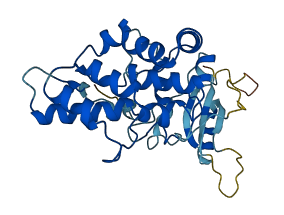
2 structures for Q05237
| Entry ID | Method | Resolution | Chain | Position | Source |
|---|---|---|---|---|---|
| 7EXT | EM | 350 A | N1/N2/N4/N5/N6/N8/a1/a2/a4/a5/a6/a8 | 1-290 | PDB |
| AF-Q05237-F1 | Predicted | AlphaFoldDB |
No variants for Q05237
| Variant ID(s) | Position | Change | Description | Diseaes Association | Provenance |
|---|---|---|---|---|---|
| No variants for Q05237 | |||||
No associated diseases with Q05237
Functions
2 GO annotations of cellular component
| Name | Definition |
|---|---|
| phycobilisome | Any of the granules, approximately 32 nm x 48 nm and consisting of highly aggregated phycobiliproteins, that are attached in arrays to the external face of a thylakoid membrane in algae of the phyla Cyanophyta and Rhodophyta, where they function as light-harvesting devices in photosynthesis. Excitation energy in the phycobilisome flows in the sequence: phycoerythrin, phycocyanin, allophycocyanin before passing to the antenna chlorophyll of photosystem II. |
| plasma membrane-derived thylakoid membrane | The pigmented membrane of a plasma membrane-derived thylakoid. |
No GO annotations of molecular function
| Name | Definition |
|---|---|
| No GO annotations for molecular function |
1 GO annotations of biological process
| Name | Definition |
|---|---|
| photosynthesis | The synthesis by organisms of organic chemical compounds, especially carbohydrates, from carbon dioxide (CO2) using energy obtained from light rather than from the oxidation of chemical compounds. |
No homologous proteins in AiPD
| UniProt AC | Gene Name | Protein Name | Species | Evidence Code |
|---|---|---|---|---|
| No homologous proteins | ||||
| 10 | 20 | 30 | 40 | 50 | 60 |
| MPVTVAASRL | GTAAFDQSPV | ELRANYSRDD | AQTVIRAVYR | QVLGNDYVMS | SERLTAAESL |
| 70 | 80 | 90 | 100 | 110 | 120 |
| FTNGFISVRD | FVRAVAQSEL | YKEKFLYNNF | QTRVIELNFK | HLLGRAPYDE | AEVIEHLDRY |
| 130 | 140 | 150 | 160 | 170 | 180 |
| QNEGFEADIN | SYIDSAEYTE | NFGDNIVPYI | RSYVVQTGHR | TVGFTRMFSL | QRGYANSDRA |
| 190 | 200 | 210 | 220 | 230 | 240 |
| QIAGNASRLA | QELARNTTSA | VVGPSGVNEG | WAFRSAADDY | HPGQSLGGST | GLSADDQVVR |
| 250 | 260 | 270 | 280 | ||
| VEVAALSTPR | YPRIRRSSRV | FFVPVSRLSQ | KLQEIQRMGG | RVASISPAGQ |