Q04772
Gene name |
IRC21 (YMR073C, YM9916.12C) |
Protein name |
Increased recombination centers protein 21 |
Names |
|
Species |
Saccharomyces cerevisiae (strain ATCC 204508 / S288c) (Baker's yeast) |
KEGG Pathway |
sce:YMR073C |
EC number |
|
Protein Class |
|
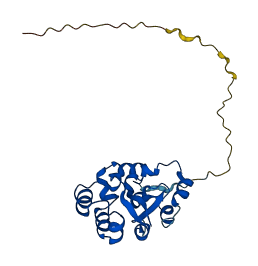
Descriptions
The autoinhibited protein was predicted that may have potential autoinhibitory elements via cis-regPred.
Autoinhibitory domains (AIDs)
Target domain |
|
Relief mechanism |
|
Assay |
cis-regPred |
Accessory elements
No accessory elements
Autoinhibited structure

Activated structure
1 structures for Q04772
| Entry ID | Method | Resolution | Chain | Position | Source |
|---|---|---|---|---|---|
| AF-Q04772-F1 | Predicted | AlphaFoldDB |
5 variants for Q04772
| Variant ID(s) | Position | Change | Description | Diseaes Association | Provenance |
|---|---|---|---|---|---|
| s13-412814 | 20 | A>V | No | SGRP | |
| s13-412788 | 29 | H>D | No | SGRP | |
| s13-412782 | 31 | A>T | No | SGRP | |
| s13-412694 | 60 | S>I | No | SGRP | |
| s13-412377 | 166 | I>L | No | SGRP |
No associated diseases with Q04772
1 GO annotations of cellular component
| Name | Definition |
|---|---|
| cytoplasm | The contents of a cell excluding the plasma membrane and nucleus, but including other subcellular structures. |
3 GO annotations of molecular function
| Name | Definition |
|---|---|
| cytochrome-b5 reductase activity, acting on NAD(P)H | Catalysis of the reaction: NAD(P)H + H+ + 2 ferricytochrome b(5) = NAD(P)+ + 2 ferrocytochrome b(5). |
| heme binding | Binding to a heme, a compound composed of iron complexed in a porphyrin (tetrapyrrole) ring. |
| metal ion binding | Binding to a metal ion. |
2 GO annotations of biological process
| Name | Definition |
|---|---|
| cellular response to DNA damage stimulus | Any process that results in a change in state or activity of a cell (in terms of movement, secretion, enzyme production, gene expression, etc.) as a result of a stimulus indicating damage to its DNA from environmental insults or errors during metabolism. |
| response to xenobiotic stimulus | Any process that results in a change in state or activity of a cell or an organism (in terms of movement, secretion, enzyme production, gene expression, etc.) as a result of a stimulus from a xenobiotic, a compound foreign to the organim exposed to it. It may be synthesized by another organism (like ampicilin) or it can be a synthetic chemical. |
No homologous proteins in AiPD
| UniProt AC | Gene Name | Protein Name | Species | Evidence Code |
|---|---|---|---|---|
| No homologous proteins | ||||
| 10 | 20 | 30 | 40 | 50 | 60 |
| MSSDGMNRDV | SNSKPNVRFA | APQRLSVAHP | AISSPLHMPM | SKSSRKPLVR | TKIRLDPGHS |
| 70 | 80 | 90 | 100 | 110 | 120 |
| ALDWHSLTSN | PANYYTKFVS | LQLIQDLLDD | PVFQKDNFKF | SPSQLKNQLL | VQKIPLYKIM |
| 130 | 140 | 150 | 160 | 170 | 180 |
| PPLRINRKIV | KKHCKGEDEL | WCVINGKVYD | ISSYLKFHPG | GTDILIKHRN | SDDLITYFNK |
| 190 | 200 | ||||
| YHQWVNYEKL | LQVCFIGVVC | E |