Q04744
Gene name |
Emx2 (Emx-2) |
Protein name |
Homeobox protein EMX2 |
Names |
Empty spiracles homolog 2, Empty spiracles-like protein 2 |
Species |
Mus musculus (Mouse) |
KEGG Pathway |
mmu:13797 |
EC number |
|
Protein Class |
|
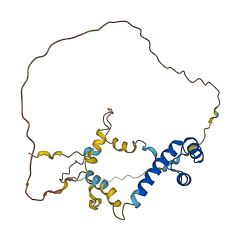
Descriptions
The autoinhibited protein was predicted that may have potential autoinhibitory elements via cis-regPred.
Autoinhibitory domains (AIDs)
Target domain |
|
Relief mechanism |
|
Assay |
cis-regPred |
Accessory elements
No accessory elements
Autoinhibited structure

Activated structure
1 structures for Q04744
| Entry ID | Method | Resolution | Chain | Position | Source |
|---|---|---|---|---|---|
| AF-Q04744-F1 | Predicted | AlphaFoldDB |
8 variants for Q04744
| Variant ID(s) | Position | Change | Description | Diseaes Association | Provenance |
|---|---|---|---|---|---|
| rs3409340701 | 98 | H>Y | No | EVA | |
| rs3389559545 | 123 | W>* | No | EVA | |
| rs3389516323 | 129 | R>* | No | EVA | |
| rs3389516288 | 150 | A>G | No | EVA | |
| rs3389458152 | 175 | E>* | No | EVA | |
| rs3389529198 | 176 | K>E | No | EVA | |
| rs3389516298 | 198 | Q>H | No | EVA | |
| rs3389553931 | 244 | P>T | No | EVA |
No associated diseases with Q04744
5 regional properties for Q04744
| Type | Name | Position | InterPro Accession |
|---|---|---|---|
| conserved_site | Helix-turn-helix motif | 184 - 209 | IPR000047 |
| domain | Homeobox domain | 153 - 217 | IPR001356 |
| conserved_site | Homeobox, conserved site | 188 - 211 | IPR017970 |
| domain | Homeobox domain, metazoa | 177 - 188 | IPR020479-1 |
| domain | Homeobox domain, metazoa | 192 - 211 | IPR020479-2 |
1 GO annotations of cellular component
| Name | Definition |
|---|---|
| nucleus | A membrane-bounded organelle of eukaryotic cells in which chromosomes are housed and replicated. In most cells, the nucleus contains all of the cell's chromosomes except the organellar chromosomes, and is the site of RNA synthesis and processing. In some species, or in specialized cell types, RNA metabolism or DNA replication may be absent. |
3 GO annotations of molecular function
| Name | Definition |
|---|---|
| DNA-binding transcription factor activity, RNA polymerase II-specific | A DNA-binding transcription factor activity that modulates the transcription of specific gene sets transcribed by RNA polymerase II. |
| RNA polymerase II cis-regulatory region sequence-specific DNA binding | Binding to a specific upstream regulatory DNA sequence (transcription factor recognition sequence or binding site) located in cis relative to the transcription start site (i.e., on the same strand of DNA) of a gene transcribed by RNA polymerase II. |
| sequence-specific double-stranded DNA binding | Binding to double-stranded DNA of a specific nucleotide composition, e.g. GC-rich DNA binding, or with a specific sequence motif or type of DNA, e.g. promotor binding or rDNA binding. |
15 GO annotations of biological process
| Name | Definition |
|---|---|
| anterior/posterior pattern specification | The regionalization process in which specific areas of cell differentiation are determined along the anterior-posterior axis. The anterior-posterior axis is defined by a line that runs from the head or mouth of an organism to the tail or opposite end of the organism. |
| brain development | The process whose specific outcome is the progression of the brain over time, from its formation to the mature structure. Brain development begins with patterning events in the neural tube and ends with the mature structure that is the center of thought and emotion. The brain is responsible for the coordination and control of bodily activities and the interpretation of information from the senses (sight, hearing, smell, etc.). |
| cell proliferation in forebrain | The creation of greater cell numbers in the forebrain due to cell division of progenitor cells. |
| central nervous system development | The process whose specific outcome is the progression of the central nervous system over time, from its formation to the mature structure. The central nervous system is the core nervous system that serves an integrating and coordinating function. In vertebrates it consists of the brain and spinal cord. In those invertebrates with a central nervous system it typically consists of a brain, cerebral ganglia and a nerve cord. |
| cerebral cortex development | The progression of the cerebral cortex over time from its initial formation until its mature state. The cerebral cortex is the outer layered region of the telencephalon. |
| cerebral cortex regionalization | The regionalization process that results in the creation of areas within the cerebral cortex that will direct the behavior of cell migration and differentiation as the cortex develops. |
| dentate gyrus development | The process whose specific outcome is the progression of the dentate gyrus over time, from its formation to the mature structure. The dentate gyrus is one of two interlocking gyri of the hippocampus. It contains granule cells, which project to the pyramidal cells and interneurons of the CA3 region of the ammon gyrus. |
| forebrain cell migration | The orderly movement of a cell from one site to another at least one of which is located in the forebrain. |
| forebrain development | The process whose specific outcome is the progression of the forebrain over time, from its formation to the mature structure. The forebrain is the anterior of the three primary divisions of the developing chordate brain or the corresponding part of the adult brain (in vertebrates, includes especially the cerebral hemispheres, the thalamus, and the hypothalamus and especially in higher vertebrates is the main control center for sensory and associative information processing, visceral functions, and voluntary motor functions). |
| neuron differentiation | The process in which a relatively unspecialized cell acquires specialized features of a neuron. |
| neuron migration | The characteristic movement of an immature neuron from germinal zones to specific positions where they will reside as they mature. |
| regulation of gene expression | Any process that modulates the frequency, rate or extent of gene expression. Gene expression is the process in which a gene's coding sequence is converted into a mature gene product (protein or RNA). |
| regulation of transcription by RNA polymerase II | Any process that modulates the frequency, rate or extent of transcription mediated by RNA polymerase II. |
| response to xenobiotic stimulus | Any process that results in a change in state or activity of a cell or an organism (in terms of movement, secretion, enzyme production, gene expression, etc.) as a result of a stimulus from a xenobiotic, a compound foreign to the organim exposed to it. It may be synthesized by another organism (like ampicilin) or it can be a synthetic chemical. |
| ureter morphogenesis | The process in which the anatomical structures of the ureter are generated and organized. The ureter is a muscular tube that transports urine from the kidney to the urinary bladder. |
No homologous proteins in AiPD
| UniProt AC | Gene Name | Protein Name | Species | Evidence Code |
|---|---|---|---|---|
| No homologous proteins | ||||
| 10 | 20 | 30 | 40 | 50 | 60 |
| MFQPAPKRCF | TIESLVAKDS | PLPASRSEDP | IRPAALSYAN | SSPINPFLNG | FHSAAAAAAA |
| 70 | 80 | 90 | 100 | 110 | 120 |
| GRGVYSNPDL | VFAEAVSHPP | NPAVPVHPVP | PPHALAAHPL | PSSHSPHPLF | ASQQRDPSTF |
| 130 | 140 | 150 | 160 | 170 | 180 |
| YPWLIHRYRY | LGHRFQGNDT | SPESFLLHNA | LARKPKRIRT | AFSPSQLLRL | EHAFEKNHYV |
| 190 | 200 | 210 | 220 | 230 | 240 |
| VGAERKQLAH | SLSLTETQVK | VWFQNRRTKF | KRQKLEEEGS | DSQQKKKGTH | HINRWRIATK |
| 250 | |||||
| QASPEEIDVT | SDD |