Q04377
Gene name |
LCD1 (DDC2, PIE1, YDR499W) |
Protein name |
DNA damage checkpoint protein LCD1 |
Names |
DNA damage checkpoint protein 2, Lethal, checkpoint-defective, DNA damage-sensitive protein 1 |
Species |
Saccharomyces cerevisiae (strain ATCC 204508 / S288c) (Baker's yeast) |
KEGG Pathway |
sce:YDR499W |
EC number |
|
Protein Class |
|
Descriptions
The autoinhibited protein was predicted that may have potential autoinhibitory elements via cis-regPred.
Autoinhibitory domains (AIDs)
Target domain |
|
Relief mechanism |
|
Assay |
cis-regPred |
Accessory elements
No accessory elements
Autoinhibited structure

Activated structure
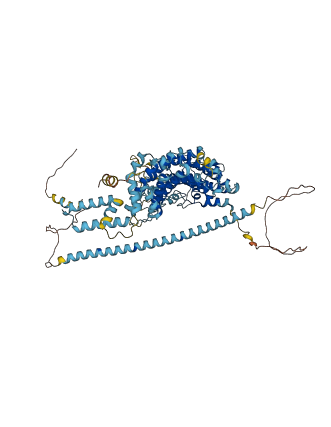
9 structures for Q04377
| Entry ID | Method | Resolution | Chain | Position | Source |
|---|---|---|---|---|---|
| 5OMD | X-ray | 210 A | A | 73-136 | PDB |
| 5X6O | EM | 390 A | G | 1-747 | PDB |
| 6Z2W | EM | 282 A | C/D | 1-747 | PDB |
| 6Z2X | EM | 320 A | C/D | 1-747 | PDB |
| 6Z3A | EM | 380 A | C/D | 1-747 | PDB |
| 7WZR | EM | 470 A | D/E | 1-747 | PDB |
| 7WZW | EM | 380 A | C/D | 1-747 | PDB |
| 8B4J | X-ray | 158 A | P | 4-24 | PDB |
| AF-Q04377-F1 | Predicted | AlphaFoldDB |
17 variants for Q04377
| Variant ID(s) | Position | Change | Description | Diseaes Association | Provenance |
|---|---|---|---|---|---|
| s04-1447829 | 3 | R>Q | No | SGRP | |
| s04-1447869 | 16 | D>E | No | SGRP | |
| s04-1447935 | 38 | L>F | No | SGRP | |
| s04-1447951 | 44 | T>A | No | SGRP | |
| s04-1447954 | 45 | T>A | No | SGRP | |
| s04-1448092 | 91 | K>E | No | SGRP | |
| s04-1448333 | 171 | P>L | No | SGRP | |
| s04-1448512 | 231 | L>F | No | SGRP | |
| s04-1448578 | 253 | S>P | No | SGRP | |
| s04-1448737 | 306 | I>V | No | SGRP | |
| s04-1448837 | 339 | V>A | No | SGRP | |
| s04-1449115 | 432 | I>V | No | SGRP | |
| s04-1449164 | 448 | S>N | No | SGRP | |
| s04-1449398 | 526 | G>E | No | SGRP | |
| s04-1449421 | 534 | A>T | No | SGRP | |
| s04-1449917 | 699 | M>T | No | SGRP | |
| s04-1450033 | 738 | A>S | No | SGRP |
No associated diseases with Q04377
1 regional properties for Q04377
| Type | Name | Position | InterPro Accession |
|---|---|---|---|
| domain | Diacylglycerol kinase, catalytic domain | 224 - 368 | IPR001206 |
Functions
4 GO annotations of cellular component
| Name | Definition |
|---|---|
| ATR-ATRIP complex | A protein complex that contains the protein kinase ATR and ATR-interacting protein (ATRIP) and binds single-stranded DNA; ssDNA binding affinity is increased in the presence of replication protein A. |
| cytoplasm | The contents of a cell excluding the plasma membrane and nucleus, but including other subcellular structures. |
| nuclear chromosome | A chromosome that encodes the nuclear genome and is found in the nucleus of a eukaryotic cell during the cell cycle phases when the nucleus is intact. |
| nucleus | A membrane-bounded organelle of eukaryotic cells in which chromosomes are housed and replicated. In most cells, the nucleus contains all of the cell's chromosomes except the organellar chromosomes, and is the site of RNA synthesis and processing. In some species, or in specialized cell types, RNA metabolism or DNA replication may be absent. |
1 GO annotations of molecular function
| Name | Definition |
|---|---|
| damaged DNA binding | Binding to damaged DNA. |
7 GO annotations of biological process
| Name | Definition |
|---|---|
| chromatin organization | The assembly or remodeling of chromatin composed of DNA complexed with histones, other associated proteins, and sometimes RNA. |
| DNA damage checkpoint signaling | A signal transduction process that contributes to a DNA damage checkpoint. |
| DNA repair | The process of restoring DNA after damage. Genomes are subject to damage by chemical and physical agents in the environment (e.g. UV and ionizing radiations, chemical mutagens, fungal and bacterial toxins, etc.) and by free radicals or alkylating agents endogenously generated in metabolism. DNA is also damaged because of errors during its replication. A variety of different DNA repair pathways have been reported that include direct reversal, base excision repair, nucleotide excision repair, photoreactivation, bypass, double-strand break repair pathway, and mismatch repair pathway. |
| establishment of protein localization | The directed movement of a protein to a specific location. |
| nucleobase-containing compound metabolic process | Any cellular metabolic process involving nucleobases, nucleosides, nucleotides and nucleic acids. |
| regulation of double-strand break repair | Any process that modulates the frequency, rate or extent of double-strand break repair. |
| telomere maintenance via telomerase | The maintenance of proper telomeric length by the addition of telomeric repeats by telomerase. |
No homologous proteins in AiPD
| UniProt AC | Gene Name | Protein Name | Species | Evidence Code |
|---|---|---|---|---|
| No homologous proteins | ||||
| 10 | 20 | 30 | 40 | 50 | 60 |
| MRRETVGEFS | SDDDDDILLE | LGTRPPRFTQ | IPPSSAALQT | QIPTTLEVTT | TTLNNKQSKN |
| 70 | 80 | 90 | 100 | 110 | 120 |
| DNQLVNQLNK | AQGEASMLRD | KINFLNIERE | KEKNIQAVKV | NELQVKHLQE | LAKLKQELQK |
| 130 | 140 | 150 | 160 | 170 | 180 |
| LEDEKKFLQM | EARGKSKREV | ITNVKPPSTT | LSTNTNTITP | DSSSVAIEAK | PQSPQSKKRK |
| 190 | 200 | 210 | 220 | 230 | 240 |
| ISDNLLKKNM | VPLNPNRIIP | DETSLFLESI | LLHQIIGADL | STIEILNRLK | LDYITEFKFK |
| 250 | 260 | 270 | 280 | 290 | 300 |
| NFVIAKGAPI | GKSIVSLLLR | CKKTLTLDRF | IDTLLEDIAV | LIKEISVHPN | ESKLAVPFLV |
| 310 | 320 | 330 | 340 | 350 | 360 |
| ALMYQIVQFR | PSATHNLALK | DCFLFICDLI | RIYHHVLKVP | IHESNMNLHV | EPQIFQYELI |
| 370 | 380 | 390 | 400 | 410 | 420 |
| DYLIISYSFD | LLEGILRVLQ | SHPKQTYMEF | FDENILKSFE | FVYKLALTIS | YKPMVNVIFS |
| 430 | 440 | 450 | 460 | 470 | 480 |
| AVEVVNIITS | IILNMDNSSD | LKSLISGSWW | RDCITRLYAL | LEKEIKSGDV | YNENVDTTTL |
| 490 | 500 | 510 | 520 | 530 | 540 |
| HMSKYHDFFG | LIRNIGDNEL | GGLISKLIYT | DRLQSVPRVI | SKEDIGMDSD | KFTAPIIGYK |
| 550 | 560 | 570 | 580 | 590 | 600 |
| MEKWLLKLKD | EVLNIFENLL | MIYGDDATIV | NGEMLIHSSK | FLSREQALMI | ERYVGQDSPN |
| 610 | 620 | 630 | 640 | 650 | 660 |
| LDLRCHLIEH | TLTIIYRLWK | DHFKQLREEQ | IKQVESQLIM | SLWRFLVCQT | ETVTANEREM |
| 670 | 680 | 690 | 700 | 710 | 720 |
| RDHRHLVDSL | HDLTIKDQAS | YYEDAFEDLP | EYIEEELKMQ | LNKRTGRIMQ | VKYDEKFQEM |
| 730 | 740 | ||||
| ARTILESKSF | DLTTLEEADS | LYISMGL |