Q04033
Gene name |
YDR415C |
Protein name |
Probable aminopeptidase YDR415C |
Names |
|
Species |
Saccharomyces cerevisiae (strain ATCC 204508 / S288c) (Baker's yeast) |
KEGG Pathway |
sce:YDR415C |
EC number |
|
Protein Class |
|
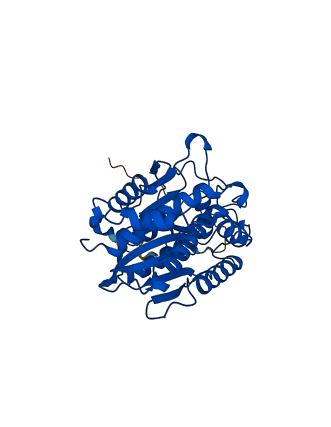
Descriptions
The autoinhibited protein was predicted that may have potential autoinhibitory elements via cis-regPred.
Autoinhibitory domains (AIDs)
Target domain |
|
Relief mechanism |
|
Assay |
cis-regPred |
Accessory elements
No accessory elements
Autoinhibited structure

Activated structure
1 structures for Q04033
| Entry ID | Method | Resolution | Chain | Position | Source |
|---|---|---|---|---|---|
| AF-Q04033-F1 | Predicted | AlphaFoldDB |
7 variants for Q04033
| Variant ID(s) | Position | Change | Description | Diseaes Association | Provenance |
|---|---|---|---|---|---|
| s04-1298065 | 30 | G>E | No | SGRP | |
| s04-1297962 | 64 | F>L | No | SGRP | |
| s04-1297882 | 91 | S>L | No | SGRP | |
| s04-1297670 | 162 | V>F | No | SGRP | |
| s04-1297657 | 166 | T>N | No | SGRP | |
| s04-1297637 | 173 | I>V | No | SGRP | |
| s04-1297539 | 205 | M>I | No | SGRP |
No associated diseases with Q04033
1 regional properties for Q04033
| Type | Name | Position | InterPro Accession |
|---|---|---|---|
| domain | Peptidase M28 | 158 - 363 | IPR007484 |
1 GO annotations of cellular component
| Name | Definition |
|---|---|
| fungal-type vacuole | A vacuole that has both lytic and storage functions. The fungal vacuole is a large, membrane-bounded organelle that functions as a reservoir for the storage of small molecules (including polyphosphate, amino acids, several divalent cations (e.g. calcium), other ions, and other small molecules) as well as being the primary compartment for degradation. It is an acidic compartment, containing an ensemble of acid hydrolases. At least in S. cerevisiae, there are indications that the morphology of the vacuole is variable and correlated with the cell cycle, with logarithmically growing cells having a multilobed, reticulated vacuole, while stationary phase cells contain a single large structure. |
3 GO annotations of molecular function
| Name | Definition |
|---|---|
| aminopeptidase activity | Catalysis of the hydrolysis of a single N-terminal amino acid residue from a polypeptide chain. |
| metal ion binding | Binding to a metal ion. |
| metalloexopeptidase activity | Catalysis of the hydrolysis of a peptide bond not more than three residues from the N- or C-terminus of a polypeptide chain by a mechanism in which water acts as a nucleophile, one or two metal ions hold the water molecule in place, and charged amino acid side chains are ligands for the metal ions. |
1 GO annotations of biological process
| Name | Definition |
|---|---|
| proteolysis | The hydrolysis of proteins into smaller polypeptides and/or amino acids by cleavage of their peptide bonds. |
No homologous proteins in AiPD
| UniProt AC | Gene Name | Protein Name | Species | Evidence Code |
|---|---|---|---|---|
| No homologous proteins | ||||
| 10 | 20 | 30 | 40 | 50 | 60 |
| MRIQSLFVLF | NVAIIAWSYP | YEPLRVLQVG | ENEVMEVPES | EKLNLRRRGV | KFFDVTKHTS |
| 70 | 80 | 90 | 100 | 110 | 120 |
| FLPFFNKEEE | PTVPTYNYPP | EISNKEVVDD | SIKNIDKGSM | HKNLAKFTSF | YTRYYKSDHG |
| 130 | 140 | 150 | 160 | 170 | 180 |
| FESAEWLAAT | IANITKDIPQ | DTLTIEHFDH | KEWKQYSIIV | RVTGSTTPED | IIIIGSHQDS |
| 190 | 200 | 210 | 220 | 230 | 240 |
| INLLLPSIMA | APGADDNGSG | TVTNMEALRL | YTENFLKRGF | RPNNTVEFHF | YSAEEGGLLG |
| 250 | 260 | 270 | 280 | 290 | 300 |
| SLDVFTAYAK | QKKHVRAMLQ | QDMTGYVSDP | EDEHVGIVTD | YTTPALTDFI | KLIINSYLSI |
| 310 | 320 | 330 | 340 | 350 | 360 |
| PYRDTQCGYA | CSDHGSATRN | GFPGSFVIES | EFKKTNKYIH | STMDTLDRLS | LAHMAEHTKI |
| 370 | |||||
| VLGVIIELGS | WSAW |