Q03768
Gene name |
GIR2 (DFRP2, YDR152W, YD8358.08) |
Protein name |
Protein GIR2 |
Names |
DRG family-regulatory protein 2, Genetically interacts with ribosomal genes protein 2 |
Species |
Saccharomyces cerevisiae (strain ATCC 204508 / S288c) (Baker's yeast) |
KEGG Pathway |
sce:YDR152W |
EC number |
|
Protein Class |
|
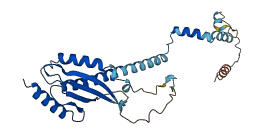
Descriptions
The autoinhibited protein was predicted that may have potential autoinhibitory elements via cis-regPred.
Autoinhibitory domains (AIDs)
Target domain |
|
Relief mechanism |
|
Assay |
cis-regPred |
Accessory elements
No accessory elements
Autoinhibited structure

Activated structure
1 structures for Q03768
| Entry ID | Method | Resolution | Chain | Position | Source |
|---|---|---|---|---|---|
| AF-Q03768-F1 | Predicted | AlphaFoldDB |
2 variants for Q03768
| Variant ID(s) | Position | Change | Description | Diseaes Association | Provenance |
|---|---|---|---|---|---|
| s04-766029 | 109 | K>N | No | SGRP | |
| s04-766077 | 125 | E>D | No | SGRP |
No associated diseases with Q03768
1 regional properties for Q03768
| Type | Name | Position | InterPro Accession |
|---|---|---|---|
| domain | RWD domain | 5 - 159 | IPR006575 |
2 GO annotations of cellular component
| Name | Definition |
|---|---|
| cytoplasm | The contents of a cell excluding the plasma membrane and nucleus, but including other subcellular structures. |
| polysome | A multiribosomal structure representing a linear array of ribosomes held together by messenger RNA. They represent the active complexes in cellular protein synthesis and are able to incorporate amino acids into polypeptides both in vivo and in vitro. |
1 GO annotations of molecular function
| Name | Definition |
|---|---|
| protein kinase inhibitor activity | Binds to and stops, prevents or reduces the activity of a protein kinase, an enzyme which phosphorylates a protein. |
5 GO annotations of biological process
| Name | Definition |
|---|---|
| cellular response to amino acid starvation | Any process that results in a change in state or activity of a cell (in terms of movement, secretion, enzyme production, gene expression, etc.) as a result of deprivation of amino acids. |
| cytoplasmic translation | The chemical reactions and pathways resulting in the formation of a protein in the cytoplasm. This is a ribosome-mediated process in which the information in messenger RNA (mRNA) is used to specify the sequence of amino acids in the protein. |
| negative regulation of protein phosphorylation | Any process that stops, prevents or reduces the rate of addition of phosphate groups to amino acids within a protein. |
| negative regulation of protein-containing complex assembly | Any process that stops, prevents, or reduces the frequency, rate or extent of protein complex assembly. |
| positive regulation of cellular response to amino acid starvation | Any process that activates or increases the frequency, rate or extent of cellular response to amino acid starvation. |
No homologous proteins in AiPD
| UniProt AC | Gene Name | Protein Name | Species | Evidence Code |
|---|---|---|---|---|
| No homologous proteins | ||||
| 10 | 20 | 30 | 40 | 50 | 60 |
| MDYKEEQKQE | LEVLESIYPD | ELRIINDEYP | KIKFEVAIKL | ELDTGDSTSV | LTKEHTIIAE |
| 70 | 80 | 90 | 100 | 110 | 120 |
| FKLPENYPDE | PCLISLEAQE | VALNDNEEDN | EEDEDEVEYD | DHGNKVLKKF | ENLPDLISFK |
| 130 | 140 | 150 | 160 | 170 | 180 |
| GYLPELTVQL | ESQIETDMLL | GMQMCFALIS | SIKERCEQWY | SEQLNKLEKQ | YELEAQEREK |
| 190 | 200 | 210 | 220 | 230 | 240 |
| KEQAKFHGTK | VTRESYLEWR | SKFRQELKLD | ERDQVRRMKA | HHGKLTGKQM | FEQGVVGTGD |
| 250 | 260 | ||||
| EYMEEDDASV | DDVAKGLAKT | EIANQ |