Q03577
Gene name |
dars-1 |
Protein name |
Aspartate--tRNA ligase, cytoplasmic |
Names |
Aspartyl-tRNA synthetase, AspRS |
Species |
Caenorhabditis elegans |
KEGG Pathway |
cel:CELE_B0464.1 |
EC number |
6.1.1.12: Ligases forming aminoacyl-tRNA and related compounds |
Protein Class |
|
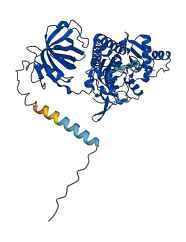
Descriptions
The autoinhibited protein was predicted that may have potential autoinhibitory elements via cis-regPred.
Autoinhibitory domains (AIDs)
Target domain |
|
Relief mechanism |
|
Assay |
cis-regPred |
Accessory elements
No accessory elements
Autoinhibited structure

Activated structure
1 structures for Q03577
| Entry ID | Method | Resolution | Chain | Position | Source |
|---|---|---|---|---|---|
| AF-Q03577-F1 | Predicted | AlphaFoldDB |
No variants for Q03577
| Variant ID(s) | Position | Change | Description | Diseaes Association | Provenance |
|---|---|---|---|---|---|
| No variants for Q03577 | |||||
No associated diseases with Q03577
7 regional properties for Q03577
| Type | Name | Position | InterPro Accession |
|---|---|---|---|
| domain | C2 domain | 94 - 216 | IPR000008-1 |
| domain | C2 domain | 256 - 389 | IPR000008-2 |
| domain | Synaptotagmin | 260 - 275 | IPR001565-1 |
| domain | Synaptotagmin | 275 - 288 | IPR001565-2 |
| domain | Synaptotagmin | 332 - 347 | IPR001565-3 |
| domain | Synaptotagmin | 352 - 362 | IPR001565-4 |
| domain | Rabphilin/Doc2, first C2 domain | 95 - 218 | IPR047022 |
Functions
| Description | ||
|---|---|---|
| EC Number | 6.1.1.12 | Ligases forming aminoacyl-tRNA and related compounds |
| Subcellular Localization |
|
|
| PANTHER Family | ||
| PANTHER Subfamily | ||
| PANTHER Protein Class | ||
| PANTHER Pathway Category | No pathway information available | |
2 GO annotations of cellular component
| Name | Definition |
|---|---|
| aminoacyl-tRNA synthetase multienzyme complex | A multienzyme complex found in all multicellular eukaryotes composed of eight proteins with aminoacyl-tRNA synthetase activities (abbreviated as: ArgRS, AspRS, GluProRS, GlnRS, IleRS, LeuRS, LysRS, MetRS where RS is the enzyme, preceded by the amino acid it uses as a substrate) as well as three non-synthetase proteins (p43, p38, and p18) with diverse functions. Several of these subunits are known dimers, so the total polypeptide count in the multisynthetase complex is at least fifteen. All of the enzymes in this assembly catalyze the same reaction, the covalent attachment of an amino acid to either the 2'- or 3'-hydroxyl of the 3'-terminal adenosine of tRNA, but using different substrates. |
| cytosol | The part of the cytoplasm that does not contain organelles but which does contain other particulate matter, such as protein complexes. |
3 GO annotations of molecular function
| Name | Definition |
|---|---|
| aspartate-tRNA ligase activity | Catalysis of the reaction: ATP + L-aspartate + tRNA(Asp) = AMP + diphosphate + L-aspartyl-tRNA(Asp). |
| ATP binding | Binding to ATP, adenosine 5'-triphosphate, a universally important coenzyme and enzyme regulator. |
| RNA binding | Binding to an RNA molecule or a portion thereof. |
1 GO annotations of biological process
| Name | Definition |
|---|---|
| aspartyl-tRNA aminoacylation | The process of coupling aspartate to aspartyl-tRNA, catalyzed by aspartyl-tRNA synthetase. The aspartyl-tRNA synthetase is a class-II synthetase. The activated amino acid is transferred to the 3'-OH group of an aspartic acid accetping tRNA. |
1 homologous proteins in AiPD
| UniProt AC | Gene Name | Protein Name | Species | Evidence Code |
|---|---|---|---|---|
| P04802 | DPS1 | Aspartate--tRNA ligase, cytoplasmic | Saccharomyces cerevisiae (strain ATCC 204508 / S288c) (Baker's yeast) | PR |
| 10 | 20 | 30 | 40 | 50 | 60 |
| MADAAEGEQP | KLSKKELNKL | ARKAKKDEKA | GEKGGNQQQA | AAMDQEDASK | DFYGSYGLVN |
| 70 | 80 | 90 | 100 | 110 | 120 |
| SKEKKVLNFL | KVKEINVSNA | TKDVWVRGRI | HTTRSKGKNC | FLVLRQGVYT | VQVAMFMNEK |
| 130 | 140 | 150 | 160 | 170 | 180 |
| ISKQMLKFVS | SISKESIVDV | YATINKVDNP | IESCTQKDVE | LLAQQVFVVS | TSAPKLPLQI |
| 190 | 200 | 210 | 220 | 230 | 240 |
| EDASRRAPTD | EEKASEQENQ | LAVVNLDTRL | DNRVIDLRTP | TSHAIFRIQA | GICNQFRNIL |
| 250 | 260 | 270 | 280 | 290 | 300 |
| DVRGFVEIMA | PKIISAPSEG | GANVFEVSYF | KGSAYLAQSP | QLYKQMAIAG | DFEKVYTIGP |
| 310 | 320 | 330 | 340 | 350 | 360 |
| VFRAEDSNTH | RHMTEFVGLD | LEMAFNFHYH | EVMETIAEVL | TQMFKGLQQN | YQDEIAAVGN |
| 370 | 380 | 390 | 400 | 410 | 420 |
| QYPAEPFQFC | EPPLILKYPD | AITLLRENGI | EIGDEDDLST | PVEKFLGKLV | KEKYSTDFYV |
| 430 | 440 | 450 | 460 | 470 | 480 |
| LDKFPLSVRP | FYTMPDAHDE | RYSNSYDMFM | RGEEILSGAQ | RIHDADMLVE | RAKHHQVDLA |
| 490 | 500 | 510 | 520 | 530 | |
| KIQSYIDSFK | YGCPPHAGGG | IGLERVTMLF | LGLHNIRLAS | LFPRDPKRLT | P |