Q02ND1
Gene name |
nuoC |
Protein name |
NADH-quinone oxidoreductase subunit C/D |
Names |
NADH dehydrogenase I subunit C/D, NDH-1 subunit C/D |
Species |
Pseudomonas aeruginosa (strain UCBPP-PA14) |
KEGG Pathway |
pau:PA14_29990 |
EC number |
|
Protein Class |
|
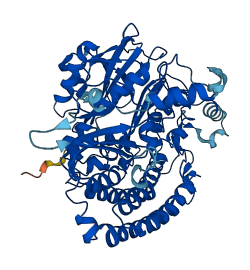
Descriptions
The autoinhibited protein was predicted that may have potential autoinhibitory elements via cis-regPred.
Autoinhibitory domains (AIDs)
Target domain |
|
Relief mechanism |
|
Assay |
cis-regPred |
Accessory elements
No accessory elements
Autoinhibited structure

Activated structure
1 structures for Q02ND1
| Entry ID | Method | Resolution | Chain | Position | Source |
|---|---|---|---|---|---|
| AF-Q02ND1-F1 | Predicted | AlphaFoldDB |
No variants for Q02ND1
| Variant ID(s) | Position | Change | Description | Diseaes Association | Provenance |
|---|---|---|---|---|---|
| No variants for Q02ND1 | |||||
No associated diseases with Q02ND1
3 regional properties for Q02ND1
2 GO annotations of cellular component
| Name | Definition |
|---|---|
| NADH dehydrogenase complex | An integral membrane complex that possesses NADH oxidoreductase activity. The complex is one of the components of the electron transport chain. It catalyzes the transfer of a pair of electrons from NADH to a quinone. |
| plasma membrane | The membrane surrounding a cell that separates the cell from its external environment. It consists of a phospholipid bilayer and associated proteins. |
3 GO annotations of molecular function
| Name | Definition |
|---|---|
| NAD binding | Binding to nicotinamide adenine dinucleotide, a coenzyme involved in many redox and biosynthetic reactions; binding may be to either the oxidized form, NAD+, or the reduced form, NADH. |
| NADH dehydrogenase (ubiquinone) activity | Catalysis of the reaction: NADH + ubiquinone + 5 H(+)(in) <=> NAD(+) + ubiquinol + 4 H(+)(out). |
| quinone binding | Binding to a quinone, any member of a class of diketones derivable from aromatic compounds by conversion of two CH groups into CO groups with any necessary rearrangement of double bonds. |
1 GO annotations of biological process
| Name | Definition |
|---|---|
| respiratory electron transport chain | A process in which a series of electron carriers operate together to transfer electrons from donors such as NADH and FADH2 to any of several different terminal electron acceptors to generate a transmembrane electrochemical gradient. |
No homologous proteins in AiPD
| UniProt AC | Gene Name | Protein Name | Species | Evidence Code |
|---|---|---|---|---|
| No homologous proteins | ||||
| 10 | 20 | 30 | 40 | 50 | 60 |
| MTADSALYIP | PYKADDQDIV | VELNSRFGAE | TFTVQPTRTG | MPVLWVPRER | LIEVLTFLRQ |
| 70 | 80 | 90 | 100 | 110 | 120 |
| VPKPYVMLYD | LHGVDERLRT | HRRGLPSADF | SVFYHLMSLE | RNSDVMIKVA | LSERDLNLPT |
| 130 | 140 | 150 | 160 | 170 | 180 |
| ATRIWPNANW | YEREVWDMYG | ITFTGHPHLT | RMLMPPTWQG | HPLRKDYPAR | ATEFDPYSLS |
| 190 | 200 | 210 | 220 | 230 | 240 |
| AAKQDLEQEA | LRFKPEDWGM | KRHGENEDYM | FLNLGPNHPS | AHGAFRIILQ | LDGEEIIDCV |
| 250 | 260 | 270 | 280 | 290 | 300 |
| PEIGYHHRGA | EKMAERQSWH | SFIPYTDRID | YLGGVMNNLP | YVLSVEKLAG | IKVPQRVDVI |
| 310 | 320 | 330 | 340 | 350 | 360 |
| RIMMAEFFRI | LNHLLYLGTY | IQDVGAMTPV | FFTFTDRQRA | YKVVEAITGF | RLHPAWYRIG |
| 370 | 380 | 390 | 400 | 410 | 420 |
| GVAHDLPRGW | DKLVREFLDW | MPKRLDEYET | AALKNSILRG | RTIGVAQYNT | KEALEWGTTG |
| 430 | 440 | 450 | 460 | 470 | 480 |
| AGLRATGCDF | DLRKARPYSG | YENFEFEVPL | AHNGDAYDRC | MVKMGEMRQS | LRIIEQCLKN |
| 490 | 500 | 510 | 520 | 530 | 540 |
| MPEGPYKADH | PLTTPPPKER | TLQHIETLIT | HFLQVSWGPV | MPANEAFQMI | EATKGINSYY |
| 550 | 560 | 570 | 580 | 590 | |
| LTSDGSTMSY | RTRIRTPSFA | HLQQIPSVIN | GSMIADLIAY | LGSIDFVMAD | VDR |