Q02955
Gene name |
Il1r1 (Il1ra) |
Protein name |
Interleukin-1 receptor type 1 |
Names |
|
Species |
Rattus norvegicus (Rat) |
KEGG Pathway |
|
EC number |
3.2.2.6: Hydrolyzing N-glycosyl compounds |
Protein Class |
|
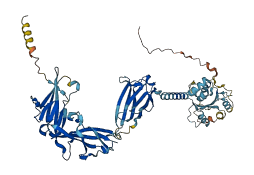
Descriptions
The autoinhibited protein was predicted that may have potential autoinhibitory elements via cis-regPred.
Autoinhibitory domains (AIDs)
Target domain |
|
Relief mechanism |
|
Assay |
cis-regPred |
Accessory elements
No accessory elements
Autoinhibited structure

Activated structure
1 structures for Q02955
| Entry ID | Method | Resolution | Chain | Position | Source |
|---|---|---|---|---|---|
| AF-Q02955-F1 | Predicted | AlphaFoldDB |
No variants for Q02955
| Variant ID(s) | Position | Change | Description | Diseaes Association | Provenance |
|---|---|---|---|---|---|
| No variants for Q02955 | |||||
No associated diseases with Q02955
8 regional properties for Q02955
| Type | Name | Position | InterPro Accession |
|---|---|---|---|
| domain | Toll/interleukin-1 receptor homology (TIR) domain | 386 - 548 | IPR000157 |
| domain | Immunoglobulin subtype | 38 - 117 | IPR003599-1 |
| domain | Immunoglobulin subtype | 130 - 215 | IPR003599-2 |
| domain | Immunoglobulin subtype | 236 - 333 | IPR003599-3 |
| domain | Immunoglobulin-like domain | 16 - 115 | IPR007110-1 |
| domain | Immunoglobulin-like domain | 121 - 217 | IPR007110-2 |
| domain | Immunoglobulin-like domain | 229 - 331 | IPR007110-3 |
| domain | IL-1Ra-like, immunoglobulin domain | 57 - 111 | IPR041416 |
Functions
| Description | ||
|---|---|---|
| EC Number | 3.2.2.6 | Hydrolyzing N-glycosyl compounds |
| Subcellular Localization |
|
|
| PANTHER Family | ||
| PANTHER Subfamily | ||
| PANTHER Protein Class | ||
| PANTHER Pathway Category | No pathway information available | |
9 GO annotations of cellular component
| Name | Definition |
|---|---|
| axon | The long process of a neuron that conducts nerve impulses, usually away from the cell body to the terminals and varicosities, which are sites of storage and release of neurotransmitter. |
| cell surface | The external part of the cell wall and/or plasma membrane. |
| external side of plasma membrane | The leaflet of the plasma membrane that faces away from the cytoplasm and any proteins embedded or anchored in it or attached to its surface. |
| extracellular space | That part of a multicellular organism outside the cells proper, usually taken to be outside the plasma membranes, and occupied by fluid. |
| integral component of membrane | The component of a membrane consisting of the gene products and protein complexes having at least some part of their peptide sequence embedded in the hydrophobic region of the membrane. |
| membrane | A lipid bilayer along with all the proteins and protein complexes embedded in it an attached to it. |
| nucleus | A membrane-bounded organelle of eukaryotic cells in which chromosomes are housed and replicated. In most cells, the nucleus contains all of the cell's chromosomes except the organellar chromosomes, and is the site of RNA synthesis and processing. In some species, or in specialized cell types, RNA metabolism or DNA replication may be absent. |
| postsynaptic density | An electron dense network of proteins within and adjacent to the postsynaptic membrane of an asymmetric, neuron-neuron synapse. Its major components include neurotransmitter receptors and the proteins that spatially and functionally organize them such as anchoring and scaffolding molecules, signaling enzymes and cytoskeletal components. |
| protein-containing complex | A stable assembly of two or more macromolecules, i.e. proteins, nucleic acids, carbohydrates or lipids, in which at least one component is a protein and the constituent parts function together. |
8 GO annotations of molecular function
| Name | Definition |
|---|---|
| interleukin-1 binding | Binding to interleukin-1. |
| interleukin-1 receptor activity | Combining with interleukin-1 to initiate a change in cell activity. Interleukin-1 is produced mainly by activated macrophages and is involved in the inflammatory response. |
| interleukin-1, type I, activating receptor activity | Combining with interleukin-1 to initiate a change in cell activity via signaling pathways and mediated by adaptor proteins. |
| ionotropic glutamate receptor binding | Binding to an ionotropic glutamate receptor. Ionotropic glutamate receptors bind glutamate and exert an effect through the regulation of ion channels. |
| NAD(P)+ nucleosidase activity | Catalysis of the reaction: NAD(P)+ + H2O = ADP-ribose(P) + nicotinamide. |
| NAD+ nucleotidase, cyclic ADP-ribose generating | Catalysis of the reaction: NAD+ + H2O = nicotinamide + ADP-ribose that proceeds in a stepwise fashion by ADP-ribosyl cyclase activity followed by cyclic ADP-ribose hydrolase activity. |
| platelet-derived growth factor receptor binding | Binding to a platelet-derived growth factor receptor. |
| protease binding | Binding to a protease or a peptidase. |
18 GO annotations of biological process
| Name | Definition |
|---|---|
| cellular response to glucose stimulus | Any process that results in a change in state or activity of a cell (in terms of movement, secretion, enzyme production, gene expression, etc.) as a result of a glucose stimulus. |
| cytokine-mediated signaling pathway | The series of molecular signals initiated by the binding of a cytokine to a receptor on the surface of a cell, and ending with the regulation of a downstream cellular process, e.g. transcription. |
| heat acclimation | Any process that increases heat tolerance of an organism in response to high temperatures. |
| inflammatory response | The immediate defensive reaction (by vertebrate tissue) to infection or injury caused by chemical or physical agents. The process is characterized by local vasodilation, extravasation of plasma into intercellular spaces and accumulation of white blood cells and macrophages. |
| interleukin-1-mediated signaling pathway | The series of molecular signals initiated by interleukin-1 binding to its receptor on the surface of a target cell, and ending with the regulation of a downstream cellular process, e.g. transcription. |
| ovulation | The release of a mature ovum/oocyte from an ovary. |
| positive regulation of interferon-gamma production | Any process that activates or increases the frequency, rate, or extent of interferon-gamma production. Interferon-gamma is also known as type II interferon. |
| positive regulation of interleukin-1-mediated signaling pathway | Any process that activates or increases the frequency, rate or extent of interleukin-1-mediated signaling pathway. |
| positive regulation of neuron migration | Any process that activates or increases the frequency, rate or extent of neuron migration. |
| positive regulation of neutrophil extravasation | Any process that activates or increases the frequency, rate or extent of neutrophil extravasation. |
| positive regulation of T-helper 1 cell cytokine production | Any process that activates or increases the frequency, rate or extent of T-helper 1 cell cytokine production. |
| regulation of inflammatory response | Any process that modulates the frequency, rate or extent of the inflammatory response, the immediate defensive reaction (by vertebrate tissue) to infection or injury caused by chemical or physical agents. |
| response to epidermal growth factor | Any process that results in a change in state or activity of a cell or an organism (in terms of movement, secretion, enzyme production, gene expression, etc.) as a result of an epidermal growth factor stimulus. |
| response to interleukin-1 | Any process that results in a change in state or activity of a cell or an organism (in terms of movement, secretion, enzyme production, gene expression, etc.) as a result of an interleukin-1 stimulus. |
| response to nitric oxide | Any process that results in a change in state or activity of a cell or an organism (in terms of movement, secretion, enzyme production, gene expression, etc.) as a result of a nitric oxide stimulus. |
| response to odorant | Any process that results in a change in state or activity of a cell or an organism (in terms of movement, secretion, enzyme production, gene expression, etc.) as a result of an odorant stimulus. An odorant is any substance capable of stimulating the sense of smell. |
| response to radiation | Any process that results in a change in state or activity of a cell or an organism (in terms of movement, secretion, enzyme production, gene expression, etc.) as a result of an electromagnetic radiation stimulus. Electromagnetic radiation is a propagating wave in space with electric and magnetic components. These components oscillate at right angles to each other and to the direction of propagation. |
| response to transforming growth factor beta | Any process that results in a change in state or activity of a cell or an organism (in terms of movement, secretion, enzyme production, gene expression, etc.) as a result of a transforming growth factor beta stimulus. |
| 10 | 20 | 30 | 40 | 50 | 60 |
| MENMKVLLGF | ICLIVPLLSL | ETDKCTEYPN | EVISFSSVNE | IDIRSCPLTP | NEMHGGTIIW |
| 70 | 80 | 90 | 100 | 110 | 120 |
| YKNDSKTPIS | ADKDSRIHQQ | NEHLWFVPAK | MEDSGYYYCI | MRNSTYCLKT | KITMSVLEND |
| 130 | 140 | 150 | 160 | 170 | 180 |
| PGLCYNTQAS | FIQRLHVAGD | GSLVCPYLDF | FKDENNELPK | VQWYKNCKPL | PLDDGNFFGF |
| 190 | 200 | 210 | 220 | 230 | 240 |
| KNKLMVMNVA | EEHRGNYTCR | TSYTYQGKQY | PVTRVITFIT | IDDSKRDRPV | IMSPRNETME |
| 250 | 260 | 270 | 280 | 290 | 300 |
| ADPGSTIQLI | CNVTGQFTDL | VYWKWNGSEI | EWDDPILAED | YQFLEHPSAK | RKYTLITTLN |
| 310 | 320 | 330 | 340 | 350 | 360 |
| VSEVKSQFYR | YPFICFVKNT | HILETAHVRL | VYPVPDFKNY | LIGGFAIFTA | TAVFCACIYK |
| 370 | 380 | 390 | 400 | 410 | 420 |
| VFKVDIVLWY | RDSCSDFLPR | KASDGRTYDA | YVLYPKTYGE | GSFAYLDTFV | FKLLPEVLEG |
| 430 | 440 | 450 | 460 | 470 | 480 |
| QFGYKLFICG | RDDYVGEDTI | EVTNENVKRS | RRLIIILVRD | MGSFSCLGQS | SEEQIAIYDA |
| 490 | 500 | 510 | 520 | 530 | 540 |
| LIREGIKIIL | LELEKIQDYE | KMPESIQFIK | QKHGAICWSG | DFKERPQSAK | TRFWKNLRYQ |
| 550 | 560 | 570 | |||
| MPAQRRSPLS | KHHLLTLDPV | LDTKEKLQAE | THLPLG |