Q02398
Gene name |
uvsH (nuvA, rad18, AN7309) |
Protein name |
Postreplication repair E3 ubiquitin-protein ligase rad18 |
Names |
RING-type E3 ubiquitin transferase rad18 |
Species |
Emericella nidulans (strain FGSC A4 / ATCC 38163 / CBS 112.46 / NRRL 194 / M139) (Aspergillus nidulans) |
KEGG Pathway |
ani:AN7309.2 |
EC number |
2.3.2.27: Aminoacyltransferases |
Protein Class |
|
Descriptions
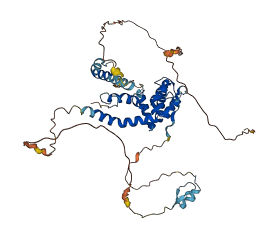
The autoinhibited protein was predicted that may have potential autoinhibitory elements via cis-regPred.
Autoinhibitory domains (AIDs)
Target domain |
|
Relief mechanism |
|
Assay |
cis-regPred |
Accessory elements
No accessory elements
Autoinhibited structure

Activated structure
1 structures for Q02398
| Entry ID | Method | Resolution | Chain | Position | Source |
|---|---|---|---|---|---|
| AF-Q02398-F1 | Predicted | AlphaFoldDB |
No variants for Q02398
| Variant ID(s) | Position | Change | Description | Diseaes Association | Provenance |
|---|---|---|---|---|---|
| No variants for Q02398 | |||||
No associated diseases with Q02398
Functions
| Description | ||
|---|---|---|
| EC Number | 2.3.2.27 | Aminoacyltransferases |
| Subcellular Localization |
|
|
| PANTHER Family | ||
| PANTHER Subfamily | ||
| PANTHER Protein Class | ||
| PANTHER Pathway Category | No pathway information available | |
2 GO annotations of cellular component
| Name | Definition |
|---|---|
| nucleus | A membrane-bounded organelle of eukaryotic cells in which chromosomes are housed and replicated. In most cells, the nucleus contains all of the cell's chromosomes except the organellar chromosomes, and is the site of RNA synthesis and processing. In some species, or in specialized cell types, RNA metabolism or DNA replication may be absent. |
| Rad6-Rad18 complex | A ubiquitin ligase complex found to be involved in post-replicative bypass of UV-damaged DNA and UV mutagenesis. In S. cerevisiae, the complex contains the ubiquitin conjugating enzyme Rad6 and Rad18, a protein containing a RING finger motif and a nucleotide binding motif. The yeast Rad6-Rad18 heterodimer has ubiquitin conjugating activity, binds single-stranded DNA, and possesses single-stranded DNA-dependent ATPase activity. |
3 GO annotations of molecular function
| Name | Definition |
|---|---|
| metal ion binding | Binding to a metal ion. |
| single-stranded DNA binding | Binding to single-stranded DNA. |
| ubiquitin protein ligase activity | Catalysis of the transfer of ubiquitin to a substrate protein via the reaction X-ubiquitin + S -> X + S-ubiquitin, where X is either an E2 or E3 enzyme, the X-ubiquitin linkage is a thioester bond, and the S-ubiquitin linkage is an amide bond: an isopeptide bond between the C-terminal glycine of ubiquitin and the epsilon-amino group of lysine residues in the substrate or, in the linear extension of ubiquitin chains, a peptide bond the between the C-terminal glycine and N-terminal methionine of ubiquitin residues. |
4 GO annotations of biological process
| Name | Definition |
|---|---|
| DNA repair | The process of restoring DNA after damage. Genomes are subject to damage by chemical and physical agents in the environment (e.g. UV and ionizing radiations, chemical mutagens, fungal and bacterial toxins, etc.) and by free radicals or alkylating agents endogenously generated in metabolism. DNA is also damaged because of errors during its replication. A variety of different DNA repair pathways have been reported that include direct reversal, base excision repair, nucleotide excision repair, photoreactivation, bypass, double-strand break repair pathway, and mismatch repair pathway. |
| mitotic recombination | The exchange, reciprocal or nonreciprocal, of genetic material between one DNA molecule and a homologous DNA region that occurs during mitotic cell cycles. |
| postreplication repair | The conversion of DNA-damage induced single-stranded gaps into large molecular weight DNA after replication. Includes pathways that remove replication-blocking lesions in conjunction with DNA replication. |
| protein monoubiquitination | Addition of a single ubiquitin group to a protein. |
No homologous proteins in AiPD
| UniProt AC | Gene Name | Protein Name | Species | Evidence Code |
|---|---|---|---|---|
| No homologous proteins | ||||
| 10 | 20 | 30 | 40 | 50 | 60 |
| MEPTFDIPDS | TDWLDTPLTL | LAPFETSLRC | QVCKDFFDNP | VITSCSHTFC | SLCIRRCLST |
| 70 | 80 | 90 | 100 | 110 | 120 |
| EGKCPTCRSS | DQELKLRRNW | VVQELVEGFK | NARPSILQLA | RMAQTGTDDS | GDLAAEEPAS |
| 130 | 140 | 150 | 160 | 170 | 180 |
| KKRKIEPNAI | VGTDGLPEEG | IRTRSQSRGA | SRQPQATPVQ | VIDDGNDEDY | MPDGLVPCPV |
| 190 | 200 | 210 | 220 | 230 | 240 |
| CGRRMKEEAV | FRHLDSCTGT | AEELKPAAFG | SLAPGPRKSF | LAATGKPPER | LPVINYSLLK |
| 250 | 260 | 270 | 280 | 290 | 300 |
| DTVLRKKLKD | LGIPNWGPRA | LLQRRHTEWL | NLWNANCDSR | TPKPKRELLR | ELDVWERTQG |
| 310 | 320 | 330 | 340 | 350 | 360 |
| GNSVTPTDPT | NAVMNKDFNT | EEWSANYDTD | FKALIANARK | KNDAVIRSTI | PNASQANSDT |
| 370 | 380 | 390 | 400 | 410 | 420 |
| PRSAQLVDQP | IEASLTPQDV | DEKSTMNPQD | AIDNRTEVPP | VPDPPQALSG | IDRAVNSPMK |
| 430 | 440 | ||||
| NVTEGDAQAI | PISSSASTHK | TPH |