Descriptions
The autoinhibited protein was predicted that may have potential autoinhibitory elements via cis-regPred.
Autoinhibitory domains (AIDs)
Target domain |
|
Relief mechanism |
|
Assay |
cis-regPred |
Accessory elements
No accessory elements
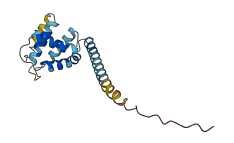
Autoinhibited structure

Activated structure
1 structures for Q01249
| Entry ID | Method | Resolution | Chain | Position | Source |
|---|---|---|---|---|---|
| AF-Q01249-F1 | Predicted | AlphaFoldDB |
No variants for Q01249
| Variant ID(s) | Position | Change | Description | Diseaes Association | Provenance |
|---|---|---|---|---|---|
| No variants for Q01249 | |||||
1 associated diseases with Q01249
[MIM: 615866]: Intellectual developmental disorder with microcephaly and with or without ocular malformations or hypogonadotropic hypogonadism (IDDMOH)
An autosomal dominant disorder characterized by developmental delay, impaired intellectual development and microcephaly. Affected individuals may also have oculomotor apraxia, ocular malformations including coloboma, lens abnormalities and microphthalmia, and hypogonadotropic hypogonadism. Some patients may have finger clinodactyly and hypoplastic distal phalanges with nail hypoplasia, especially of the fifth digits. . Note=The disease is caused by variants affecting the gene represented in this entry.
Without disease ID
- An autosomal dominant disorder characterized by developmental delay, impaired intellectual development and microcephaly. Affected individuals may also have oculomotor apraxia, ocular malformations including coloboma, lens abnormalities and microphthalmia, and hypogonadotropic hypogonadism. Some patients may have finger clinodactyly and hypoplastic distal phalanges with nail hypoplasia, especially of the fifth digits. . Note=The disease is caused by variants affecting the gene represented in this entry.
Functions
1 GO annotations of cellular component
| Name | Definition |
|---|---|
| type III protein secretion system complex | A complex of approximately 20 proteins, most of which are located in the cytoplasmic membrane that carries out protein secretion in the bacterial type III secretion system; type III secretion also requires a cytoplasmic, probably membrane-associated ATPase. |
No GO annotations of molecular function
| Name | Definition |
|---|---|
| No GO annotations for molecular function |
1 GO annotations of biological process
| Name | Definition |
|---|---|
| protein secretion by the type III secretion system | The process in which proteins are transferred into the extracellular milieu or directly into host cells by the bacterial type III secretion system; secretion occurs in a continuous process without the distinct presence of periplasmic intermediates and does not involve proteolytic processing of secreted proteins. |
No homologous proteins in AiPD
| UniProt AC | Gene Name | Protein Name | Species | Evidence Code |
|---|---|---|---|---|
| No homologous proteins | ||||
| 10 | 20 | 30 | 40 | 50 | 60 |
| MTVTLNRGSI | TSLMSSSQAV | STLQPAASEL | KTQLEHKLKS | ESAEKTREVL | WQQYYASNPP |
| 70 | 80 | 90 | 100 | 110 | 120 |
| DHAVLEVLAT | PVREALLARF | GQHQGPVVPA | IDLPELRSVL | QQFDSFGKRR | EAILLQVLEG |
| 130 | 140 | 150 | 160 | ||
| IKPNESQVGL | PYLSELINKE | LMILLPYNSI | VDSLLHNSHQ | IDMET |