Q01233
Gene name |
hsps-1 (B18E6.040, NCU09602) |
Protein name |
Heat shock 70 kDa protein |
Names |
HSP70 |
Species |
Neurospora crassa (strain ATCC 24698 / 74-OR23-1A / CBS 708.71 / DSM 1257 / FGSC 987) |
KEGG Pathway |
ncr:NCU09602 |
EC number |
|
Protein Class |
|
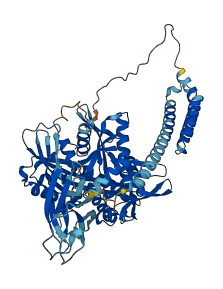
Descriptions
The autoinhibited protein was predicted that may have potential autoinhibitory elements via cis-regPred.
Autoinhibitory domains (AIDs)
Target domain |
|
Relief mechanism |
|
Assay |
cis-regPred |
Accessory elements
No accessory elements
Autoinhibited structure

Activated structure
1 structures for Q01233
| Entry ID | Method | Resolution | Chain | Position | Source |
|---|---|---|---|---|---|
| AF-Q01233-F1 | Predicted | AlphaFoldDB |
No variants for Q01233
| Variant ID(s) | Position | Change | Description | Diseaes Association | Provenance |
|---|---|---|---|---|---|
| No variants for Q01233 | |||||
No associated diseases with Q01233
3 regional properties for Q01233
| Type | Name | Position | InterPro Accession |
|---|---|---|---|
| conserved_site | Heat shock protein 70, conserved site | 7 - 14 | IPR018181-1 |
| conserved_site | Heat shock protein 70, conserved site | 195 - 208 | IPR018181-2 |
| conserved_site | Heat shock protein 70, conserved site | 332 - 346 | IPR018181-3 |
4 GO annotations of cellular component
| Name | Definition |
|---|---|
| cytoplasm | The contents of a cell excluding the plasma membrane and nucleus, but including other subcellular structures. |
| cytosol | The part of the cytoplasm that does not contain organelles but which does contain other particulate matter, such as protein complexes. |
| nucleus | A membrane-bounded organelle of eukaryotic cells in which chromosomes are housed and replicated. In most cells, the nucleus contains all of the cell's chromosomes except the organellar chromosomes, and is the site of RNA synthesis and processing. In some species, or in specialized cell types, RNA metabolism or DNA replication may be absent. |
| plasma membrane | The membrane surrounding a cell that separates the cell from its external environment. It consists of a phospholipid bilayer and associated proteins. |
7 GO annotations of molecular function
| Name | Definition |
|---|---|
| ATP binding | Binding to ATP, adenosine 5'-triphosphate, a universally important coenzyme and enzyme regulator. |
| ATP hydrolysis activity | Catalysis of the reaction: ATP + H2O = ADP + H+ phosphate. ATP hydrolysis is used in some reactions as an energy source, for example to catalyze a reaction or drive transport against a concentration gradient. |
| ATP-dependent protein folding chaperone | Binding to a protein or a protein-containing complex to assist the protein folding process, driven by ATP hydrolysis. |
| heat shock protein binding | Binding to a heat shock protein, a protein synthesized or activated in response to heat shock. |
| misfolded protein binding | Binding to a misfolded protein. |
| protein folding chaperone | Binding to a protein or a protein-containing complex to assist the protein folding process. |
| unfolded protein binding | Binding to an unfolded protein. |
4 GO annotations of biological process
| Name | Definition |
|---|---|
| cellular response to unfolded protein | Any process that results in a change in state or activity of a cell (in terms of movement, secretion, enzyme production, gene expression, etc.) as a result of an unfolded protein stimulus. |
| chaperone cofactor-dependent protein refolding | The process of assisting in the correct posttranslational noncovalent assembly of proteins, which is dependent on additional protein cofactors. This process occurs over one or several cycles of nucleotide hydrolysis-dependent binding and release. |
| protein refolding | The process carried out by a cell that restores the biological activity of an unfolded or misfolded protein, using helper proteins such as chaperones. |
| vesicle-mediated transport | A cellular transport process in which transported substances are moved in membrane-bounded vesicles; transported substances are enclosed in the vesicle lumen or located in the vesicle membrane. The process begins with a step that directs a substance to the forming vesicle, and includes vesicle budding and coating. Vesicles are then targeted to, and fuse with, an acceptor membrane. |
No homologous proteins in AiPD
| UniProt AC | Gene Name | Protein Name | Species | Evidence Code |
|---|---|---|---|---|
| No homologous proteins | ||||
| 10 | 20 | 30 | 40 | 50 | 60 |
| MAPAVGIDLG | TTYSCVGVFR | EDRCEIIAND | QGNRTTPSFV | AFTDTERLVG | DAAKNQVAMN |
| 70 | 80 | 90 | 100 | 110 | 120 |
| PANTVFDAKR | LIGRKFSDPE | VQADMKHFPF | KVIDRGGKPV | IQVEFKGETK | VFTPEEISAM |
| 130 | 140 | 150 | 160 | 170 | 180 |
| ILQKMKETAE | AYLGGTVNNA | VVTVPAYFND | SQRQATKDAG | LIAGLNVLRI | INEPTAAAIA |
| 190 | 200 | 210 | 220 | 230 | 240 |
| YGLDKKVEGE | RNVLIFDLGG | GTFDVSLLTI | EEGIFEVKST | AGDTHLGGED | FDNRLVNHFV |
| 250 | 260 | 270 | 280 | 290 | 300 |
| QEFKRKHKKD | LSTNARALRR | LRTACERAKR | TLSSSAQTSI | EIDSLFEGID | FYTSITRARF |
| 310 | 320 | 330 | 340 | 350 | 360 |
| EELCQDLFRS | TLQPVDRVLT | DAKIDKSQVH | EIVLVGGSTR | IPRIQKLISD | YFNGKEPNKS |
| 370 | 380 | 390 | 400 | 410 | 420 |
| INPDEAVAYG | AAVQAAILSG | DTSSKSTSEI | LLLDVAPLSL | GIETAGGMMT | KLIPRNTTIP |
| 430 | 440 | 450 | 460 | 470 | 480 |
| TKKSEVFSTF | SDNQPGVLIQ | VYEGERQRTK | DNNLLGKFEL | TGIPPAPRGV | PQIEVTFDVD |
| 490 | 500 | 510 | 520 | 530 | 540 |
| ANGIMNVSAL | EKGTGKTNQI | TITNDKGRLS | KEEIERMLAE | AEKFKEEDEA | EAKRVAAKNG |
| 550 | 560 | 570 | 580 | 590 | 600 |
| LESYAYSLRN | TLSDSKVDEK | LDAADKEKLK | SEIDKIVAWL | DENQQATREE | YEERQKELEA |
| 610 | 620 | 630 | 640 | ||
| IANPIMMKFY | GAGGAPGGMP | GAAPGGFPGG | APGSNDNEGP | TVEEVD |