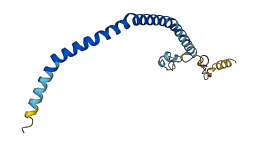
Descriptions
The autoinhibited protein was predicted that may have potential autoinhibitory elements via cis-regPred.
Autoinhibitory domains (AIDs)
Target domain |
|
Relief mechanism |
|
Assay |
cis-regPred |
Accessory elements
No accessory elements
Autoinhibited structure

Activated structure
1 structures for Q00PK0
| Entry ID | Method | Resolution | Chain | Position | Source |
|---|---|---|---|---|---|
| AF-Q00PK0-F1 | Predicted | AlphaFoldDB |
No variants for Q00PK0
| Variant ID(s) | Position | Change | Description | Diseaes Association | Provenance |
|---|---|---|---|---|---|
| No variants for Q00PK0 | |||||
No associated diseases with Q00PK0
1 regional properties for Q00PK0
| Type | Name | Position | InterPro Accession |
|---|---|---|---|
| conserved_site | Caveolin, conserved site | 53 - 60 | IPR018361 |
Functions
5 GO annotations of cellular component
| Name | Definition |
|---|---|
| caveola | A membrane raft that forms small pit, depression, or invagination that communicates with the outside of a cell and extends inward, indenting the cytoplasm and the cell membrane. Examples include flask-shaped invaginations of the plasma membrane in adipocytes associated with caveolin proteins, and minute pits or incuppings of the cell membrane formed during pinocytosis. Caveolae may be pinched off to form free vesicles within the cytoplasm. |
| extrinsic component of cytoplasmic side of plasma membrane | The component of a plasma membrane consisting of gene products and protein complexes that are loosely bound to its cytoplasmic surface, but not integrated into the hydrophobic region. |
| Golgi membrane | The lipid bilayer surrounding any of the compartments of the Golgi apparatus. |
| nucleus | A membrane-bounded organelle of eukaryotic cells in which chromosomes are housed and replicated. In most cells, the nucleus contains all of the cell's chromosomes except the organellar chromosomes, and is the site of RNA synthesis and processing. In some species, or in specialized cell types, RNA metabolism or DNA replication may be absent. |
| perinuclear region of cytoplasm | Cytoplasm situated near, or occurring around, the nucleus. |
1 GO annotations of molecular function
| Name | Definition |
|---|---|
| D1 dopamine receptor binding | Binding to a D1 dopamine receptor. |
8 GO annotations of biological process
| Name | Definition |
|---|---|
| caveola assembly | The aggregation, arrangement and bonding together of a set of components to form a caveola. A caveola is a plasma membrane raft that forms a small pit, depression, or invagination that communicates with the outside of a cell and extends inward, indenting the cytoplasm and the cell membrane. |
| endoplasmic reticulum organization | A process that is carried out at the cellular level which results in the assembly, arrangement of constituent parts, or disassembly of the endoplasmic reticulum. |
| mitochondrion organization | A process that is carried out at the cellular level which results in the assembly, arrangement of constituent parts, or disassembly of a mitochondrion; includes mitochondrial morphogenesis and distribution, and replication of the mitochondrial genome as well as synthesis of new mitochondrial components. |
| negative regulation of endothelial cell proliferation | Any process that stops, prevents, or reduces the rate or extent of endothelial cell proliferation. |
| positive regulation of dopamine receptor signaling pathway | Any process that activates or increases the frequency, rate or extent of the dopamine receptor protein signaling pathway. A dopamine receptor signaling pathway is the series of molecular signals generated as a consequence of a dopamine receptor binding to one of its physiological ligands. |
| skeletal muscle fiber development | The process whose specific outcome is the progression of the skeletal muscle fiber over time, from its formation to the mature structure. Muscle fibers are formed by the maturation of myotubes. They can be classed as slow, intermediate/fast or fast. |
| vesicle docking | The initial attachment of a transport vesicle membrane to the target membrane, mediated by proteins protruding from the membrane of the vesicle and the target membrane. Docking requires only that the two membranes come close enough for these proteins to interact and adhere. |
| vesicle fusion | Fusion of the membrane of a transport vesicle with its target membrane. |
No homologous proteins in AiPD
| UniProt AC | Gene Name | Protein Name | Species | Evidence Code |
|---|---|---|---|---|
| No homologous proteins | ||||
| 10 | 20 | 30 | 40 | 50 | 60 |
| MGLETEKADV | QLFMDDDSYS | HHSGVDYGDP | EKFVDSGQDR | DPHRLNSHLK | VGFEDVIAEP |
| 70 | 80 | 90 | 100 | 110 | 120 |
| MNMHSFDKVW | ICSHALFEIS | KYVIYKFLTV | FLAIPLAFTA | GILFATLSCL | HIWIIMPFVK |
| 130 | 140 | 150 | 160 | ||
| TCLMVLPSVQ | TIWRSVTDVI | IAPLCTSIGR | ICSSVSLQVS | HD |