Q00740
Gene name |
acdS |
Protein name |
1-aminocyclopropane-1-carboxylate deaminase |
Names |
ACC deaminase, ACCD |
Species |
Pseudomonas sp (strain ACP) |
KEGG Pathway |
|
EC number |
3.5.99.7: In other compounds |
Protein Class |
|
Descriptions
The autoinhibited protein was predicted that may have potential autoinhibitory elements via cis-regPred.
Autoinhibitory domains (AIDs)
Target domain |
|
Relief mechanism |
|
Assay |
cis-regPred |
Accessory elements
No accessory elements
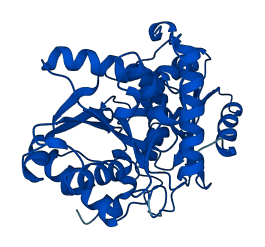
Autoinhibited structure

Activated structure
7 structures for Q00740
No variants for Q00740
| Variant ID(s) | Position | Change | Description | Diseaes Association | Provenance |
|---|---|---|---|---|---|
| No variants for Q00740 | |||||
No associated diseases with Q00740
1 regional properties for Q00740
| Type | Name | Position | InterPro Accession |
|---|---|---|---|
| domain | Tryptophan synthase beta chain-like, PALP domain | 13 - 321 | IPR001926 |
Functions
| Description | ||
|---|---|---|
| EC Number | 3.5.99.7 | In other compounds |
| Subcellular Localization |
|
|
| PANTHER Family | ||
| PANTHER Subfamily | ||
| PANTHER Protein Class | ||
| PANTHER Pathway Category | No pathway information available | |
No GO annotations of cellular component
| Name | Definition |
|---|---|
| No GO annotations for cellular component |
2 GO annotations of molecular function
| Name | Definition |
|---|---|
| 1-aminocyclopropane-1-carboxylate deaminase activity | Catalysis of the reaction: 1-aminocyclopropane-1-carboxylate + H(2)O = 2-oxobutanate + NH(4)(+). |
| pyridoxal phosphate binding | Binding to pyridoxal 5' phosphate, 3-hydroxy-5-(hydroxymethyl)-2-methyl4-pyridine carboxaldehyde 5' phosphate, the biologically active form of vitamin B6. |
2 GO annotations of biological process
| Name | Definition |
|---|---|
| 1-aminocyclopropane-1-carboxylate metabolic process | The chemical reactions and pathways involving 1-aminocyclopropane-1-carboxylate, the anion of 1-aminocyclopropane-1-carboxylic acid, a natural product found in plant tissues. It is a key intermediate in the biosynthesis of ethylene (ethene), a fruit-ripening hormone in plants. |
| amine catabolic process | The chemical reactions and pathways resulting in the breakdown of any organic compound that is weakly basic in character and contains an amino or a substituted amino group. Amines are called primary, secondary, or tertiary according to whether one, two, or three carbon atoms are attached to the nitrogen atom. |
No homologous proteins in AiPD
| UniProt AC | Gene Name | Protein Name | Species | Evidence Code |
|---|---|---|---|---|
| No homologous proteins | ||||
| 10 | 20 | 30 | 40 | 50 | 60 |
| MNLQRFPRYP | LTFGPTPIQP | LARLSKHLGG | KVHLYAKRED | CNSGLAFGGN | KTRKLEYLIP |
| 70 | 80 | 90 | 100 | 110 | 120 |
| EALAQGCDTL | VSIGGIQSNQ | TRQVAAVAAH | LGMKCVLVQE | NWVNYSDAVY | DRVGNIQMSR |
| 130 | 140 | 150 | 160 | 170 | 180 |
| ILGADVRLVP | DGFDIGFRRS | WEDALESVRA | AGGKPYAIPA | GCSDHPLGGL | GFVGFAEEVR |
| 190 | 200 | 210 | 220 | 230 | 240 |
| AQEAELGFKF | DYVVVCSVTG | STQAGMVVGF | AADGRADRVI | GVDASAKPAQ | TREQITRIAR |
| 250 | 260 | 270 | 280 | 290 | 300 |
| QTAEKVGLER | DIMRADVVLD | ERFAGPEYGL | PNEGTLEAIR | LCARTEGMLT | DPVYEGKSMH |
| 310 | 320 | 330 | |||
| GMIEMVRNGE | FPEGSRVLYA | HLGGVPALNG | YSFIFRDG |