Q00673
Gene name |
ALI1 |
Protein name |
Probable NADH-ubiquinone oxidoreductase 30.4 kDa subunit, mitochondrial |
Names |
Alkane-inducible protein 1, CI-31kD, Complex I-30kD |
Species |
Candida maltosa (Yeast) |
KEGG Pathway |
|
EC number |
7.1.1.2: Hydron translocation or charge separation linked to oxidoreductase reactions |
Protein Class |
|
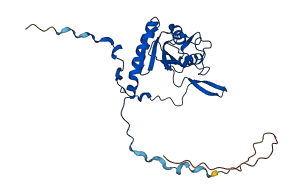
Descriptions
The autoinhibited protein was predicted that may have potential autoinhibitory elements via cis-regPred.
Autoinhibitory domains (AIDs)
Target domain |
|
Relief mechanism |
|
Assay |
cis-regPred |
Accessory elements
No accessory elements
Autoinhibited structure

Activated structure
1 structures for Q00673
| Entry ID | Method | Resolution | Chain | Position | Source |
|---|---|---|---|---|---|
| AF-Q00673-F1 | Predicted | AlphaFoldDB |
No variants for Q00673
| Variant ID(s) | Position | Change | Description | Diseaes Association | Provenance |
|---|---|---|---|---|---|
| No variants for Q00673 | |||||
No associated diseases with Q00673
Functions
| Description | ||
|---|---|---|
| EC Number | 7.1.1.2 | Hydron translocation or charge separation linked to oxidoreductase reactions |
| Subcellular Localization |
|
|
| PANTHER Family | ||
| PANTHER Subfamily | ||
| PANTHER Protein Class | ||
| PANTHER Pathway Category | No pathway information available | |
2 GO annotations of cellular component
| Name | Definition |
|---|---|
| mitochondrial inner membrane | The inner, i.e. lumen-facing, lipid bilayer of the mitochondrial envelope. It is highly folded to form cristae. |
| respirasome | The protein complexes that form the electron transport system (the respiratory chain), associated with a cell membrane, usually the plasma membrane (in prokaryotes) or the inner mitochondrial membrane (on eukaryotes). The respiratory chain complexes transfer electrons from an electron donor to an electron acceptor and are associated with a proton pump to create a transmembrane electrochemical gradient. |
1 GO annotations of molecular function
| Name | Definition |
|---|---|
| NADH dehydrogenase (ubiquinone) activity | Catalysis of the reaction: NADH + ubiquinone + 5 H(+)(in) <=> NAD(+) + ubiquinol + 4 H(+)(out). |
No GO annotations of biological process
| Name | Definition |
|---|---|
| No GO annotations for biological process |
No homologous proteins in AiPD
| UniProt AC | Gene Name | Protein Name | Species | Evidence Code |
|---|---|---|---|---|
| No homologous proteins | ||||
| 10 | 20 | 30 | 40 | 50 | 60 |
| MISRTLLKRT | VPASRLLRSF | TTSNVRLSAH | EEDLVNVNNL | PRPKPTENYV | PLINPTEKYK |
| 70 | 80 | 90 | 100 | 110 | 120 |
| VQIEELHKFG | TYIMSCLPKY | IQQFSVWKDE | LTIYVAPSAI | RPVMSYLKNH | TSCQFKAVMD |
| 130 | 140 | 150 | 160 | 170 | 180 |
| ITAADYPSRT | NRFDVVYNLL | SDRHNSRIRV | KTYANETSPV | PSVTPLFNGA | NWYERETYDL |
| 190 | 200 | 210 | 220 | 230 | 240 |
| FGVFFVGHPD | LRRIMTDYGF | EGHPLRKDFP | TTGYTEVRYD | EEKKRVIYEP | LELTQAWRNF |
| 250 | 260 | 270 | |||
| TVGSSVWEPV | GEGKDFTPES | FKLPTPQPEP | EQEEKK |