Q00664
Gene name |
nudF |
Protein name |
Nuclear distribution protein nudF |
Names |
Lissencephaly-1 homolog, LIS-1, Nuclear migration protein nudF |
Species |
Emericella nidulans (strain FGSC A4 / ATCC 38163 / CBS 112.46 / NRRL 194 / M139) (Aspergillus nidulans) |
KEGG Pathway |
ani:AN6197.2 |
EC number |
|
Protein Class |
|
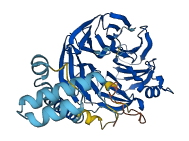
Descriptions
The autoinhibited protein was predicted that may have potential autoinhibitory elements via cis-regPred.
Autoinhibitory domains (AIDs)
Target domain |
|
Relief mechanism |
|
Assay |
cis-regPred |
Accessory elements
No accessory elements
Autoinhibited structure

Activated structure
1 structures for Q00664
| Entry ID | Method | Resolution | Chain | Position | Source |
|---|---|---|---|---|---|
| AF-Q00664-F1 | Predicted | AlphaFoldDB |
No variants for Q00664
| Variant ID(s) | Position | Change | Description | Diseaes Association | Provenance |
|---|---|---|---|---|---|
| No variants for Q00664 | |||||
No associated diseases with Q00664
9 regional properties for Q00664
| Type | Name | Position | InterPro Accession |
|---|---|---|---|
| repeat | WD40 repeat | 103 - 186 | IPR001680-1 |
| repeat | WD40 repeat | 190 - 336 | IPR001680-2 |
| repeat | WD40 repeat | 338 - 444 | IPR001680-3 |
| domain | LIS1 homology motif | 9 - 41 | IPR006594 |
| conserved_site | WD40 repeat, conserved site | 217 - 231 | IPR019775-1 |
| conserved_site | WD40 repeat, conserved site | 260 - 274 | IPR019775-2 |
| repeat | G-protein beta WD-40 repeat | 129 - 143 | IPR020472-1 |
| repeat | G-protein beta WD-40 repeat | 173 - 187 | IPR020472-2 |
| repeat | G-protein beta WD-40 repeat | 217 - 231 | IPR020472-3 |
Functions
6 GO annotations of cellular component
| Name | Definition |
|---|---|
| cytoplasmic microtubule | Any microtubule in the cytoplasm of a cell. |
| kinetochore | A multisubunit complex that is located at the centromeric region of DNA and provides an attachment point for the spindle microtubules. |
| microtubule associated complex | Any multimeric complex connected to a microtubule. |
| nuclear envelope | The double lipid bilayer enclosing the nucleus and separating its contents from the rest of the cytoplasm; includes the intermembrane space, a gap of width 20-40 nm (also called the perinuclear space). |
| spindle pole | Either of the ends of a spindle, where spindle microtubules are organized; usually contains a microtubule organizing center and accessory molecules, spindle microtubules and astral microtubules. |
| spindle pole body | The microtubule organizing center in fungi; functionally homologous to the animal cell centrosome. |
3 GO annotations of molecular function
| Name | Definition |
|---|---|
| dynein complex binding | Binding to a dynein complex, a protein complex that contains two or three dynein heavy chains and several light chains, and has microtubule motor activity. |
| microtubule binding | Binding to a microtubule, a filament composed of tubulin monomers. |
| microtubule plus-end binding | Binding to the plus end of a microtubule. |
8 GO annotations of biological process
| Name | Definition |
|---|---|
| cell division | The process resulting in division and partitioning of components of a cell to form more cells; may or may not be accompanied by the physical separation of a cell into distinct, individually membrane-bounded daughter cells. |
| conidium formation | The process of producing non-motile spores, called conidia, via mitotic asexual reproduction in higher fungi. Conidia are haploid cells genetically identical to their haploid parent. They are produced by conversion of hyphal elements, or are borne on sporogenous cells on or within specialized structures termed conidiophores, and participate in dispersal of the fungus. |
| establishment of mitotic spindle orientation | A cell cycle process that sets the alignment of mitotic spindle relative to other cellular structures. |
| microtubule organizing center organization | A process that is carried out at the cellular level which results in the assembly, arrangement of constituent parts, or disassembly of a microtubule organizing center, a structure from which microtubules grow. |
| microtubule sliding | The movement of one microtubule along another microtubule. |
| nuclear migration | The directed movement of the nucleus to a specific location within a cell. |
| sexual sporulation resulting in formation of a cellular spore | The formation of spores derived from the products of meiosis. A cellular spore is a cell form that can be used for dissemination, for survival of adverse conditions because of its heat and dessication resistance, and/or for reproduction. |
| vesicle transport along microtubule | The directed movement of a vesicle along a microtubule, mediated by motor proteins. This process begins with the attachment of a vesicle to a microtubule, and ends when the vesicle reaches its final destination. |
No homologous proteins in AiPD
| UniProt AC | Gene Name | Protein Name | Species | Evidence Code |
|---|---|---|---|---|
| No homologous proteins | ||||
| 10 | 20 | 30 | 40 | 50 | 60 |
| MSQILTAPQA | EALHKAMLAY | LSVINAPQTA | ETLREELHFD | ESYNEATCKK | FEGVLEKKWT |
| 70 | 80 | 90 | 100 | 110 | 120 |
| GIARLQRRIN | DLEAEVRSLQ | AELEASPSAA | RAKNQDPTNW | LPKPSSTHTL | TSHRDAVTCV |
| 130 | 140 | 150 | 160 | 170 | 180 |
| AFHPVFTSLA | SGSEDCTIKI | WDWELGEIER | TLKGHIRGVS | GLDYGGQKGN | TLLASCSSDL |
| 190 | 200 | 210 | 220 | 230 | 240 |
| TIKLWDPSKD | YANIRTLSGH | DHSVSSVRFL | TSNDNHLISA | SRDGTLRIWD | VSTGFCVKVI |
| 250 | 260 | 270 | 280 | 290 | 300 |
| KSATESWIRD | VSPSFDGKWL | VSGGRDQAIT | VWEVSSAEPK | AALLGHENFI | ECCVFAPPAS |
| 310 | 320 | 330 | 340 | 350 | 360 |
| YEHLATLAGL | KKPPPATSSC | EFVATGARDK | TIKLWEARGR | LIKTLHGHDN | WVRGLVFHPG |
| 370 | 380 | 390 | 400 | 410 | 420 |
| GKYLFSVSDD | KTIRCWDLSQ | EGRLVKTISG | AHEHFVSCIR | WAPSPNTDNP | DPAGEKAGKK |
| 430 | 440 | ||||
| DAVKPSYRCV | IATGCADNSV | RVFS |