Q00659
Gene name |
sconB (mapB1, AN6359) |
Protein name |
Probable E3 ubiquitin ligase complex SCF subunit sconB |
Names |
Sulfur controller B, Sulfur metabolite repression control protein B |
Species |
Emericella nidulans (strain FGSC A4 / ATCC 38163 / CBS 112.46 / NRRL 194 / M139) (Aspergillus nidulans) |
KEGG Pathway |
ani:AN6359.2 |
EC number |
|
Protein Class |
|
Descriptions
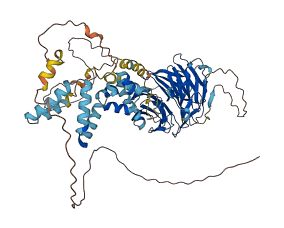
The autoinhibited protein was predicted that may have potential autoinhibitory elements via cis-regPred.
Autoinhibitory domains (AIDs)
Target domain |
|
Relief mechanism |
|
Assay |
cis-regPred |
Accessory elements
No accessory elements
Autoinhibited structure

Activated structure
1 structures for Q00659
| Entry ID | Method | Resolution | Chain | Position | Source |
|---|---|---|---|---|---|
| AF-Q00659-F1 | Predicted | AlphaFoldDB |
No variants for Q00659
| Variant ID(s) | Position | Change | Description | Diseaes Association | Provenance |
|---|---|---|---|---|---|
| No variants for Q00659 | |||||
No associated diseases with Q00659
9 regional properties for Q00659
| Type | Name | Position | InterPro Accession |
|---|---|---|---|
| repeat | WD40 repeat | 338 - 505 | IPR001680-1 |
| repeat | WD40 repeat | 499 - 678 | IPR001680-2 |
| domain | F-box domain | 178 - 225 | IPR001810 |
| conserved_site | WD40 repeat, conserved site | 362 - 376 | IPR019775-1 |
| conserved_site | WD40 repeat, conserved site | 442 - 456 | IPR019775-2 |
| conserved_site | WD40 repeat, conserved site | 483 - 497 | IPR019775-3 |
| repeat | G-protein beta WD-40 repeat | 362 - 376 | IPR020472-1 |
| repeat | G-protein beta WD-40 repeat | 442 - 456 | IPR020472-2 |
| repeat | G-protein beta WD-40 repeat | 622 - 636 | IPR020472-3 |
2 GO annotations of cellular component
| Name | Definition |
|---|---|
| nuclear SCF ubiquitin ligase complex | A ubiquitin ligase complex, located in the nucleus, in which a cullin from the Cul1 subfamily and a RING domain protein form the catalytic core; substrate specificity is conferred by a Skp1 adaptor and an F-box protein. SCF complexes are involved in targeting proteins for degradation by the proteasome. The best characterized complexes are those from yeast and mammals (with core subunits named Cdc53/Cul1, Rbx1/Hrt1/Roc1). |
| nucleus | A membrane-bounded organelle of eukaryotic cells in which chromosomes are housed and replicated. In most cells, the nucleus contains all of the cell's chromosomes except the organellar chromosomes, and is the site of RNA synthesis and processing. In some species, or in specialized cell types, RNA metabolism or DNA replication may be absent. |
3 GO annotations of molecular function
| Name | Definition |
|---|---|
| identical protein binding | Binding to an identical protein or proteins. |
| ubiquitin binding | Binding to ubiquitin, a protein that when covalently bound to other cellular proteins marks them for proteolytic degradation. |
| ubiquitin ligase-substrate adaptor activity | The binding activity of a molecule that brings together a ubiquitin ligase and its substrate. Usually mediated by F-box BTB/POZ domain proteins. |
5 GO annotations of biological process
| Name | Definition |
|---|---|
| protein polyubiquitination | Addition of multiple ubiquitin groups to a protein, forming a ubiquitin chain. |
| regulation of transcription involved in G1/S transition of mitotic cell cycle | Any process that regulates transcription such that the target genes are involved in the transition between G1 and S phase of the mitotic cell cycle. |
| response to arsenic-containing substance | Any process that results in a change in state or activity of a cell or an organism (in terms of movement, secretion, enzyme production, gene expression, etc.) as a result of an arsenic stimulus from compounds containing arsenic, including arsenates, arsenites, and arsenides. |
| response to cadmium ion | Any process that results in a change in state or activity of a cell or an organism (in terms of movement, secretion, enzyme production, gene expression, etc.) as a result of a cadmium (Cd) ion stimulus. |
| SCF-dependent proteasomal ubiquitin-dependent protein catabolic process | The chemical reactions and pathways resulting in the breakdown of a protein or peptide by hydrolysis of its peptide bonds, initiated by the covalent attachment of ubiquitin, with ubiquitin-protein ligation catalyzed by an SCF (Skp1/Cul1/F-box protein) complex, and mediated by the proteasome. |
No homologous proteins in AiPD
| UniProt AC | Gene Name | Protein Name | Species | Evidence Code |
|---|---|---|---|---|
| No homologous proteins | ||||
| 10 | 20 | 30 | 40 | 50 | 60 |
| MSTEDNHDSQ | ILTARHRSDA | SEQSFKSLFG | GPSSEDGKET | EPDTHDHNHS | FSNAKAPAKF |
| 70 | 80 | 90 | 100 | 110 | 120 |
| ANQNVAPFLA | RHIPEQYAPL | GAQSILPADL | SSANSKYCYR | HRPDQKCRRQ | ADEPSMDKLQ |
| 130 | 140 | 150 | 160 | 170 | 180 |
| RELESLPQGD | QQSISHVWSL | FSAAPAKHRK | LILQGIMAQC | CFPQLSYISA | TVRDLIRIDF |
| 190 | 200 | 210 | 220 | 230 | 240 |
| ITALPPEIAF | KILCYLDTTS | LCKASQVSRG | WRALADDDVV | WHRMCEQHIH | RKCKKCGWGL |
| 250 | 260 | 270 | 280 | 290 | 300 |
| PLLDRKRLRE | SKREIELRAT | TWDKGVVGPR | SPDASAESPP | SGKRKLEDDE | VAVVKRHCSS |
| 310 | 320 | 330 | 340 | 350 | 360 |
| LGSDAGVDKD | SDFFKTRYRP | WKEVYKDRFK | VGTNWKYGRC | SIKTFKGHTN | GVMCLQFEDN |
| 370 | 380 | 390 | 400 | 410 | 420 |
| ILATGSYDTT | IKIWDTETGE | ELRTLRGHES | GIRCLQFDDT | KLISGSMDRT | IKVWNWRTGE |
| 430 | 440 | 450 | 460 | 470 | 480 |
| CISTYTGHRG | GVIGLHFDAS | ILASGSVDKT | VKIWNFEDKS | TFSLRGHTDW | VNAVRVDTSS |
| 490 | 500 | 510 | 520 | 530 | 540 |
| RTVFSASDDC | TVRLWDLDTK | TCIRTFHGHV | GQVQQVVPLP | REFEFEEHDA | ECENDDLSTT |
| 550 | 560 | 570 | 580 | 590 | 600 |
| SGDADPPSIQ | ASMGLEPNAA | YSQSSAFGTS | FDNGRAAPPR | YMVTSALDST | IRLWETTTGR |
| 610 | 620 | 630 | 640 | 650 | 660 |
| CLRTFFGHLE | GVWALGADTL | RIVSGAEDRM | IKIWDPRTGK | CERTFTGHSG | PVTCIGLGDS |
| 670 | |||||
| RFATGSEDCE | VRMYSFQS |