Q00619
Gene name |
mam2 (SPAC11H11.04) |
Protein name |
Pheromone P-factor receptor |
Names |
|
Species |
Schizosaccharomyces pombe (strain 972 / ATCC 24843) (Fission yeast) |
KEGG Pathway |
spo:SPAC11H11.04 |
EC number |
|
Protein Class |
|
Descriptions
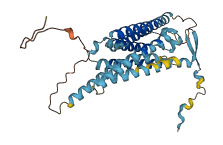
The autoinhibited protein was predicted that may have potential autoinhibitory elements via cis-regPred.
Autoinhibitory domains (AIDs)
Target domain |
|
Relief mechanism |
|
Assay |
cis-regPred |
Accessory elements
No accessory elements
Autoinhibited structure

Activated structure
1 structures for Q00619
| Entry ID | Method | Resolution | Chain | Position | Source |
|---|---|---|---|---|---|
| AF-Q00619-F1 | Predicted | AlphaFoldDB |
4 variants for Q00619
| Variant ID(s) | Position | Change | Description | Diseaes Association | Provenance |
|---|---|---|---|---|---|
| I_4780988_A_G | 101 | I>V | No | Jeffares_SNPs | |
| I_4781150_C_A | 155 | H>N | No | Jeffares_SNPs | |
| I_4781161_G_T | 158 | K>N | No | Jeffares_SNPs | |
| I_4781177_A_T | 164 | T>S | No | Jeffares_SNPs |
No associated diseases with Q00619
No regional properties for Q00619
| Type | Name | Position | InterPro Accession |
|---|---|---|---|
| No domain, repeats, and functional sites for Q00619 | |||
8 GO annotations of cellular component
| Name | Definition |
|---|---|
| cell cortex | The region of a cell that lies just beneath the plasma membrane and often, but not always, contains a network of actin filaments and associated proteins. |
| cell division site | The eventual plane of cell division (also known as cell cleavage or cytokinesis) in a dividing cell. In Eukaryotes, the cleavage apparatus, composed of septin structures and the actomyosin contractile ring, forms along this plane, and the mitotic, or meiotic, spindle is aligned perpendicular to the division plane. In bacteria, the cell division site is generally located at mid-cell and is the site at which the cytoskeletal structure, the Z-ring, assembles. |
| cell tip | The region at the end of the longest axis of a cylindrical or elongated cell. |
| fungal-type vacuole | A vacuole that has both lytic and storage functions. The fungal vacuole is a large, membrane-bounded organelle that functions as a reservoir for the storage of small molecules (including polyphosphate, amino acids, several divalent cations (e.g. calcium), other ions, and other small molecules) as well as being the primary compartment for degradation. It is an acidic compartment, containing an ensemble of acid hydrolases. At least in S. cerevisiae, there are indications that the morphology of the vacuole is variable and correlated with the cell cycle, with logarithmically growing cells having a multilobed, reticulated vacuole, while stationary phase cells contain a single large structure. |
| G protein-coupled receptor homodimeric complex | A protein complex that contains two G protein-coupled receptors (GPCRs) of the same subtype. Formation of a GPCR homodimer may be important for the transport of newly formed receptors to the cell surface, and the function of the receptor. |
| integral component of plasma membrane | The component of the plasma membrane consisting of the gene products and protein complexes having at least some part of their peptide sequence embedded in the hydrophobic region of the membrane. |
| mating projection membrane | The portion of the plasma membrane surrounding a mating projection, the projection formed by unicellular fungi in response to mating pheromone. |
| plasma membrane of cell tip | The portion of the plasma membrane surrounding the cell tip. |
3 GO annotations of molecular function
| Name | Definition |
|---|---|
| mating-type factor pheromone receptor activity | Combining with a mating-type factor pheromone to initiate a change in cell activity. |
| mating-type P-factor pheromone receptor activity | Combining with the mating-type peptide pheromone P-factor and transmitting the signal across the membrane to initiate a change in cell activity. P-factor is a polypeptide of 23 residues, with the sequence Thr-Tyr-Ala-Asp-Phe-Leu-Arg-Ala-Tyr-Gln-Ser-Trp-Asn-Thr-Phe-Val-Asn-Pro-Asp-Arg-Pro-Asn-Leu, and is a peptide pheromone released by Schizosaccharomyces pombe cells of the cellular mating type Plus. |
| pheromone binding | Binding to a pheromone, a substance, or characteristic mixture of substances, that is secreted and released by an organism and detected by a second organism of the same or a closely related species, in which it causes a specific reaction, such as a definite behavioral reaction or a developmental process. |
3 GO annotations of biological process
| Name | Definition |
|---|---|
| pheromone-dependent signal transduction involved in conjugation with cellular fusion | A signal transduction process resulting in the relay, amplification or dampening of a signal generated in response to pheromone exposure in organisms that undergo conjugation with cellular fusion. An example of this process is found in Saccharomyces cerevisiae. |
| positive regulation of conjugation with cellular fusion | Any process that increases the rate or frequency of conjugation with cellular fusion. |
| positive regulation of pheromone response MAPK cascade | Any process that activates or increases the frequency, rate or extent of a pheromone response MAPK cascade. |
No homologous proteins in AiPD
| UniProt AC | Gene Name | Protein Name | Species | Evidence Code |
|---|---|---|---|---|
| No homologous proteins | ||||
| 10 | 20 | 30 | 40 | 50 | 60 |
| MRQPWWKDFT | IPDASAIIHQ | NITIVSIVGE | IEVPVSTIDA | YERDRLLTGM | TLSAQLALGV |
| 70 | 80 | 90 | 100 | 110 | 120 |
| LTILMVCLLS | SSEKRKHPVF | VFNSASIVAM | CLRAILNIVT | ICSNSYSILV | NYGFILNMVH |
| 130 | 140 | 150 | 160 | 170 | 180 |
| MYVHVFNILI | LLLAPVIIFT | AEMSMMIQVR | IICAHDRKTQ | RIMTVISACL | TVLVLAFWIT |
| 190 | 200 | 210 | 220 | 230 | 240 |
| NMCQQIQYLL | WLTPLSSKTI | VGYSWPYFIA | KILFAFSIIF | HSGVFSYKLF | RAILIRKKIG |
| 250 | 260 | 270 | 280 | 290 | 300 |
| QFPFGPMQCI | LVISCQCLIV | PATFTIIDSF | IHTYDGFSSM | TQCLLIISLP | LSSLWASSTA |
| 310 | 320 | 330 | 340 | ||
| LKLQSMKTSS | AQGETTEVSI | RVDRTFDIKH | TPSDDYSISD | ESETKKWT |