Q00372
Gene name |
SNF1 (CAGL0M08910g) |
Protein name |
Carbon catabolite-derepressing protein kinase |
Names |
|
Species |
Candida glabrata (strain ATCC 2001 / CBS 138 / JCM 3761 / NBRC 0622 / NRRL Y-65) (Yeast) (Torulopsis glabrata) |
KEGG Pathway |
cgr:CAGL0M08910g |
EC number |
2.7.11.1: Protein-serine/threonine kinases |
Protein Class |
|
Descriptions
The autoinhibited protein was predicted that may have potential autoinhibitory elements via cis-regPred.
Autoinhibitory domains (AIDs)
Target domain |
|
Relief mechanism |
|
Assay |
cis-regPred |
Accessory elements
178-200 (Activation loop from InterPro)
Target domain |
39-290 (Protein kinase domain) |
Relief mechanism |
|
Assay |
|
Autoinhibited structure

Activated structure
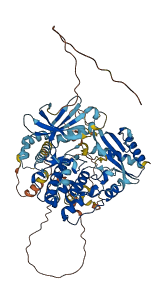
1 structures for Q00372
| Entry ID | Method | Resolution | Chain | Position | Source |
|---|---|---|---|---|---|
| AF-Q00372-F1 | Predicted | AlphaFoldDB |
No variants for Q00372
| Variant ID(s) | Position | Change | Description | Diseaes Association | Provenance |
|---|---|---|---|---|---|
| No variants for Q00372 | |||||
No associated diseases with Q00372
5 regional properties for Q00372
| Type | Name | Position | InterPro Accession |
|---|---|---|---|
| domain | Protein kinase domain | 39 - 290 | IPR000719 |
| active_site | Serine/threonine-protein kinase, active site | 157 - 169 | IPR008271 |
| domain | Carbon catabolite-derepressing protein kinase, ubiquitin-associated domain | 322 - 373 | IPR013896 |
| binding_site | Protein kinase, ATP binding site | 45 - 68 | IPR017441 |
| domain | AMPK, C-terminal adenylate sensor domain | 480 - 605 | IPR032270 |
Functions
| Description | ||
|---|---|---|
| EC Number | 2.7.11.1 | Protein-serine/threonine kinases |
| Subcellular Localization |
|
|
| PANTHER Family | ||
| PANTHER Subfamily | ||
| PANTHER Protein Class | ||
| PANTHER Pathway Category | No pathway information available | |
5 GO annotations of cellular component
| Name | Definition |
|---|---|
| cellular bud neck septin ring | A ring-shaped structure that forms at the site of cytokinesis in the bud neck of a budding cell; composed of members of the conserved family of filament forming proteins called septins as well as septin-associated proteins. In S. cerevisiae, this structure forms at the time of bud emergence and the septins show a high rate of exchange. |
| nuclear envelope lumen | The region between the two lipid bilayers of the nuclear envelope; 20-40 nm wide. |
| nuclear membrane | Either of the lipid bilayers that surround the nucleus and form the nuclear envelope; excludes the intermembrane space. |
| nucleotide-activated protein kinase complex | A protein complex that possesses nucleotide-dependent protein kinase activity. The nucleotide can be AMP (in S. pombe and human) or ADP (in S. cerevisiae). |
| vacuolar membrane | The lipid bilayer surrounding the vacuole and separating its contents from the cytoplasm of the cell. |
5 GO annotations of molecular function
| Name | Definition |
|---|---|
| AMP-activated protein kinase activity | Catalysis of the reaction: ATP + a protein = ADP + a phosphoprotein. This reaction requires the presence of AMP. |
| ATP binding | Binding to ATP, adenosine 5'-triphosphate, a universally important coenzyme and enzyme regulator. |
| guanyl-nucleotide exchange factor activity | Stimulates the exchange of GDP to GTP on a signaling GTPase, changing its conformation to its active form. Guanine nucleotide exchange factors (GEFs) act by stimulating the release of guanosine diphosphate (GDP) to allow binding of guanosine triphosphate (GTP), which is more abundant in the cell under normal cellular physiological conditions. |
| identical protein binding | Binding to an identical protein or proteins. |
| protein serine kinase activity | Catalysis of the reactions: ATP + protein serine = ADP + protein serine phosphate. |
16 GO annotations of biological process
| Name | Definition |
|---|---|
| cell adhesion | The attachment of a cell, either to another cell or to an underlying substrate such as the extracellular matrix, via cell adhesion molecules. |
| cellular response to nitrogen starvation | Any process that results in a change in state or activity of a cell (in terms of movement, secretion, enzyme production, gene expression, etc.) as a result of deprivation of nitrogen. |
| establishment of mitotic spindle orientation | A cell cycle process that sets the alignment of mitotic spindle relative to other cellular structures. |
| fungal-type cell wall assembly | The aggregation, arrangement and bonding together of a set of components to form a fungal-type cell wall. |
| invasive growth in response to glucose limitation | A growth pattern exhibited by budding haploid cells under certain growth conditions, in which cells retain the typical axial budding pattern of haploids, but become elongated and fail to separate after division; during growth on a solid substrate, this results in penetration of cells into the agar medium. An example of this process is found in Saccharomyces cerevisiae. |
| negative regulation of translation | Any process that stops, prevents, or reduces the frequency, rate or extent of the chemical reactions and pathways resulting in the formation of proteins by the translation of mRNA or circRNA. |
| positive regulation of filamentous growth of a population of unicellular organisms in response to starvation | Any process that activates or increases the frequency, rate or extent of filamentous growth of a population of unicellular organisms in response to starvation. |
| positive regulation of gluconeogenesis | Any process that activates or increases the frequency, rate or extent of gluconeogenesis. |
| positive regulation of macroautophagy | Any process, such as recognition of nutrient depletion, that activates or increases the rate of macroautophagy to bring cytosolic macromolecules to the vacuole/lysosome for degradation. |
| positive regulation of pseudohyphal growth | Any process that activates or increases the frequency, rate or extent of pseudohyphal growth. |
| protein phosphorylation | The process of introducing a phosphate group on to a protein. |
| regulation of invasive growth in response to glucose limitation | Any process that modulates the frequency, rate or extent of invasive growth in response to glucose limitation. |
| response to endoplasmic reticulum stress | Any process that results in a change in state or activity of a cell (in terms of movement, secretion, enzyme production, gene expression, etc.) as a result of a stress acting at the endoplasmic reticulum. ER stress usually results from the accumulation of unfolded or misfolded proteins in the ER lumen. |
| response to unfolded protein | Any process that results in a change in state or activity of a cell or an organism (in terms of movement, secretion, enzyme production, gene expression, etc.) as a result of an unfolded protein stimulus. |
| single-species surface biofilm formation | A process in which microorganisms produce an extracellular matrix and form multicellular aggregates at an air-liquid interface. |
| trehalose catabolic process | The chemical reactions and pathways resulting in the breakdown of trehalose, a disaccharide isomeric with sucrose and obtained from certain lichens and fungi. |
No homologous proteins in AiPD
| UniProt AC | Gene Name | Protein Name | Species | Evidence Code |
|---|---|---|---|---|
| No homologous proteins | ||||
| 10 | 20 | 30 | 40 | 50 | 60 |
| MENKEHHHHH | HHHHHHHSNG | SYVSNKVSSL | ADGSRVGNYQ | IVKTLGEGSF | GKVKLAYHVT |
| 70 | 80 | 90 | 100 | 110 | 120 |
| TGQKVALKII | NKKVLAKSDM | QGRIEREISY | LRLLRHPHII | KLYDVIKSKD | EIIMVIEYAG |
| 130 | 140 | 150 | 160 | 170 | 180 |
| NELFDYIVQR | NKMSEQEARR | FFQQIISAVE | YCHRHKIVHR | DLKPENLLLD | EHLNVKIADF |
| 190 | 200 | 210 | 220 | 230 | 240 |
| GLSNIMTDGN | FLKTSCGSPN | YAAPEVISGK | LYAGPEVDVW | SCGVILYVML | CRRLPFDDES |
| 250 | 260 | 270 | 280 | 290 | 300 |
| IPVLFKNISN | GVYTLPKFLS | PGASDLIKRM | LIVNPLNRIS | IHEIMQDEWF | KVDLAEYLVP |
| 310 | 320 | 330 | 340 | 350 | 360 |
| QDLKQQEQFN | KKSGNEENVE | EIDDEMVVTL | SKTMGYDKDE | IYEALESSED | TPAYNEIRNA |
| 370 | 380 | 390 | 400 | 410 | 420 |
| YILIKDNKSL | IKDMKQDNNV | TQELDTFLSQ | SPPTFQQNGD | GMKASEDQKK | KHSGRRLASS |
| 430 | 440 | 450 | 460 | 470 | 480 |
| VTQQRTFHQP | PFMDQSKEED | STISILPTSL | PQIHRANMLA | QGLPAASKIS | PLVTKKSKTR |
| 490 | 500 | 510 | 520 | 530 | 540 |
| WHFGIRSRSY | PLDVMGEIYI | ALKNLGAEWA | KPSEEDLWTI | RVRWKYDSDE | SRLIEDGVKK |
| 550 | 560 | 570 | 580 | 590 | 600 |
| IPNLMKIVIQ | LFQIETNNYL | VDFKFDGWES | TYGDSTISTN | MSEDEMSTFS | AYPFLHLTTK |
| 610 | |||||
| LIMELAVNSQ | GN |