P9WMI1
Gene name |
ramB |
Protein name |
HTH-type transcriptional regulator RamB |
Names |
icl1 and ramB operon repressor protein |
Species |
Mycobacterium tuberculosis (strain ATCC 25618 / H37Rv) |
KEGG Pathway |
mtu:Rv0465c |
EC number |
|
Protein Class |
|
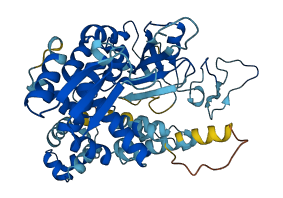
Descriptions
The autoinhibited protein was predicted that may have potential autoinhibitory elements via cis-regPred.
Autoinhibitory domains (AIDs)
Target domain |
|
Relief mechanism |
|
Assay |
cis-regPred |
Accessory elements
No accessory elements
Autoinhibited structure

Activated structure
1 structures for P9WMI1
| Entry ID | Method | Resolution | Chain | Position | Source |
|---|---|---|---|---|---|
| AF-P9WMI1-F1 | Predicted | AlphaFoldDB |
No variants for P9WMI1
| Variant ID(s) | Position | Change | Description | Diseaes Association | Provenance |
|---|---|---|---|---|---|
| No variants for P9WMI1 | |||||
No associated diseases with P9WMI1
1 GO annotations of cellular component
| Name | Definition |
|---|---|
| plasma membrane | The membrane surrounding a cell that separates the cell from its external environment. It consists of a phospholipid bilayer and associated proteins. |
2 GO annotations of molecular function
| Name | Definition |
|---|---|
| DNA binding | Any molecular function by which a gene product interacts selectively and non-covalently with DNA (deoxyribonucleic acid). |
| DNA-binding transcription factor activity | A transcription regulator activity that modulates transcription of gene sets via selective and non-covalent binding to a specific double-stranded genomic DNA sequence (sometimes referred to as a motif) within a cis-regulatory region. Regulatory regions include promoters (proximal and distal) and enhancers. Genes are transcriptional units, and include bacterial operons. |
2 GO annotations of biological process
| Name | Definition |
|---|---|
| regulation of DNA-templated transcription | Any process that modulates the frequency, rate or extent of cellular DNA-templated transcription. |
| response to hypoxia | Any process that results in a change in state or activity of a cell or an organism (in terms of movement, secretion, enzyme production, gene expression, etc.) as a result of a stimulus indicating lowered oxygen tension. Hypoxia, defined as a decline in O2 levels below normoxic levels of 20.8 - 20.95%, results in metabolic adaptation at both the cellular and organismal level. |
No homologous proteins in AiPD
| UniProt AC | Gene Name | Protein Name | Species | Evidence Code |
|---|---|---|---|---|
| No homologous proteins | ||||
| 10 | 20 | 30 | 40 | 50 | 60 |
| MSKTYVGSRV | RQLRNERGFS | QAALAQMLEI | SPSYLNQIEH | DVRPLTVAVL | LRITEVFGVD |
| 70 | 80 | 90 | 100 | 110 | 120 |
| ATFFASQDDT | RLVAELREVT | LDRDLDIAID | PHEVAEMVSA | HPGLACAVVN | LHRRYRITTA |
| 130 | 140 | 150 | 160 | 170 | 180 |
| QLAAATEERF | SDGSGRGSIT | MPHEEVRDYF | YQRQNYLHAL | DTAAEDLTAQ | MRMHHGDLAR |
| 190 | 200 | 210 | 220 | 230 | 240 |
| ELTRRLTEVH | GVRINKRIDL | GDTVLHRYDP | ATNTLEISSH | LSPGQQVFKM | AAELAYLEFG |
| 250 | 260 | 270 | 280 | 290 | 300 |
| DLIDAMVTDG | KFTSAESRTL | ARLGLANYFA | AATVLPYRQF | HDVAENFRYD | VERLSAFYSV |
| 310 | 320 | 330 | 340 | 350 | 360 |
| SYETIAHRLS | TLQRPSMRGV | PFTFVRVDRA | GNMSKRQSAT | GFHFSSSGGT | CPLWNVYETF |
| 370 | 380 | 390 | 400 | 410 | 420 |
| ANPGKILVQI | AQMPDGRNYL | WVARTVELRA | ARYGQPGKTF | AIGLGCELRH | AHRLVYSEGL |
| 430 | 440 | 450 | 460 | 470 | |
| DLSGDPNTAA | TPIGAGCRVC | ERDNCPQRAF | PALGRALDLD | EHRSTVSPYL | VKQL |