P9WJ93
Gene name |
hmp (kshB, Rv3571) |
Protein name |
3-ketosteroid-9-alpha-monooxygenase, ferredoxin reductase component |
Names |
3-ketosteroid-9-alpha-hydroxylase, ferredoxin reductase component, KSH, Androsta-1,4-diene-3,17-dione 9-alpha-hydroxylase, Rieske-type oxygenase, RO |
Species |
Mycobacterium tuberculosis (strain ATCC 25618 / H37Rv) |
KEGG Pathway |
mtu:Rv3571 |
EC number |
1.14.15.30: With reduced iron-sulfur protein as one donor, and incorporation of one atom of oxygen |
Protein Class |
|
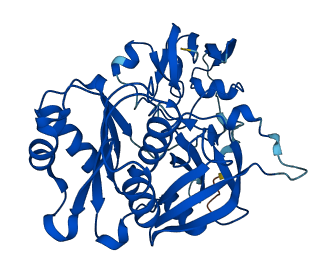
Descriptions
The autoinhibited protein was predicted that may have potential autoinhibitory elements via cis-regPred.
Autoinhibitory domains (AIDs)
Target domain |
|
Relief mechanism |
|
Assay |
cis-regPred |
Accessory elements
No accessory elements
Autoinhibited structure

Activated structure
1 structures for P9WJ93
| Entry ID | Method | Resolution | Chain | Position | Source |
|---|---|---|---|---|---|
| AF-P9WJ93-F1 | Predicted | AlphaFoldDB |
No variants for P9WJ93
| Variant ID(s) | Position | Change | Description | Diseaes Association | Provenance |
|---|---|---|---|---|---|
| No variants for P9WJ93 | |||||
No associated diseases with P9WJ93
9 regional properties for P9WJ93
| Type | Name | Position | InterPro Accession |
|---|---|---|---|
| domain | 2Fe-2S ferredoxin-type iron-sulfur binding domain | 269 - 358 | IPR001041 |
| domain | Oxidoreductase FAD/NAD(P)-binding | 132 - 229 | IPR001433 |
| domain | Flavoprotein pyridine nucleotide cytochrome reductase | 72 - 79 | IPR001709-1 |
| domain | Flavoprotein pyridine nucleotide cytochrome reductase | 131 - 150 | IPR001709-2 |
| domain | Flavoprotein pyridine nucleotide cytochrome reductase | 155 - 164 | IPR001709-3 |
| domain | Flavoprotein pyridine nucleotide cytochrome reductase | 215 - 223 | IPR001709-4 |
| binding_site | 2Fe-2S ferredoxin, iron-sulphur binding site | 305 - 313 | IPR006058 |
| domain | Flavoprotein pyridine nucleotide cytochrome reductase-like, FAD-binding domain | 48 - 121 | IPR008333 |
| domain | FAD-binding domain, ferredoxin reductase-type | 12 - 124 | IPR017927 |
Functions
| Description | ||
|---|---|---|
| EC Number | 1.14.15.30 | With reduced iron-sulfur protein as one donor, and incorporation of one atom of oxygen |
| Subcellular Localization |
|
|
| PANTHER Family | ||
| PANTHER Subfamily | ||
| PANTHER Protein Class | ||
| PANTHER Pathway Category | No pathway information available | |
No GO annotations of cellular component
| Name | Definition |
|---|---|
| No GO annotations for cellular component |
5 GO annotations of molecular function
| Name | Definition |
|---|---|
| 2 iron, 2 sulfur cluster binding | Binding to a 2 iron, 2 sulfur (2Fe-2S) cluster; this cluster consists of two iron atoms, with two inorganic sulfur atoms found between the irons and acting as bridging ligands. |
| 3-ketosteroid 9-alpha-monooxygenase activity | Catalysis of the reaction: androsta-1,4-diene-3,17-dione + NADH + H+ + O2 = 9alpha-hydroxyandrosta-1,4-diene-3,17-dione + NAD+ + H2O. |
| FAD binding | Binding to the oxidized form, FAD, of flavin-adenine dinucleotide, the coenzyme or the prosthetic group of various flavoprotein oxidoreductase enzymes. |
| ketosteroid monooxygenase activity | Catalysis of the reaction: O2 + NADPH + progesterone = H2O + NADP+ + testosterone acetate. |
| metal ion binding | Binding to a metal ion. |
5 GO annotations of biological process
| Name | Definition |
|---|---|
| cholesterol catabolic process | The chemical reactions and pathways resulting in the breakdown of cholesterol, cholest-5-en-3 beta-ol, the principal sterol of vertebrates and the precursor of many steroids, including bile acids and steroid hormones. |
| cholesterol metabolic process | The chemical reactions and pathways involving cholesterol, cholest-5-en-3 beta-ol, the principal sterol of vertebrates and the precursor of many steroids, including bile acids and steroid hormones. It is a component of the plasma membrane lipid bilayer and of plasma lipoproteins and can be found in all animal tissues. |
| response to hypoxia | Any process that results in a change in state or activity of a cell or an organism (in terms of movement, secretion, enzyme production, gene expression, etc.) as a result of a stimulus indicating lowered oxygen tension. Hypoxia, defined as a decline in O2 levels below normoxic levels of 20.8 - 20.95%, results in metabolic adaptation at both the cellular and organismal level. |
| response to nitrosative stress | Any process that results in a change in state or activity of a cell or an organism (in terms of movement, secretion, enzyme production, gene expression, etc.) as a result of a nitrosative stress stimulus. Nitrosative stress is a state often resulting from exposure to high levels of nitric oxide (NO) or the highly reactive oxidant peroxynitrite, which is produced following interaction of NO with superoxide anions. |
| steroid biosynthetic process | The chemical reactions and pathways resulting in the formation of steroids, compounds with a 1,2,cyclopentanoperhydrophenanthrene nucleus; includes de novo formation and steroid interconversion by modification. |
No homologous proteins in AiPD
| UniProt AC | Gene Name | Protein Name | Species | Evidence Code |
|---|---|---|---|---|
| No homologous proteins | ||||
| 10 | 20 | 30 | 40 | 50 | 60 |
| MTEAIGDEPL | GDHVLELQIA | EVVDETDEAR | SLVFAVPDGS | DDPEIPPRRL | RYAPGQFLTL |
| 70 | 80 | 90 | 100 | 110 | 120 |
| RVPSERTGSV | ARCYSLCSSP | YTDDALAVTV | KRTADGYASN | WLCDHAQVGM | RIHVLAPSGN |
| 130 | 140 | 150 | 160 | 170 | 180 |
| FVPTTLDADF | LLLAAGSGIT | PIMSICKSAL | AEGGGQVTLL | YANRDDRSVI | FGDALRELAA |
| 190 | 200 | 210 | 220 | 230 | 240 |
| KYPDRLTVLH | WLESLQGLPS | ASALAKLVAP | YTDRPVFICG | PGPFMQAARD | ALAALKVPAQ |
| 250 | 260 | 270 | 280 | 290 | 300 |
| QVHIEVFKSL | ESDPFAAVKV | DDSGDEAPAT | AVVELDGQTH | TVSWPRTAKL | LDVLLAAGLD |
| 310 | 320 | 330 | 340 | 350 | |
| APFSCREGHC | GACACTLRAG | KVNMGVNDVL | EQQDLDEGLI | LACQSRPESD | SVEVTYDE |