P9WHR3
Gene name |
hip1 |
Protein name |
Serine protease Hip1 |
Names |
Hydrolase important for pathogenesis 1, Serine hydrolase Hip1 |
Species |
Mycobacterium tuberculosis (strain ATCC 25618 / H37Rv) |
KEGG Pathway |
mtu:Rv2224c |
EC number |
|
Protein Class |
|
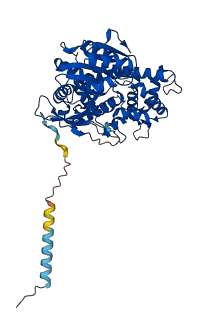
Descriptions
The autoinhibited protein was predicted that may have potential autoinhibitory elements via cis-regPred.
Autoinhibitory domains (AIDs)
Target domain |
|
Relief mechanism |
|
Assay |
cis-regPred |
Accessory elements
No accessory elements
Autoinhibited structure

Activated structure
No variants for P9WHR3
| Variant ID(s) | Position | Change | Description | Diseaes Association | Provenance |
|---|---|---|---|---|---|
| No variants for P9WHR3 | |||||
No associated diseases with P9WHR3
4 GO annotations of cellular component
| Name | Definition |
|---|---|
| cytosol | The part of the cytoplasm that does not contain organelles but which does contain other particulate matter, such as protein complexes. |
| envelope | A multilayered structure surrounding all or part of a cell; encompasses one or more lipid bilayers, and may include a cell wall layer; also includes the space between layers. |
| extracellular region | The space external to the outermost structure of a cell. For cells without external protective or external encapsulating structures this refers to space outside of the plasma membrane. This term covers the host cell environment outside an intracellular parasite. |
| plasma membrane | The membrane surrounding a cell that separates the cell from its external environment. It consists of a phospholipid bilayer and associated proteins. |
1 GO annotations of molecular function
| Name | Definition |
|---|---|
| carboxylic ester hydrolase activity | Catalysis of the hydrolysis of a carboxylic ester bond. |
2 GO annotations of biological process
| Name | Definition |
|---|---|
| post-translational protein modification | The process of covalently altering one or more amino acids in a protein after the protein has been completely translated and released from the ribosome. |
| response to host immune response | Any process that results in a change in state or activity of a cell or an organism (in terms of movement, secretion, enzyme production, gene expression, etc.) as a result of detecting the immune response of the host organism. The host is defined as the larger of the organisms involved in a symbiotic interaction. |
No homologous proteins in AiPD
| UniProt AC | Gene Name | Protein Name | Species | Evidence Code |
|---|---|---|---|---|
| No homologous proteins | ||||
| 10 | 20 | 30 | 40 | 50 | 60 |
| MGMRLSRRDK | IARMLLIWAA | LAAVALVLVG | CIRVVGGRAR | MAEPKLGQPV | EWTPCRSSNP |
| 70 | 80 | 90 | 100 | 110 | 120 |
| QVKIPGGALC | GKLAVPVDYD | RPDGDVAALA | LIRFPATGDK | IGSLVINPGG | PGESGIEAAL |
| 130 | 140 | 150 | 160 | 170 | 180 |
| GVFQTLPKRV | HERFDLVGFD | PRGVASSRPA | IWCNSDADND | RLRAEPQVDY | SREGVAHIEN |
| 190 | 200 | 210 | 220 | 230 | 240 |
| ETKQFVGRCV | DKMGKNFLAH | VGTVNVAKDL | DAIRAALGDD | KLTYLGYSYG | TRIGSAYAEE |
| 250 | 260 | 270 | 280 | 290 | 300 |
| FPQRVRAMIL | DGAVDPNADP | IEAELRQAKG | FQDAFNNYAA | DCAKNAGCPL | GADPAKAVEV |
| 310 | 320 | 330 | 340 | 350 | 360 |
| YHSLVDPLVD | PDNPRISRPA | RTKDPRGLSY | SDAIVGTIMA | LYSPNLWQHL | TDGLSELVDN |
| 370 | 380 | 390 | 400 | 410 | 420 |
| RGDTLLALAD | MYMRRDSHGR | YNNSGDARVA | INCVDQPPVT | DRDKVIDEDR | RAREIAPFMS |
| 430 | 440 | 450 | 460 | 470 | 480 |
| YGKFTGDAPL | GTCAFWPVPP | TSQPHAVSAP | GLVPTVVVST | THDPATPYKA | GVDLANQLRG |
| 490 | 500 | 510 | |||
| SLLTFDGTQH | TVVFQGDSCI | DEYVTAYLIG | GTTPPSGAKC |