P9WGM7
Gene name |
mtrA (Rv3246c, MTCY20B11.21c) |
Protein name |
DNA-binding response regulator MtrA |
Names |
|
Species |
Mycobacterium tuberculosis (strain ATCC 25618 / H37Rv) |
KEGG Pathway |
mtu:Rv3246c |
EC number |
|
Protein Class |
|
Descriptions
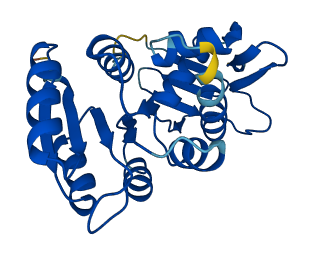
The autoinhibited protein was predicted that may have potential autoinhibitory elements via cis-regPred.
Autoinhibitory domains (AIDs)
Target domain |
|
Relief mechanism |
|
Assay |
cis-regPred |
Accessory elements
No accessory elements
Autoinhibited structure

Activated structure
3 structures for P9WGM7
| Entry ID | Method | Resolution | Chain | Position | Source |
|---|---|---|---|---|---|
| 2GWR | X-ray | 210 A | A | 1-228 | PDB |
| 3NHZ | X-ray | 250 A | A/B/C/D | 1-125 | PDB |
| AF-P9WGM7-F1 | Predicted | AlphaFoldDB |
No variants for P9WGM7
| Variant ID(s) | Position | Change | Description | Diseaes Association | Provenance |
|---|---|---|---|---|---|
| No variants for P9WGM7 | |||||
No associated diseases with P9WGM7
3 GO annotations of cellular component
| Name | Definition |
|---|---|
| cytosol | The part of the cytoplasm that does not contain organelles but which does contain other particulate matter, such as protein complexes. |
| plasma membrane | The membrane surrounding a cell that separates the cell from its external environment. It consists of a phospholipid bilayer and associated proteins. |
| protein-DNA complex | A macromolecular complex containing both protein and DNA molecules. |
4 GO annotations of molecular function
| Name | Definition |
|---|---|
| DNA-binding transcription activator activity | A DNA-binding transcription factor activity that activates or increases transcription of specific gene sets. |
| metal ion binding | Binding to a metal ion. |
| phosphorelay response regulator activity | Responds to a phosphorelay sensor to initiate a change in cell state or activity. The activity of the response regulator is regulated by transfer of a phosphate from a histidine residue in the sensor, to an aspartate residue in the response regulator. Many but not all response regulators act as transcriptional regulators to elicit a response. |
| transcription cis-regulatory region binding | Binding to a specific sequence of DNA that is part of a regulatory region that controls transcription of that section of the DNA. The transcribed region might be described as a gene, cistron, or operon. |
3 GO annotations of biological process
| Name | Definition |
|---|---|
| biological process involved in interaction with host | An interaction between two organisms living together in more or less intimate association. The term host is used for the larger (macro) of the two members of a symbiosis; the various forms of symbiosis include parasitism, commensalism and mutualism. |
| positive regulation of DNA-templated transcription | Any process that activates or increases the frequency, rate or extent of cellular DNA-templated transcription. |
| protein phosphorylation | The process of introducing a phosphate group on to a protein. |
No homologous proteins in AiPD
| UniProt AC | Gene Name | Protein Name | Species | Evidence Code |
|---|---|---|---|---|
| No homologous proteins | ||||
| 10 | 20 | 30 | 40 | 50 | 60 |
| MDTMRQRILV | VDDDASLAEM | LTIVLRGEGF | DTAVIGDGTQ | ALTAVRELRP | DLVLLDLMLP |
| 70 | 80 | 90 | 100 | 110 | 120 |
| GMNGIDVCRV | LRADSGVPIV | MLTAKTDTVD | VVLGLESGAD | DYIMKPFKPK | ELVARVRARL |
| 130 | 140 | 150 | 160 | 170 | 180 |
| RRNDDEPAEM | LSIADVEIDV | PAHKVTRNGE | QISLTPLEFD | LLVALARKPR | QVFTRDVLLE |
| 190 | 200 | 210 | 220 | ||
| QVWGYRHPAD | TRLVNVHVQR | LRAKVEKDPE | NPTVVLTVRG | VGYKAGPP |