P9WG55
Gene name |
tig (Rv2462c, MTV008.18c) |
Protein name |
Trigger factor |
Names |
TF, PPIase |
Species |
Mycobacterium tuberculosis (strain ATCC 25618 / H37Rv) |
KEGG Pathway |
mtu:Rv2462c |
EC number |
5.2.1.8: Cis-trans isomerases |
Protein Class |
|
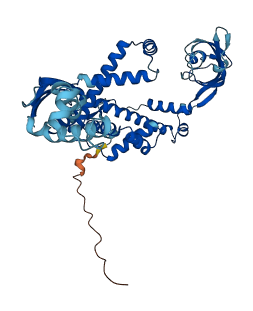
Descriptions
The autoinhibited protein was predicted that may have potential autoinhibitory elements via cis-regPred.
Autoinhibitory domains (AIDs)
Target domain |
|
Relief mechanism |
|
Assay |
cis-regPred |
Accessory elements
No accessory elements
Autoinhibited structure

Activated structure
1 structures for P9WG55
| Entry ID | Method | Resolution | Chain | Position | Source |
|---|---|---|---|---|---|
| AF-P9WG55-F1 | Predicted | AlphaFoldDB |
No variants for P9WG55
| Variant ID(s) | Position | Change | Description | Diseaes Association | Provenance |
|---|---|---|---|---|---|
| No variants for P9WG55 | |||||
No associated diseases with P9WG55
Functions
| Description | ||
|---|---|---|
| EC Number | 5.2.1.8 | Cis-trans isomerases |
| Subcellular Localization |
|
|
| PANTHER Family | ||
| PANTHER Subfamily | ||
| PANTHER Protein Class | ||
| PANTHER Pathway Category | No pathway information available | |
3 GO annotations of cellular component
| Name | Definition |
|---|---|
| cytosol | The part of the cytoplasm that does not contain organelles but which does contain other particulate matter, such as protein complexes. |
| peptidoglycan-based cell wall | A protective structure outside the cytoplasmic membrane composed of peptidoglycan (also known as murein), a molecule made up of a glycan (sugar) backbone of repetitively alternating N-acetylglucosamine and N-acetylmuramic acid with short, attached, cross-linked peptide chains containing unusual amino acids. An example of this component is found in Escherichia coli. |
| plasma membrane | The membrane surrounding a cell that separates the cell from its external environment. It consists of a phospholipid bilayer and associated proteins. |
3 GO annotations of molecular function
| Name | Definition |
|---|---|
| peptidyl-prolyl cis-trans isomerase activity | Catalysis of the reaction: peptidyl-proline (omega=180) = peptidyl-proline (omega=0). |
| protein folding chaperone | Binding to a protein or a protein-containing complex to assist the protein folding process. |
| ribosome binding | Binding to a ribosome. |
8 GO annotations of biological process
| Name | Definition |
|---|---|
| 'de novo' cotranslational protein folding | The process of assisting in the correct noncovalent assembly of the ribosome-bound nascent chains of a multidomain protein whilst other parts of the protein are still being translated. |
| cell cycle | The progression of biochemical and morphological phases and events that occur in a cell during successive cell replication or nuclear replication events. Canonically, the cell cycle comprises the replication and segregation of genetic material followed by the division of the cell, but in endocycles or syncytial cells nuclear replication or nuclear division may not be followed by cell division. |
| cell division | The process resulting in division and partitioning of components of a cell to form more cells; may or may not be accompanied by the physical separation of a cell into distinct, individually membrane-bounded daughter cells. |
| cellular response to starvation | Any process that results in a change in state or activity of a cell (in terms of movement, secretion, enzyme production, gene expression, etc.) as a result of deprivation of nourishment. |
| chaperone-mediated protein folding | The process of inhibiting aggregation and assisting in the covalent and noncovalent assembly of single chain polypeptides or multisubunit complexes into the correct tertiary structure that is dependent on interaction with a chaperone. |
| protein transport | The directed movement of proteins into, out of or within a cell, or between cells, by means of some agent such as a transporter or pore. |
| protein unfolding | The process of assisting in the disassembly of non-covalent linkages in a protein or protein aggregate, often where the proteins are in a non-functional or denatured state. |
| response to antibiotic | Any process that results in a change in state or activity of a cell or an organism (in terms of movement, secretion, enzyme production, gene expression, etc.) as a result of an antibiotic stimulus. An antibiotic is a chemical substance produced by a microorganism which has the capacity to inhibit the growth of or to kill other microorganisms. |
No homologous proteins in AiPD
| UniProt AC | Gene Name | Protein Name | Species | Evidence Code |
|---|---|---|---|---|
| No homologous proteins | ||||
| 10 | 20 | 30 | 40 | 50 | 60 |
| MKSTVEQLSP | TRVRINVEVP | FAELEPDFQR | AYKELAKQVR | LPGFRPGKAP | AKLLEARIGR |
| 70 | 80 | 90 | 100 | 110 | 120 |
| EAMLDQIVND | ALPSRYGQAV | AESDVQPLGR | PNIEVTKKEY | GQDLQFTAEV | DIRPKISPPD |
| 130 | 140 | 150 | 160 | 170 | 180 |
| LSALTVSVDP | IEIGEDDVDA | ELQSLRTRFG | TLTAVDRPVA | VGDVVSIDLS | ATVDGEDIPN |
| 190 | 200 | 210 | 220 | 230 | 240 |
| AAAEGLSHEV | GSGRLIAGLD | DAVVGLSADE | SRVFTAKLAA | GEHAGQEAQV | TVTVRSVKER |
| 250 | 260 | 270 | 280 | 290 | 300 |
| ELPEPDDEFA | QLASEFDSID | ELRASLSDQV | RQAKRAQQAE | QIRNATIDAL | LEQVDVPLPE |
| 310 | 320 | 330 | 340 | 350 | 360 |
| SYVQAQFDSV | LHSALSGLNH | DEARFNELLV | EQGSSRAAFD | AEARTASEKD | VKRQLLLDAL |
| 370 | 380 | 390 | 400 | 410 | 420 |
| ADELQVQVGQ | DDLTERLVTT | SRQYGIEPQQ | LFGYLQERNQ | LPTMFADVRR | ELAIRAAVEA |
| 430 | 440 | 450 | 460 | ||
| ATVTDSDGNT | IDTSEFFGKR | VSAGEAEEAE | PADEGAARAA | SDEATT |