P97931
Gene name |
Ung (Ung1) |
Protein name |
Uracil-DNA glycosylase |
Names |
UDG |
Species |
Mus musculus (Mouse) |
KEGG Pathway |
mmu:22256 |
EC number |
3.2.2.27: Hydrolyzing N-glycosyl compounds |
Protein Class |
|
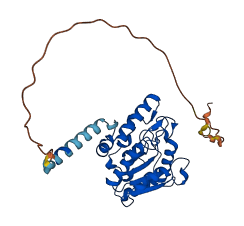
Descriptions
The autoinhibited protein was predicted that may have potential autoinhibitory elements via cis-regPred.
Autoinhibitory domains (AIDs)
Target domain |
|
Relief mechanism |
|
Assay |
cis-regPred |
Accessory elements
No accessory elements
Autoinhibited structure

Activated structure
1 structures for P97931
| Entry ID | Method | Resolution | Chain | Position | Source |
|---|---|---|---|---|---|
| AF-P97931-F1 | Predicted | AlphaFoldDB |
11 variants for P97931
| Variant ID(s) | Position | Change | Description | Diseaes Association | Provenance |
|---|---|---|---|---|---|
| rs3388775219 | 23 | S>N | No | EVA | |
| rs3388778727 | 83 | V>M | No | EVA | |
| rs248854425 | 126 | Q>E | No | EVA | |
| rs3388782620 | 143 | I>F | No | EVA | |
| rs48533177 | 177 | K>Q | No | EVA | |
| rs3412562555 | 193 | D>V | No | EVA | |
| rs3388788706 | 205 | L>I | No | EVA | |
| rs3388785786 | 220 | K>M | No | EVA | |
| rs3388779706 | 237 | Q>R | No | EVA | |
| rs47284990 | 277 | H>Y | No | EVA | |
| rs3388782630 | 288 | K>E | No | EVA |
No associated diseases with P97931
Functions
| Description | ||
|---|---|---|
| EC Number | 3.2.2.27 | Hydrolyzing N-glycosyl compounds |
| Subcellular Localization |
|
|
| PANTHER Family | ||
| PANTHER Subfamily | ||
| PANTHER Protein Class | ||
| PANTHER Pathway Category | No pathway information available | |
3 GO annotations of cellular component
| Name | Definition |
|---|---|
| mitochondrion | A semiautonomous, self replicating organelle that occurs in varying numbers, shapes, and sizes in the cytoplasm of virtually all eukaryotic cells. It is notably the site of tissue respiration. |
| nucleoplasm | That part of the nuclear content other than the chromosomes or the nucleolus. |
| nucleus | A membrane-bounded organelle of eukaryotic cells in which chromosomes are housed and replicated. In most cells, the nucleus contains all of the cell's chromosomes except the organellar chromosomes, and is the site of RNA synthesis and processing. In some species, or in specialized cell types, RNA metabolism or DNA replication may be absent. |
3 GO annotations of molecular function
| Name | Definition |
|---|---|
| damaged DNA binding | Binding to damaged DNA. |
| ribosomal small subunit binding | Binding to a small ribosomal subunit. |
| uracil DNA N-glycosylase activity | Catalysis of the cleavage of the N-C1' glycosidic bond between the damaged DNA base and the deoxyribose sugar, releasing a free base and leaving an apyrimidinic (AP) site. Enzymes with this activity recognize and remove uracil bases in DNA that result from the deamination of cytosine or the misincorporation of dUTP opposite an adenine. |
7 GO annotations of biological process
| Name | Definition |
|---|---|
| base-excision repair | In base excision repair, an altered base is removed by a DNA glycosylase enzyme, followed by excision of the resulting sugar phosphate. The small gap left in the DNA helix is filled in by the sequential action of DNA polymerase and DNA ligase. |
| base-excision repair, AP site formation via deaminated base removal | A base-excision repair, AP site formation process occurring via excision of a deaminated base. |
| DNA repair | The process of restoring DNA after damage. Genomes are subject to damage by chemical and physical agents in the environment (e.g. UV and ionizing radiations, chemical mutagens, fungal and bacterial toxins, etc.) and by free radicals or alkylating agents endogenously generated in metabolism. DNA is also damaged because of errors during its replication. A variety of different DNA repair pathways have been reported that include direct reversal, base excision repair, nucleotide excision repair, photoreactivation, bypass, double-strand break repair pathway, and mismatch repair pathway. |
| isotype switching | The switching of activated B cells from IgM biosynthesis to biosynthesis of other isotypes of immunoglobulin, accomplished through a recombination process involving an intrachromosomal deletion involving switch regions that reside 5' of each constant region gene segment in the immunoglobulin heavy chain locus. |
| negative regulation of apoptotic process | Any process that stops, prevents, or reduces the frequency, rate or extent of cell death by apoptotic process. |
| somatic hypermutation of immunoglobulin genes | Mutations occurring somatically that result in amino acid changes in the rearranged V regions of immunoglobulins. |
| somatic recombination of immunoglobulin gene segments | The process in which immunoglobulin genes are formed through recombination of the germline genetic elements, as known as immunoglobulin gene segments, within a single locus. |
1 homologous proteins in AiPD
| UniProt AC | Gene Name | Protein Name | Species | Evidence Code |
|---|---|---|---|---|
| P13051 | UNG | Uracil-DNA glycosylase | Homo sapiens (Human) | PR |
| 10 | 20 | 30 | 40 | 50 | 60 |
| MIGQKTLYSF | FSPTPTGKRT | TRSPEPVPGS | GVAAEIGGDA | VASPAKKARV | EQNEQGSPLS |
| 70 | 80 | 90 | 100 | 110 | 120 |
| AEQLVRIQRN | KAAALLRLAA | RNVPAGFGES | WKQQLCGEFG | KPYFVKLMGF | VAEERNHHKV |
| 130 | 140 | 150 | 160 | 170 | 180 |
| YPPPEQVFTW | TQMCDIRDVK | VVILGQDPYH | GPNQAHGLCF | SVQRPVPPPP | SLENIFKELS |
| 190 | 200 | 210 | 220 | 230 | 240 |
| TDIDGFVHPG | HGDLSGWARQ | GVLLLNAVLT | VRAHQANSHK | ERGWEQFTDA | VVSWLNQNLS |
| 250 | 260 | 270 | 280 | 290 | 300 |
| GLVFLLWGSY | AQKKGSVIDR | KRHHVLQTAH | PSPLSVHRGF | LGCRHFSKAN | ELLQKSGKKP |
| INWKEL |