P97792
Gene name |
Cxadr (Car) |
Protein name |
Coxsackievirus and adenovirus receptor homolog |
Names |
CAR, mCAR |
Species |
Mus musculus (Mouse) |
KEGG Pathway |
mmu:13052 |
EC number |
|
Protein Class |
|
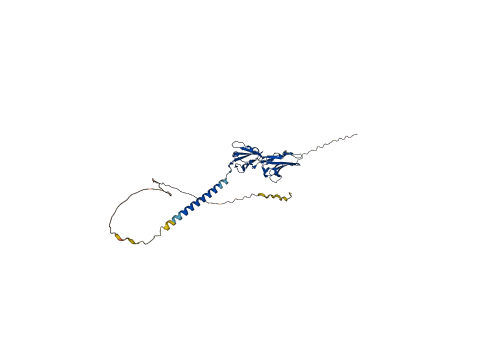
Descriptions
The autoinhibited protein was predicted that may have potential autoinhibitory elements via cis-regPred.
Autoinhibitory domains (AIDs)
Target domain |
|
Relief mechanism |
|
Assay |
cis-regPred |
Accessory elements
No accessory elements
Autoinhibited structure

Activated structure
3 structures for P97792
| Entry ID | Method | Resolution | Chain | Position | Source |
|---|---|---|---|---|---|
| 3JZ7 | X-ray | 219 A | A | 20-233 | PDB |
| 3MJ7 | X-ray | 280 A | B | 18-236 | PDB |
| AF-P97792-F1 | Predicted | AlphaFoldDB |
13 variants for P97792
| Variant ID(s) | Position | Change | Description | Diseaes Association | Provenance |
|---|---|---|---|---|---|
| rs238165832 | 13 | I>M | No | EVA | |
| rs3389415895 | 18 | S>N | No | EVA | |
| rs250717794 | 19 | G>S | No | EVA | |
| rs3389415915 | 39 | L>I | No | EVA | |
| rs3389336861 | 72 | I>N | No | EVA | |
| rs3406270989 | 75 | S>P | No | EVA | |
| rs3389421890 | 81 | D>E | No | EVA | |
| rs3389417344 | 82 | N>D | No | EVA | |
| rs3389439422 | 83 | Y>H | No | EVA | |
| rs3389413786 | 126 | P>S | No | EVA | |
| rs3389430166 | 158 | F>L | No | EVA | |
| rs3389417426 | 187 | P>S | No | EVA | |
| rs3389336870 | 235 | R>Q | No | EVA |
No associated diseases with P97792
8 regional properties for P97792
| Type | Name | Position | InterPro Accession |
|---|---|---|---|
| domain | Immunoglobulin subtype 2 | 32 - 127 | IPR003598-1 |
| domain | Immunoglobulin subtype 2 | 153 - 219 | IPR003598-2 |
| domain | Immunoglobulin subtype | 26 - 138 | IPR003599-1 |
| domain | Immunoglobulin subtype | 147 - 230 | IPR003599-2 |
| domain | Immunoglobulin-like domain | 18 - 136 | IPR007110-1 |
| domain | Immunoglobulin-like domain | 141 - 216 | IPR007110-2 |
| domain | Immunoglobulin V-set domain | 25 - 138 | IPR013106 |
| domain | Immunoglobulin | 154 - 222 | IPR013151 |
Functions
21 GO annotations of cellular component
| Name | Definition |
|---|---|
| acrosomal vesicle | A structure in the head of a spermatozoon that contains acid hydrolases, and is concerned with the breakdown of the outer membrane of the ovum during fertilization. It lies just beneath the plasma membrane and is derived from the lysosome. |
| adherens junction | A cell-cell junction composed of the epithelial cadherin-catenin complex. The epithelial cadherins, or E-cadherins, of each interacting cell extend through the plasma membrane into the extracellular space and bind to each other. The E-cadherins bind to catenins on the cytoplasmic side of the membrane, where the E-cadherin-catenin complex binds to cytoskeletal components and regulatory and signaling molecules. |
| apicolateral plasma membrane | The apical end of the lateral plasma membrane of epithelial cells. |
| basolateral plasma membrane | The region of the plasma membrane that includes the basal end and sides of the cell. Often used in reference to animal polarized epithelial membranes, where the basal membrane is the part attached to the extracellular matrix, or in plant cells, where the basal membrane is defined with respect to the zygotic axis. |
| bicellular tight junction | An occluding cell-cell junction that is composed of a branching network of sealing strands that completely encircles the apical end of each cell in an epithelial sheet; the outer leaflets of the two interacting plasma membranes are seen to be tightly apposed where sealing strands are present. Each sealing strand is composed of a long row of transmembrane adhesion proteins embedded in each of the two interacting plasma membranes. |
| cell body | The portion of a cell bearing surface projections such as axons, dendrites, cilia, or flagella that includes the nucleus, but excludes all cell projections. |
| cell junction | A cellular component that forms a specialized region of connection between two or more cells, or between a cell and the extracellular matrix, or between two membrane-bound components of a cell, such as flagella. |
| cell-cell junction | A cell junction that forms a connection between two or more cells of an organism; excludes direct cytoplasmic intercellular bridges, such as ring canals in insects. |
| cytoplasm | The contents of a cell excluding the plasma membrane and nucleus, but including other subcellular structures. |
| extracellular space | That part of a multicellular organism outside the cells proper, usually taken to be outside the plasma membranes, and occupied by fluid. |
| filopodium | Thin, stiff, actin-based protrusion extended by the leading edge of a motile cell such as a crawling fibroblast or amoeba, or an axonal or dendritic growth cone, or a dendritic shaft. |
| growth cone | The migrating motile tip of a growing neuron projection, where actin accumulates, and the actin cytoskeleton is the most dynamic. |
| integral component of membrane | The component of a membrane consisting of the gene products and protein complexes having at least some part of their peptide sequence embedded in the hydrophobic region of the membrane. |
| intercalated disc | A complex cell-cell junction at which myofibrils terminate in cardiomyocytes; mediates mechanical and electrochemical integration between individual cardiomyocytes. The intercalated disc contains regions of tight mechanical attachment (fasciae adherentes and desmosomes) and electrical coupling (gap junctions) between adjacent cells. |
| membrane raft | Any of the small (10-200 nm), heterogeneous, highly dynamic, sterol- and sphingolipid-enriched membrane domains that compartmentalize cellular processes. Small rafts can sometimes be stabilized to form larger platforms through protein-protein and protein-lipid interactions. |
| neuromuscular junction | The junction between the axon of a motor neuron and a muscle fiber. In response to the arrival of action potentials, the presynaptic button releases molecules of neurotransmitters into the synaptic cleft. These diffuse across the cleft and transmit the signal to the postsynaptic membrane of the muscle fiber, leading to a change in post-synaptic potential. |
| neuron projection | A prolongation or process extending from a nerve cell, e.g. an axon or dendrite. |
| nucleoplasm | That part of the nuclear content other than the chromosomes or the nucleolus. |
| nucleus | A membrane-bounded organelle of eukaryotic cells in which chromosomes are housed and replicated. In most cells, the nucleus contains all of the cell's chromosomes except the organellar chromosomes, and is the site of RNA synthesis and processing. In some species, or in specialized cell types, RNA metabolism or DNA replication may be absent. |
| plasma membrane | The membrane surrounding a cell that separates the cell from its external environment. It consists of a phospholipid bilayer and associated proteins. |
| protein-containing complex | A stable assembly of two or more macromolecules, i.e. proteins, nucleic acids, carbohydrates or lipids, in which at least one component is a protein and the constituent parts function together. |
8 GO annotations of molecular function
| Name | Definition |
|---|---|
| beta-catenin binding | Binding to a catenin beta subunit. |
| cell adhesion molecule binding | Binding to a cell adhesion molecule. |
| cell adhesive protein binding involved in AV node cell-bundle of His cell communication | Binding to a protein or protein complex that results in the connection of an AV node cell with a bundle of His cell and contributes to the communication between the two cells. |
| connexin binding | Binding to a connexin, any of a group of related proteins that assemble to form gap junctions. |
| identical protein binding | Binding to an identical protein or proteins. |
| integrin binding | Binding to an integrin. |
| PDZ domain binding | Binding to a PDZ domain of a protein, a domain found in diverse signaling proteins. |
| signaling receptor binding | Binding to one or more specific sites on a receptor molecule, a macromolecule that undergoes combination with a hormone, neurotransmitter, drug or intracellular messenger to initiate a change in cell function. |
20 GO annotations of biological process
| Name | Definition |
|---|---|
| actin cytoskeleton reorganization | A process that is carried out at the cellular level which results in dynamic structural changes to the arrangement of constituent parts of cytoskeletal structures comprising actin filaments and their associated proteins. |
| AV node cell to bundle of His cell communication | The process that mediates interactions between an AV node cell and its surroundings that contributes to the process of the AV node cell communicating with a bundle of His cell in cardiac conduction. Encompasses interactions such as signaling or attachment between one cell and another cell, between a cell and an extracellular matrix, or between a cell and any other aspect of its environment. |
| AV node cell-bundle of His cell adhesion involved in cell communication | The attachment of an AV node cell to an bundle of His cell via adhesion molecules that results in the cells being juxtaposed so that they can communicate. |
| cardiac muscle cell development | The process whose specific outcome is the progression of a cardiac muscle cell over time, from its formation to the mature state. |
| cardiac muscle cell proliferation | The expansion of a cardiac muscle cell population by cell division. |
| cell-cell adhesion | The attachment of one cell to another cell via adhesion molecules. |
| cell-cell junction organization | A process that is carried out at the cellular level which results in the assembly, arrangement of constituent parts, or disassembly of a cell-cell junction. A cell-cell junction is a specialized region of connection between two cells. |
| defense response to virus | Reactions triggered in response to the presence of a virus that act to protect the cell or organism. |
| epithelial structure maintenance | A tissue homeostatic process required for the maintenance of epithelial structure. |
| gamma-delta T cell activation | The change in morphology and behavior of a gamma-delta T cell resulting from exposure to a mitogen, cytokine, chemokine, cellular ligand, or an antigen for which it is specific. |
| germ cell migration | The orderly movement of a cell specialized to produce haploid gametes through the embryo from its site of production to the place where the gonads will form. |
| heart development | The process whose specific outcome is the progression of the heart over time, from its formation to the mature structure. The heart is a hollow, muscular organ, which, by contracting rhythmically, keeps up the circulation of the blood. |
| heterophilic cell-cell adhesion via plasma membrane cell adhesion molecules | The attachment of an adhesion molecule in one cell to a nonidentical adhesion molecule in an adjacent cell. |
| homotypic cell-cell adhesion | The attachment of a cell to a second cell of the identical type via adhesion molecules. |
| mitochondrion organization | A process that is carried out at the cellular level which results in the assembly, arrangement of constituent parts, or disassembly of a mitochondrion; includes mitochondrial morphogenesis and distribution, and replication of the mitochondrial genome as well as synthesis of new mitochondrial components. |
| negative regulation of cardiac muscle cell proliferation | Any process that stops, prevents, or reduces the frequency, rate or extent of cardiac muscle cell proliferation. |
| neutrophil chemotaxis | The directed movement of a neutrophil cell, the most numerous polymorphonuclear leukocyte found in the blood, in response to an external stimulus, usually an infection or wounding. |
| positive regulation of epithelial cell proliferation involved in wound healing | Any process that activates or increases the rate or extent of epithelial cell proliferation, contributing to the restoration of integrity to a damaged tissue following an injury. |
| regulation of AV node cell action potential | Any process that modulates the frequency, rate or extent of action potential creation, propagation or termination in an atrioventricular node myocyte. This typically occurs via modulation of the activity or expression of voltage-gated ion channels. |
| transepithelial transport | The directed movement of a substance from one side of an epithelium to the other. |
No homologous proteins in AiPD
| UniProt AC | Gene Name | Protein Name | Species | Evidence Code |
|---|---|---|---|---|
| No homologous proteins | ||||
| 10 | 20 | 30 | 40 | 50 | 60 |
| MARLLCFVLL | CGIADFTSGL | SITTPEQRIE | KAKGETAYLP | CKFTLSPEDQ | GPLDIEWLIS |
| 70 | 80 | 90 | 100 | 110 | 120 |
| PSDNQIVDQV | IILYSGDKIY | DNYYPDLKGR | VHFTSNDVKS | GDASINVTNL | QLSDIGTYQC |
| 130 | 140 | 150 | 160 | 170 | 180 |
| KVKKAPGVAN | KKFLLTVLVK | PSGTRCFVDG | SEEIGNDFKL | KCEPKEGSLP | LQFEWQKLSD |
| 190 | 200 | 210 | 220 | 230 | 240 |
| SQTMPTPWLA | EMTSPVISVK | NASSEYSGTY | SCTVQNRVGS | DQCMLRLDVV | PPSNRAGTIA |
| 250 | 260 | 270 | 280 | 290 | 300 |
| GAVIGTLLAL | VLIGAILFCC | HRKRREEKYE | KEVHHDIRED | VPPPKSRTST | ARSYIGSNHS |
| 310 | 320 | 330 | 340 | 350 | 360 |
| SLGSMSPSNM | EGYSKTQYNQ | VPSEDFERAP | QSPTLAPAKV | AAPNLSRMGA | VPVMIPAQSK |
| DGSIV |