P97742
Gene name |
Cpt1a (Cpt-1, Cpt1) |
Protein name |
Carnitine O-palmitoyltransferase 1, liver isoform |
Names |
CPT1-L, Carnitine O-palmitoyltransferase I, liver isoform, CPT I, CPTI-L, Carnitine palmitoyltransferase 1A |
Species |
Mus musculus (Mouse) |
KEGG Pathway |
mmu:12894 |
EC number |
2.3.1.21: Transferring groups other than amino-acyl groups |
Protein Class |
|
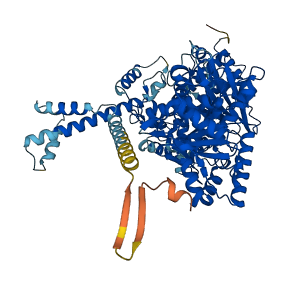
Descriptions
The autoinhibited protein was predicted that may have potential autoinhibitory elements via cis-regPred.
Autoinhibitory domains (AIDs)
Target domain |
|
Relief mechanism |
|
Assay |
cis-regPred |
Accessory elements
No accessory elements
Autoinhibited structure

Activated structure
1 structures for P97742
| Entry ID | Method | Resolution | Chain | Position | Source |
|---|---|---|---|---|---|
| AF-P97742-F1 | Predicted | AlphaFoldDB |
42 variants for P97742
| Variant ID(s) | Position | Change | Description | Diseaes Association | Provenance |
|---|---|---|---|---|---|
| rs3389514196 | 3 | E>D | No | EVA | |
| rs3389509435 | 17 | D>E | No | EVA | |
| rs3406953428 | 34 | S>V* | No | EVA | |
| rs3389514169 | 56 | P>H | No | EVA | |
| rs3408983300 | 57 | A>V | No | EVA | |
| rs3389493644 | 64 | I>F | No | EVA | |
| rs3389513321 | 87 | I>F | No | EVA | |
| rs225716906 | 101 | T>M | No | EVA | |
| rs3389514222 | 102 | K>N | No | EVA | |
| rs3389423312 | 107 | G>R | No | EVA | |
| rs3389506512 | 135 | W>L | No | EVA | |
| rs3389471004 | 143 | M>K | No | EVA | |
| rs387059894 | 145 | R>C | No | EVA | |
| rs3407803663 | 190 | V>E | No | EVA | |
| rs3389423274 | 200 | Q>R | No | EVA | |
| rs3389514208 | 232 | V>L | No | EVA | |
| rs3389513361 | 259 | M>I | No | EVA | |
| rs3389529827 | 261 | Y>C | No | EVA | |
| rs3389514139 | 275 | T>I | No | EVA | |
| rs3389461771 | 304 | C>Y | No | EVA | |
| rs3389524889 | 333 | H>D | No | EVA | |
| rs3389523622 | 340 | G>A | No | EVA | |
| rs3389514399 | 340 | G>C | No | EVA | |
| rs3389479062 | 366 | I>T | No | EVA | |
| rs3389423268 | 423 | S>L | No | EVA | |
| rs222112061 | 429 | E>K | No | EVA | |
| rs3389524945 | 447 | R>K | No | EVA | |
| rs3389506522 | 457 | I>N | No | EVA | |
| rs3389523639 | 461 | V>F | No | EVA | |
| rs3389470997 | 478 | A>T | No | EVA | |
| rs3389518326 | 492 | D>G | No | EVA | |
| rs3389514336 | 506 | G>* | No | EVA | |
| rs3389509427 | 516 | T>S | No | EVA | |
| rs3389523554 | 517 | R>T | No | EVA | |
| rs3389514156 | 520 | W>L | No | EVA | |
| rs3389506465 | 526 | C>* | No | EVA | |
| rs248220120 | 553 | T>A | No | EVA | |
| rs248220120 | 553 | T>S | No | EVA | |
| rs3389524912 | 570 | I>N | No | EVA | |
| rs3389506525 | 625 | T>A | No | EVA | |
| rs3389461711 | 704 | D>E | No | EVA | |
| rs217995711 | 757 | A>S | No | EVA |
No associated diseases with P97742
Functions
| Description | ||
|---|---|---|
| EC Number | 2.3.1.21 | Transferring groups other than amino-acyl groups |
| Subcellular Localization |
|
|
| PANTHER Family | ||
| PANTHER Subfamily | ||
| PANTHER Protein Class | ||
| PANTHER Pathway Category | No pathway information available | |
6 GO annotations of cellular component
| Name | Definition |
|---|---|
| integral component of membrane | The component of a membrane consisting of the gene products and protein complexes having at least some part of their peptide sequence embedded in the hydrophobic region of the membrane. |
| integral component of mitochondrial outer membrane | The component of the mitochondrial outer membrane consisting of the gene products having at least some part of their peptide sequence embedded in the hydrophobic region of the membrane. |
| intracellular membrane-bounded organelle | Organized structure of distinctive morphology and function, bounded by a single or double lipid bilayer membrane and occurring within the cell. Includes the nucleus, mitochondria, plastids, vacuoles, and vesicles. Excludes the plasma membrane. |
| mitochondrial inner membrane | The inner, i.e. lumen-facing, lipid bilayer of the mitochondrial envelope. It is highly folded to form cristae. |
| mitochondrial outer membrane | The outer, i.e. cytoplasm-facing, lipid bilayer of the mitochondrial envelope. |
| mitochondrion | A semiautonomous, self replicating organelle that occurs in varying numbers, shapes, and sizes in the cytoplasm of virtually all eukaryotic cells. It is notably the site of tissue respiration. |
3 GO annotations of molecular function
| Name | Definition |
|---|---|
| carnitine O-palmitoyltransferase activity | Catalysis of the reaction: palmitoyl-CoA + L-carnitine = CoA + L-palmitoylcarnitine. |
| identical protein binding | Binding to an identical protein or proteins. |
| palmitoleoyltransferase activity | Catalysis of the transfer of a palmitoleyl group, a 16-carbon monounsaturated fatty acid (C16:1), to an acceptor molecule. |
22 GO annotations of biological process
| Name | Definition |
|---|---|
| carnitine metabolic process | The chemical reactions and pathways involving carnitine (hydroxy-trimethyl aminobutyric acid), a compound that participates in the transfer of acyl groups across the inner mitochondrial membrane. |
| cellular response to fatty acid | Any process that results in a change in state or activity of a cell (in terms of movement, secretion, enzyme production, gene expression, etc.) as a result of a fatty acid stimulus. |
| eating behavior | The specific behavior of an organism relating to the intake of food, any substance (usually solid) that can be metabolized by an organism to give energy and build tissue. |
| epithelial cell differentiation | The process in which a relatively unspecialized cell acquires specialized features of an epithelial cell, any of the cells making up an epithelium. |
| fatty acid beta-oxidation | A fatty acid oxidation process that results in the complete oxidation of a long-chain fatty acid. Fatty acid beta-oxidation begins with the addition of coenzyme A to a fatty acid, and occurs by successive cycles of reactions during each of which the fatty acid is shortened by a two-carbon fragment removed as acetyl coenzyme A; the cycle continues until only two or three carbons remain (as acetyl-CoA or propionyl-CoA respectively). |
| fatty acid metabolic process | The chemical reactions and pathways involving fatty acids, aliphatic monocarboxylic acids liberated from naturally occurring fats and oils by hydrolysis. |
| glucose metabolic process | The chemical reactions and pathways involving glucose, the aldohexose gluco-hexose. D-glucose is dextrorotatory and is sometimes known as dextrose; it is an important source of energy for living organisms and is found free as well as combined in homo- and hetero-oligosaccharides and polysaccharides. |
| lipid localization | Any process in which a lipid is transported to, or maintained in, a specific location. |
| liver regeneration | The regrowth of lost or destroyed liver. |
| long-chain fatty acid metabolic process | The chemical reactions and pathways involving long-chain fatty acids, A long-chain fatty acid is a fatty acid with a chain length between C13 and C22. |
| positive regulation of fatty acid beta-oxidation | Any process that activates or increases the frequency, rate or extent of fatty acid beta-oxidation. |
| regulation of fatty acid oxidation | Any process that modulates the frequency, rate or extent of fatty acid oxidation. |
| regulation of insulin secretion | Any process that modulates the frequency, rate or extent of the regulated release of insulin. |
| regulation of lipid storage | Any process that modulates the rate, frequency or extent of lipid storage. Lipid storage is the accumulation and maintenance in cells or tissues of lipids, compounds soluble in organic solvents but insoluble or sparingly soluble in aqueous solvents. Lipid reserves can be accumulated during early developmental stages for mobilization and utilization at later stages of development. |
| response to alkaloid | Any process that results in a change in state or activity of a cell or an organism (in terms of movement, secretion, enzyme production, gene expression, etc.) as a result of an alkaloid stimulus. Alkaloids are a large group of nitrogenous substances found in naturally in plants, many of which have extracts that are pharmacologically active. |
| response to antibiotic | Any process that results in a change in state or activity of a cell or an organism (in terms of movement, secretion, enzyme production, gene expression, etc.) as a result of an antibiotic stimulus. An antibiotic is a chemical substance produced by a microorganism which has the capacity to inhibit the growth of or to kill other microorganisms. |
| response to ethanol | Any process that results in a change in state or activity of a cell or an organism (in terms of movement, secretion, enzyme production, gene expression, etc.) as a result of an ethanol stimulus. |
| response to nutrient levels | Any process that results in a change in state or activity of a cell or an organism (in terms of movement, secretion, enzyme production, gene expression, etc.) as a result of a stimulus reflecting the presence, absence, or concentration of nutrients. |
| response to organic cyclic compound | Any process that results in a change in state or activity of a cell or an organism (in terms of movement, secretion, enzyme production, gene expression, etc.) as a result of an organic cyclic compound stimulus. |
| response to tetrachloromethane | Any process that results in a change in state or activity of a cell or an organism (in terms of movement, secretion, enzyme production, gene expression, etc.) as a result of a tetrachloromethane stimulus. |
| response to xenobiotic stimulus | Any process that results in a change in state or activity of a cell or an organism (in terms of movement, secretion, enzyme production, gene expression, etc.) as a result of a stimulus from a xenobiotic, a compound foreign to the organim exposed to it. It may be synthesized by another organism (like ampicilin) or it can be a synthetic chemical. |
| triglyceride metabolic process | The chemical reactions and pathways involving triglyceride, any triester of glycerol. The three fatty acid residues may all be the same or differ in any permutation. Triglycerides are important components of plant oils, animal fats and animal plasma lipoproteins. |
1 homologous proteins in AiPD
| UniProt AC | Gene Name | Protein Name | Species | Evidence Code |
|---|---|---|---|---|
| Q92523 | CPT1B | Carnitine O-palmitoyltransferase 1, muscle isoform | Homo sapiens (Human) | PR |
| 10 | 20 | 30 | 40 | 50 | 60 |
| MAEAHQAVAF | QFTVTPDGID | LRLSHEALKQ | ICLSGLHSWK | KKFIRFKNGI | ITGVFPASPS |
| 70 | 80 | 90 | 100 | 110 | 120 |
| SWLIVVVGVI | SSMHTKVDPS | LGMIAKINRT | LDTTGRMSSQ | TKNIVSGVLF | GTGLWVAIIM |
| 130 | 140 | 150 | 160 | 170 | 180 |
| TMRYSLKVLL | SYHGWMFAEH | GKMSRSTRIW | MAMVKVFSGR | KPMLYSFQTS | LPRLPVPAVK |
| 190 | 200 | 210 | 220 | 230 | 240 |
| DTVSRYLESV | RPLMKEGDFQ | RMTALAQDFA | VNLGPKLQWY | LKLKSWWATN | YVSDWWEEYI |
| 250 | 260 | 270 | 280 | 290 | 300 |
| YLRGRGPIMV | NSNYYAMEML | YITPTHIQAA | RAGNTIHAIL | LYRRTVDREE | LKPIRLLGST |
| 310 | 320 | 330 | 340 | 350 | 360 |
| IPLCSAQWER | LFNTSRIPGE | ETDTIQHVKD | SRHIVVYHRG | RYFKVWLYHD | GRLLRPRELE |
| 370 | 380 | 390 | 400 | 410 | 420 |
| QQMQQILDDT | SEPQPGEAKL | AALTAADRVP | WAKCRQTYFA | RGKNKQSLDA | VEKAAFFVTL |
| 430 | 440 | 450 | 460 | 470 | 480 |
| DESEQGYREE | DPEASIDSYA | KSLLHGRCFD | RWFDKSITFV | VFKNSKIGIN | AEHSWADAPI |
| 490 | 500 | 510 | 520 | 530 | 540 |
| VGHLWEYVMA | TDVFQLGYSE | DGHCKGDKNP | NIPKPTRLQW | DIPGECQEVI | ETSLSSASFL |
| 550 | 560 | 570 | 580 | 590 | 600 |
| ANDVDLHSFP | FDTFGKGLIK | KCRTSPDAFI | QLALQLAHYK | DMGKFCLTYE | ASMTRLFREG |
| 610 | 620 | 630 | 640 | 650 | 660 |
| RTETVRSCTT | ESCNFVLAMM | DPTTTAEQRF | KLFKIACEKH | QHLYRLAMTG | AGIDRHLFCL |
| 670 | 680 | 690 | 700 | 710 | 720 |
| YVVSKYLAVD | SPFLKEVLSE | PWRLSTSQTP | QQQVELFDFE | KYPDYVSCGG | GFGPVADDGY |
| 730 | 740 | 750 | 760 | 770 | |
| GVSYIIVGEN | FIHFHISSKF | SSPETDSHRF | GKHLRQAMMD | IITLFGLTAN | SKK |