P97480
Gene name |
Eya3 |
Protein name |
Eyes absent homolog 3 |
Names |
|
Species |
Mus musculus (Mouse) |
KEGG Pathway |
mmu:14050 |
EC number |
3.1.3.48: Phosphoric monoester hydrolases |
Protein Class |
|
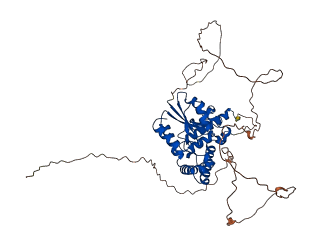
Descriptions
The autoinhibited protein was predicted that may have potential autoinhibitory elements via cis-regPred.
Autoinhibitory domains (AIDs)
Target domain |
|
Relief mechanism |
|
Assay |
cis-regPred |
Accessory elements
No accessory elements
Autoinhibited structure

Activated structure
1 structures for P97480
| Entry ID | Method | Resolution | Chain | Position | Source |
|---|---|---|---|---|---|
| AF-P97480-F1 | Predicted | AlphaFoldDB |
26 variants for P97480
| Variant ID(s) | Position | Change | Description | Diseaes Association | Provenance |
|---|---|---|---|---|---|
| rs3388719949 | 24 | T>K | No | EVA | |
| rs3388723292 | 41 | T>A | No | EVA | |
| rs3388715247 | 50 | D>G | No | EVA | |
| rs3394780492 | 62 | A>S | No | EVA | |
| rs3388717892 | 71 | E>* | No | EVA | |
| rs27593913 | 75 | P>S | No | EVA | |
| rs3388709836 | 109 | N>Y | No | EVA | |
| rs225106537 | 167 | T>N | No | EVA | |
| rs27574647 | 169 | T>A | No | EVA | |
| rs3388705246 | 197 | S>T | No | EVA | |
| rs3388718441 | 198 | A>T | No | EVA | |
| rs1134316584 | 201 | P>L | No | EVA | |
| rs3388721139 | 204 | Q>* | No | EVA | |
| rs3388717893 | 214 | Q>R | No | EVA | |
| rs3388723361 | 219 | M>K | No | EVA | |
| rs27574588 | 342 | V>A | No | EVA | |
| rs3388695881 | 351 | K>I | No | EVA | |
| rs3388695984 | 354 | F>C | No | EVA | |
| rs3388721070 | 364 | D>E | No | EVA | |
| rs241716009 | 414 | A>V | No | EVA | |
| rs3388718974 | 437 | E>V | No | EVA | |
| rs3388715258 | 447 | A>D | No | EVA | |
| rs3388723357 | 465 | K>N | No | EVA | |
| rs3388705189 | 466 | K>R | No | EVA | |
| rs3388723347 | 477 | D>E | No | EVA | |
| rs3388715246 | 509 | F>L | No | EVA |
No associated diseases with P97480
Functions
| Description | ||
|---|---|---|
| EC Number | 3.1.3.48 | Phosphoric monoester hydrolases |
| Subcellular Localization |
|
|
| PANTHER Family | ||
| PANTHER Subfamily | ||
| PANTHER Protein Class | ||
| PANTHER Pathway Category | No pathway information available | |
5 GO annotations of cellular component
| Name | Definition |
|---|---|
| centrosome | A structure comprised of a core structure (in most organisms, a pair of centrioles) and peripheral material from which a microtubule-based structure, such as a spindle apparatus, is organized. Centrosomes occur close to the nucleus during interphase in many eukaryotic cells, though in animal cells it changes continually during the cell-division cycle. |
| cytoplasm | The contents of a cell excluding the plasma membrane and nucleus, but including other subcellular structures. |
| nucleoplasm | That part of the nuclear content other than the chromosomes or the nucleolus. |
| nucleus | A membrane-bounded organelle of eukaryotic cells in which chromosomes are housed and replicated. In most cells, the nucleus contains all of the cell's chromosomes except the organellar chromosomes, and is the site of RNA synthesis and processing. In some species, or in specialized cell types, RNA metabolism or DNA replication may be absent. |
| transcription regulator complex | A protein complex that is capable of associating with DNA by direct binding, or via other DNA-binding proteins or complexes, and regulating transcription. |
5 GO annotations of molecular function
| Name | Definition |
|---|---|
| chromatin binding | Binding to chromatin, the network of fibers of DNA, protein, and sometimes RNA, that make up the chromosomes of the eukaryotic nucleus during interphase. |
| histone tyrosine phosphatase activity (H2-Y142 specific) | Catalysis of the reaction: histone H2 tyrosine phosphate (position 142) + H2O = histone tyrosine (position 142) + phosphate. |
| metal ion binding | Binding to a metal ion. |
| protein tyrosine phosphatase activity | Catalysis of the reaction: protein tyrosine phosphate + H2O = protein tyrosine + phosphate. |
| protein tyrosine/serine/threonine phosphatase activity | Catalysis of the reactions: protein serine + H2O = protein serine + phosphate; protein threonine phosphate + H2O = protein threonine + phosphate; and protein tyrosine phosphate + H2O = protein tyrosine + phosphate. |
8 GO annotations of biological process
| Name | Definition |
|---|---|
| anatomical structure development | The biological process whose specific outcome is the progression of an anatomical structure from an initial condition to its mature state. This process begins with the formation of the structure and ends with the mature structure, whatever form that may be including its natural destruction. An anatomical structure is any biological entity that occupies space and is distinguished from its surroundings. Anatomical structures can be macroscopic such as a carpel, or microscopic such as an acrosome. |
| cell differentiation | The process in which relatively unspecialized cells, e.g. embryonic or regenerative cells, acquire specialized structural and/or functional features that characterize the cells, tissues, or organs of the mature organism or some other relatively stable phase of the organism's life history. Differentiation includes the processes involved in commitment of a cell to a specific fate and its subsequent development to the mature state. |
| chromatin organization | The assembly or remodeling of chromatin composed of DNA complexed with histones, other associated proteins, and sometimes RNA. |
| double-strand break repair | The repair of double-strand breaks in DNA via homologous and nonhomologous mechanisms to reform a continuous DNA helix. |
| negative regulation of extrinsic apoptotic signaling pathway in absence of ligand | Any process that stops, prevents or reduces the frequency, rate or extent of extrinsic apoptotic signaling pathway in absence of ligand. |
| positive regulation of DNA repair | Any process that activates or increases the frequency, rate or extent of DNA repair. |
| protein dephosphorylation | The process of removing one or more phosphoric residues from a protein. |
| response to ionizing radiation | Any process that results in a change in state or activity of a cell or an organism (in terms of movement, secretion, enzyme production, gene expression, etc.) as a result of a ionizing radiation stimulus. Ionizing radiation is radiation with sufficient energy to remove electrons from atoms and may arise from spontaneous decay of unstable isotopes, resulting in alpha and beta particles and gamma rays. Ionizing radiation also includes X-rays. |
1 homologous proteins in AiPD
| UniProt AC | Gene Name | Protein Name | Species | Evidence Code |
|---|---|---|---|---|
| Q99504 | EYA3 | Eyes absent homolog 3 | Homo sapiens (Human) | PR |
| 10 | 20 | 30 | 40 | 50 | 60 |
| MQEPREQTLS | QVNNPDASDE | KPETSSLASN | LSMSEEIMTC | TDYIPRSSND | YTSQMYSAKP |
| 70 | 80 | 90 | 100 | 110 | 120 |
| YAHILSVPVS | ETTYPGQTQY | QTLQQSQPYA | VYPQATQTYG | LPPFASSTNA | SLIPTSSAIA |
| 130 | 140 | 150 | 160 | 170 | 180 |
| NIPAAAVASI | SNQDYPTYTI | LGQNQYQACY | PSSSFGVTGQ | TNSDAETTTL | AATTYQTEKP |
| 190 | 200 | 210 | 220 | 230 | 240 |
| SAMVPAPATQ | RLPSDSSASP | PLSQTTPNKD | ADDQARKNMT | VKNRGKRKAD | ASSSQDSELE |
| 250 | 260 | 270 | 280 | 290 | 300 |
| RVFLWDLDET | IIIFHSLLTG | SYAQKYGKDP | TVVIGSGLTM | EEMIFEVADT | HLFFNDLEEC |
| 310 | 320 | 330 | 340 | 350 | 360 |
| DQVHVEDVAS | DDNGQDLSNY | SFSTDGFSGS | GGSGSHGSSV | GVQGGVDWMR | KLAFRYRKVR |
| 370 | 380 | 390 | 400 | 410 | 420 |
| EIYDKHKSNV | GGLLSPQRKE | ALQRLRAEIE | VLTDSWLGTA | LKSLLLIQSR | KNCANVLITT |
| 430 | 440 | 450 | 460 | 470 | 480 |
| TQLVPALAKV | LLYGLGEIFP | IENIYSATKI | GKESCFERIV | SRFGKKVTYV | VIGDGRDEEI |
| 490 | 500 | ||||
| AAKQHNMPFW | RITNHGDLVS | LHQALELDFL |