P96600
Gene name |
dctB (ydbE, BSU04440) |
Protein name |
C4-dicarboxylate-binding protein DctB |
Names |
|
Species |
Bacillus subtilis (strain 168) |
KEGG Pathway |
bsu:BSU04440 |
EC number |
|
Protein Class |
|
Descriptions
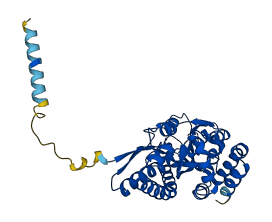
The autoinhibited protein was predicted that may have potential autoinhibitory elements via cis-regPred.
Autoinhibitory domains (AIDs)
Target domain |
|
Relief mechanism |
|
Assay |
cis-regPred |
Accessory elements
No accessory elements
Autoinhibited structure

Activated structure
1 structures for P96600
| Entry ID | Method | Resolution | Chain | Position | Source |
|---|---|---|---|---|---|
| AF-P96600-F1 | Predicted | AlphaFoldDB |
No variants for P96600
| Variant ID(s) | Position | Change | Description | Diseaes Association | Provenance |
|---|---|---|---|---|---|
| No variants for P96600 | |||||
No associated diseases with P96600
No regional properties for P96600
| Type | Name | Position | InterPro Accession |
|---|---|---|---|
| No domain, repeats, and functional sites for P96600 | |||
2 GO annotations of cellular component
| Name | Definition |
|---|---|
| extracellular region | The space external to the outermost structure of a cell. For cells without external protective or external encapsulating structures this refers to space outside of the plasma membrane. This term covers the host cell environment outside an intracellular parasite. |
| outer membrane-bounded periplasmic space | The region between the inner (cytoplasmic or plasma) membrane and outer membrane of organisms with two membranes such as Gram negative bacteria. These periplasmic spaces are relatively thick and contain a thin peptidoglycan layer (PGL), also referred to as a thin cell wall. |
No GO annotations of molecular function
| Name | Definition |
|---|---|
| No GO annotations for molecular function |
2 GO annotations of biological process
| Name | Definition |
|---|---|
| carbohydrate transport | The directed movement of carbohydrate into, out of or within a cell, or between cells, by means of some agent such as a transporter or pore. Carbohydrates are a group of organic compounds based of the general formula Cx(H2O)y. |
| transmembrane transport | The process in which a solute is transported across a lipid bilayer, from one side of a membrane to the other. |
No homologous proteins in AiPD
| UniProt AC | Gene Name | Protein Name | Species | Evidence Code |
|---|---|---|---|---|
| No homologous proteins | ||||
| 10 | 20 | 30 | 40 | 50 | 60 |
| MKSLLACLAL | MIAGIATALF | IGFHDHTGNK | KIVYDDDQEG | LQDQIVFKFS | HVVAENTPKG |
| 70 | 80 | 90 | 100 | 110 | 120 |
| LAANKFADLV | NEKSGGKIKI | EVFPNGSLYS | DIEEIEALQN | GDVQFIAPST | SKLGMLSPEW |
| 130 | 140 | 150 | 160 | 170 | 180 |
| GVLDLPYAFT | DYNAVKKGLN | GSIGTQLFDS | LKKNQLKGLA | YWTNGFKQIT | TNQGPVKTPD |
| 190 | 200 | 210 | 220 | 230 | 240 |
| DLKGQDLRIM | QSDVIEDQFK | LLGATPHQES | FNSTFQLLEN | NVVDGEENTI | SNIYSKKFYN |
| 250 | 260 | 270 | 280 | 290 | 300 |
| VQDYLTISSH | GYLGYAVMTD | EHFWKAQTPE | TRRILTEAMK | ETTEWNETYA | EQMNKEQLEE |
| 310 | 320 | 330 | 340 | ||
| IKKNSAIHIY | ELSDKEKQEW | MKRLDPVYRQ | YEPIFGRELI | RELLELRKDS |