P94126
Gene name |
glnA |
Protein name |
Glutamine synthetase |
Names |
GS, Glutamate--ammonia ligase, Glutamine synthetase I beta, GSI beta |
Species |
Azorhizobium caulinodans (strain ATCC 43989 / DSM 5975 / JCM 20966 / LMG 6465 / NBRC 14845 / NCIMB 13405 / ORS 571) |
KEGG Pathway |
azc:AZC_1601 |
EC number |
6.3.1.2: Acid--ammonia (or amine) ligases (amide synthases) |
Protein Class |
|
Descriptions
The autoinhibited protein was predicted that may have potential autoinhibitory elements via cis-regPred.
Autoinhibitory domains (AIDs)
Target domain |
|
Relief mechanism |
|
Assay |
cis-regPred |
Accessory elements
No accessory elements
Autoinhibited structure

Activated structure
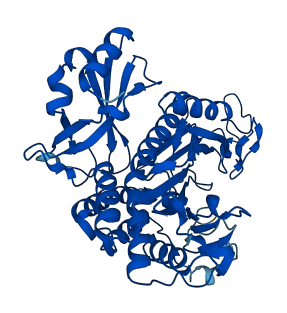
1 structures for P94126
| Entry ID | Method | Resolution | Chain | Position | Source |
|---|---|---|---|---|---|
| AF-P94126-F1 | Predicted | AlphaFoldDB |
No variants for P94126
| Variant ID(s) | Position | Change | Description | Diseaes Association | Provenance |
|---|---|---|---|---|---|
| No variants for P94126 | |||||
No associated diseases with P94126
5 regional properties for P94126
| Type | Name | Position | InterPro Accession |
|---|---|---|---|
| conserved_site | Glutamine synthetase class-I, adenylation site | 386 - 398 | IPR001637 |
| domain | Glutamine synthetase, catalytic domain | 103 - 469 | IPR008146 |
| domain | Glutamine synthetase, N-terminal domain | 14 - 98 | IPR008147 |
| conserved_site | Glutamine synthetase, N-terminal conserved site | 51 - 69 | IPR027302 |
| conserved_site | Glutamine synthetase, glycine-rich site | 259 - 274 | IPR027303 |
Functions
| Description | ||
|---|---|---|
| EC Number | 6.3.1.2 | Acid--ammonia (or amine) ligases (amide synthases) |
| Subcellular Localization |
|
|
| PANTHER Family | ||
| PANTHER Subfamily | ||
| PANTHER Protein Class | ||
| PANTHER Pathway Category | No pathway information available | |
1 GO annotations of cellular component
| Name | Definition |
|---|---|
| cytoplasm | The contents of a cell excluding the plasma membrane and nucleus, but including other subcellular structures. |
3 GO annotations of molecular function
| Name | Definition |
|---|---|
| ATP binding | Binding to ATP, adenosine 5'-triphosphate, a universally important coenzyme and enzyme regulator. |
| glutamate-ammonia ligase activity | Catalysis of the reaction: L-glutamate + ATP + NH(3) = L-glutamine + ADP + 2 H(+) + phosphate. |
| metal ion binding | Binding to a metal ion. |
2 GO annotations of biological process
| Name | Definition |
|---|---|
| glutamine biosynthetic process | The chemical reactions and pathways resulting in the formation of glutamine, 2-amino-4-carbamoylbutanoic acid. |
| nitrogen fixation | The process in which nitrogen is taken from its relatively inert molecular form (N2) in the atmosphere and converted into nitrogen compounds useful for other chemical processes, such as ammonia, nitrate and nitrogen dioxide. |
No homologous proteins in AiPD
| UniProt AC | Gene Name | Protein Name | Species | Evidence Code |
|---|---|---|---|---|
| No homologous proteins | ||||
| 10 | 20 | 30 | 40 | 50 | 60 |
| MKTAKEVLDF | IKSNDVKYVD | LRFTDPRGKW | QHVTFDITMV | DEDFFAEGQA | FDGSSIAGWK |
| 70 | 80 | 90 | 100 | 110 | 120 |
| AINESDMLLM | PDVTTACVDP | FFSETTLSVV | CDVLEPTTGE | PYGRDPRGIA | KKAMAYLQST |
| 130 | 140 | 150 | 160 | 170 | 180 |
| GIGDTVFFGP | EAEFFIFDDV | KFKADPYNTG | FKLDSIELPT | NGDTDYEGGN | LGHRIKTKGG |
| 190 | 200 | 210 | 220 | 230 | 240 |
| YFPVPPLDSA | QDMRSEMLAS | MAKMGAKVEK | HHHEVASAQH | ELGLKFGQLV | TMADHLQVYK |
| 250 | 260 | 270 | 280 | 290 | 300 |
| YCIHQVANIY | GKTATFMPKP | VYGDNGSGMH | VHQSIWKDGK | PLFAGDKYAD | LSQECLWYIG |
| 310 | 320 | 330 | 340 | 350 | 360 |
| GVIKHAKSLN | AFTNPLTNSY | KRLVPGYEAP | VLLAYSARNR | SASCRIPYTN | NPKAKRVEVR |
| 370 | 380 | 390 | 400 | 410 | 420 |
| FPDPGANPYL | AFSALFMAGM | DGILNKIDPG | SAMDKDLYDL | PPAELKQIPT | VCGSLREALE |
| 430 | 440 | 450 | 460 | ||
| SLAKDHDYLL | KGDVFQKDFI | ESYIDLKMQE | VARFEMTPHP | VEFEMYYSV |