P83337
Gene name |
POFUT1 |
Protein name |
GDP-fucose protein O-fucosyltransferase 1 |
Names |
Peptide-O-fucosyltransferase 1, O-FucT-1 |
Species |
Cricetulus griseus (Chinese hamster) (Cricetulus barabensis griseus) |
KEGG Pathway |
cge:100753417 |
EC number |
2.4.1.221: Hexosyltransferases |
Protein Class |
|
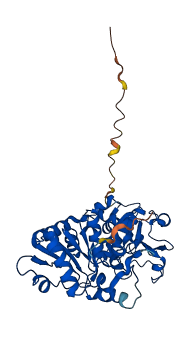
Descriptions
The autoinhibited protein was predicted that may have potential autoinhibitory elements via cis-regPred.
Autoinhibitory domains (AIDs)
Target domain |
|
Relief mechanism |
|
Assay |
cis-regPred |
Accessory elements
No accessory elements
Autoinhibited structure

Activated structure
1 structures for P83337
| Entry ID | Method | Resolution | Chain | Position | Source |
|---|---|---|---|---|---|
| AF-P83337-F1 | Predicted | AlphaFoldDB |
No variants for P83337
| Variant ID(s) | Position | Change | Description | Diseaes Association | Provenance |
|---|---|---|---|---|---|
| No variants for P83337 | |||||
No associated diseases with P83337
No regional properties for P83337
| Type | Name | Position | InterPro Accession |
|---|---|---|---|
| No domain, repeats, and functional sites for P83337 | |||
Functions
| Description | ||
|---|---|---|
| EC Number | 2.4.1.221 | Hexosyltransferases |
| Subcellular Localization |
|
|
| PANTHER Family | ||
| PANTHER Subfamily | ||
| PANTHER Protein Class | ||
| PANTHER Pathway Category | No pathway information available | |
1 GO annotations of cellular component
| Name | Definition |
|---|---|
| endoplasmic reticulum membrane | The lipid bilayer surrounding the endoplasmic reticulum. |
3 GO annotations of molecular function
| Name | Definition |
|---|---|
| glycosyltransferase activity | Catalysis of the transfer of a glycosyl group from one compound (donor) to another (acceptor). |
| peptide-O-fucosyltransferase activity | Catalysis of the transfer of an alpha-L-fucosyl residue from GDP- beta-L-fucose to the serine hydroxy group of a protein acceptor. |
| transferase activity | Catalysis of the transfer of a group, e.g. a methyl group, glycosyl group, acyl group, phosphorus-containing, or other groups, from one compound (generally regarded as the donor) to another compound (generally regarded as the acceptor). Transferase is the systematic name for any enzyme of EC class 2. |
8 GO annotations of biological process
| Name | Definition |
|---|---|
| angiogenesis | Blood vessel formation when new vessels emerge from the proliferation of pre-existing blood vessels. |
| fucose metabolic process | The chemical reactions and pathways involving fucose, or 6-deoxygalactose, which has two enantiomers, D-fucose and L-fucose. |
| heart development | The process whose specific outcome is the progression of the heart over time, from its formation to the mature structure. The heart is a hollow, muscular organ, which, by contracting rhythmically, keeps up the circulation of the blood. |
| nervous system development | The process whose specific outcome is the progression of nervous tissue over time, from its formation to its mature state. |
| Notch signaling pathway | The series of molecular signals initiated by an extracellular ligand binding to the receptor Notch on the surface of a target cell, and ending with the regulation of a downstream cellular process, e.g. transcription. |
| protein glycosylation | A protein modification process that results in the addition of a carbohydrate or carbohydrate derivative unit to a protein amino acid, e.g. the addition of glycan chains to proteins. |
| regulation of Notch signaling pathway | Any process that modulates the frequency, rate or extent of the Notch signaling pathway. |
| somitogenesis | The formation of mesodermal clusters that are arranged segmentally along the anterior posterior axis of an embryo. |
No homologous proteins in AiPD
| UniProt AC | Gene Name | Protein Name | Species | Evidence Code |
|---|---|---|---|---|
| No homologous proteins | ||||
| 10 | 20 | 30 | 40 | 50 | 60 |
| MGAAAWAPPH | LLLRVSLLLL | LLLPLRGRLA | GSWDLAGYLL | YCPCMGRFGN | QADHFLGSLA |
| 70 | 80 | 90 | 100 | 110 | 120 |
| FAKLLNRTLA | VPPWIEYQHH | KPPFTNLHVS | YQKYFKLEPL | QAYHRVISLE | EFMEKLAPIH |
| 130 | 140 | 150 | 160 | 170 | 180 |
| WPPEKRVAYC | FEVAAQRSPD | KKTCPMKEGN | PFGPFWDQFH | VSFNKSELFT | GISFSASYKE |
| 190 | 200 | 210 | 220 | 230 | 240 |
| QWIQRFPPEE | HPVLALPGAP | AQFPVLEEHR | ALQKYMVWSD | EMVKTGEAQI | STHLIRPYVG |
| 250 | 260 | 270 | 280 | 290 | 300 |
| IHLRIGSDWK | NACAMLKDGT | AGSHFMASPQ | CVGYSRSTAT | PLTMTMCLPD | LNEIQRAVKL |
| 310 | 320 | 330 | 340 | 350 | 360 |
| WVRALNARSI | YIATDSESYV | PEIQQLFKEK | VKVVSLKPEV | AQVDLYILGQ | ADHFIGNCVS |
| 370 | 380 | 390 | |||
| SFTAFVKRER | DLHGRQSSFF | GMDRPSQPRD | EF |