Descriptions
The autoinhibited protein was predicted that may have potential autoinhibitory elements via cis-regPred.
Autoinhibitory domains (AIDs)
Target domain |
|
Relief mechanism |
|
Assay |
cis-regPred |
Accessory elements
No accessory elements
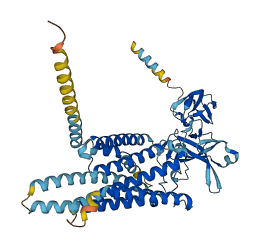
Autoinhibited structure

Activated structure
1 structures for P83120
| Entry ID | Method | Resolution | Chain | Position | Source |
|---|---|---|---|---|---|
| AF-P83120-F1 | Predicted | AlphaFoldDB |
8 variants for P83120
| Variant ID(s) | Position | Change | Description | Diseaes Association | Provenance |
|---|---|---|---|---|---|
| 15 | V>F | strain: GA2.1S, HFL2.1S and HFL4.1S [UniProt] | No | ||
| 27 | L>P | strain: GA2.1S, HFL2.1S, HFL4.1S and VA8.1S [UniProt] | No | ||
| 60 | T>A | strain: HFL2.1S, HFL4.1S and VA8.1S [UniProt] | No | ||
| 277 | K>R | strain: CT2.1S, CT5.1S, CT6.1S and VA6.1S [UniProt] | No | ||
| 345 | V>L | strain: GA2.1S [UniProt] | No | ||
| 442 | G>A | strain: HFL2.1S, VA7.1S and VA8.1S [UniProt] | No | ||
| 491 | E>V | strain: HFL4.1S [UniProt] | No | ||
| 496 | D>N | strain: GA2.1S, GA4.1S, GA5.1S, HFL1.1S, HFL2.1S, HFL4.1S, VA7.1S and VA8.1S [UniProt] | No |
No associated diseases with P83120
2 GO annotations of cellular component
| Name | Definition |
|---|---|
| integral component of membrane | The component of a membrane consisting of the gene products and protein complexes having at least some part of their peptide sequence embedded in the hydrophobic region of the membrane. |
| plasma membrane | The membrane surrounding a cell that separates the cell from its external environment. It consists of a phospholipid bilayer and associated proteins. |
1 GO annotations of molecular function
| Name | Definition |
|---|---|
| G protein-coupled receptor activity | Combining with an extracellular signal and transmitting the signal across the membrane by activating an associated G-protein; promotes the exchange of GDP for GTP on the alpha subunit of a heterotrimeric G-protein complex. |
3 GO annotations of biological process
| Name | Definition |
|---|---|
| cell surface receptor signaling pathway | The series of molecular signals initiated by activation of a receptor on the surface of a cell. The pathway begins with binding of an extracellular ligand to a cell surface receptor, or for receptors that signal in the absence of a ligand, by ligand-withdrawal or the activity of a constitutively active receptor. The pathway ends with regulation of a downstream cellular process, e.g. transcription. |
| determination of adult lifespan | The pathways that regulate the duration of the adult phase of the life-cycle of an animal. |
| response to starvation | Any process that results in a change in state or activity of a cell or an organism (in terms of movement, secretion, enzyme production, gene expression, etc.) as a result of a starvation stimulus, deprivation of nourishment. |
No homologous proteins in AiPD
| UniProt AC | Gene Name | Protein Name | Species | Evidence Code |
|---|---|---|---|---|
| No homologous proteins | ||||
| 10 | 20 | 30 | 40 | 50 | 60 |
| MKTLFVLRIS | TVILVVLVIQ | KSYADILECD | YFDTVDISAA | QKLQNGSYLF | EGLLVPAILT |
| 70 | 80 | 90 | 100 | 110 | 120 |
| GEYDFRILPD | DSKQKVASHI | RGCVCKLKPC | VRFCCPHDHI | MDNGVCNDNM | SEEELTELDP |
| 130 | 140 | 150 | 160 | 170 | 180 |
| FLNVTLDDGS | VSRRHFKNEL | IVQWDLPMPC | DGMFYLDNRE | EQDQYTLFEN | GTFFRHFDRV |
| 190 | 200 | 210 | 220 | 230 | 240 |
| TLSKREYCLQ | HLTFADGNAT | SIRIAPHNCL | IVPSITGQTV | VMITSLICMV | LTIAVYLFVK |
| 250 | 260 | 270 | 280 | 290 | 300 |
| KLQNLHGKCF | ICYMVCLFMG | YLFLLFDLWQ | ISISFCKPAG | VLGYFFVMAA | FLWLSVISLH |
| 310 | 320 | 330 | 340 | 350 | 360 |
| LWNTFRGSSH | KASRFFSEHR | FLAYNTYAWG | MSMVLTGITV | LADNVVEDQD | WNPRVGEEGH |
| 370 | 380 | 390 | 400 | 410 | 420 |
| CWIYTQAWSA | MLYFYGPMVF | LIAFNITMFI | LTARRIIGVK | KDIQNFAHRQ | ERKQKLNSDK |
| 430 | 440 | 450 | 460 | 470 | 480 |
| QTYTFFLRLF | IIMGLSWSLE | IGSYISQSNQ | TWANVFLVAD | YLNWSQGIII | FILFILKRST |
| 490 | 500 | 510 | |||
| LRLLQESIRG | EGEEVDNSEE | EISLENTRFD | RNVLS |