P82349
Gene name |
Sgcb |
Protein name |
Beta-sarcoglycan |
Names |
Beta-SG, 43 kDa dystrophin-associated glycoprotein, 43DAG |
Species |
Mus musculus (Mouse) |
KEGG Pathway |
mmu:24051 |
EC number |
|
Protein Class |
|
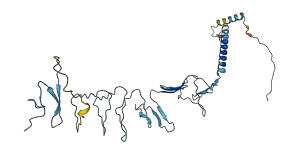
Descriptions
The autoinhibited protein was predicted that may have potential autoinhibitory elements via cis-regPred.
Autoinhibitory domains (AIDs)
Target domain |
|
Relief mechanism |
|
Assay |
cis-regPred |
Accessory elements
No accessory elements
Autoinhibited structure

Activated structure
1 structures for P82349
| Entry ID | Method | Resolution | Chain | Position | Source |
|---|---|---|---|---|---|
| AF-P82349-F1 | Predicted | AlphaFoldDB |
12 variants for P82349
| Variant ID(s) | Position | Change | Description | Diseaes Association | Provenance |
|---|---|---|---|---|---|
| rs3395672174 | 121 | I>S | No | EVA | |
| rs3395843319 | 122 | H>P | No | EVA | |
| rs3395745864 | 123 | P>L | No | EVA | |
| rs3395689767 | 123 | P>S | No | EVA | |
| rs3388763839 | 150 | Q>K | No | EVA | |
| rs3388772776 | 197 | V>L | No | EVA | |
| rs3388751963 | 204 | K>E | No | EVA | |
| rs3395688414 | 215 | T>IDFDI* | No | EVA | |
| rs3388754563 | 250 | E>K | No | EVA | |
| rs3388759352 | 252 | K>E | No | EVA | |
| rs3388747004 | 282 | G>D | No | EVA | |
| rs3388762449 | 292 | C>Y | No | EVA |
No associated diseases with P82349
No regional properties for P82349
| Type | Name | Position | InterPro Accession |
|---|---|---|---|
| No domain, repeats, and functional sites for P82349 | |||
8 GO annotations of cellular component
| Name | Definition |
|---|---|
| cytoplasm | The contents of a cell excluding the plasma membrane and nucleus, but including other subcellular structures. |
| cytoskeleton | A cellular structure that forms the internal framework of eukaryotic and prokaryotic cells. The cytoskeleton includes intermediate filaments, microfilaments, microtubules, the microtrabecular lattice, and other structures characterized by a polymeric filamentous nature and long-range order within the cell. The various elements of the cytoskeleton not only serve in the maintenance of cellular shape but also have roles in other cellular functions, including cellular movement, cell division, endocytosis, and movement of organelles. |
| dystroglycan complex | A protein complex that includes alpha- and beta-dystroglycan, which are alternative products of the same gene; the laminin-binding component of the dystrophin-associated glycoprotein complex, providing a link between the subsarcolemmal cytoskeleton (in muscle cells) and the extracellular matrix. Alpha-dystroglycan is an extracellular protein binding to alpha-laminin and to beta-dystroglycan; beta-dystroglycan is a transmembrane protein which binds alpha-dystroglycan and dystrophin. |
| dystrophin-associated glycoprotein complex | A multiprotein complex that forms a strong mechanical link between the cytoskeleton and extracellular matrix; typical of, but not confined to, muscle cells. The complex is composed of transmembrane, cytoplasmic, and extracellular proteins, including dystrophin, sarcoglycans, dystroglycan, dystrobrevins, syntrophins, sarcospan, caveolin-3, and NO synthase. |
| integral component of plasma membrane | The component of the plasma membrane consisting of the gene products and protein complexes having at least some part of their peptide sequence embedded in the hydrophobic region of the membrane. |
| plasma membrane | The membrane surrounding a cell that separates the cell from its external environment. It consists of a phospholipid bilayer and associated proteins. |
| sarcoglycan complex | A protein complex formed of four sarcoglycans plus sarcospan; there are six known sarcoglycans: alpha-, beta-, gamma-, delta-, epsilon- and zeta-sarcoglycan; all are N-glycosylated single-pass transmembrane proteins. The sarcoglycan-sarcospan complex is a subcomplex of the dystrophin glycoprotein complex, and is fixed to the dystrophin axis by a lateral association with the dystroglycan complex. |
| sarcolemma | The outer membrane of a muscle cell, consisting of the plasma membrane, a covering basement membrane (about 100 nm thick and sometimes common to more than one fiber), and the associated loose network of collagen fibers. |
No GO annotations of molecular function
| Name | Definition |
|---|---|
| No GO annotations for molecular function |
5 GO annotations of biological process
| Name | Definition |
|---|---|
| cardiac muscle cell development | The process whose specific outcome is the progression of a cardiac muscle cell over time, from its formation to the mature state. |
| membrane organization | A process which results in the assembly, arrangement of constituent parts, or disassembly of a membrane. A membrane is a double layer of lipid molecules that encloses all cells, and, in eukaryotes, many organelles; may be a single or double lipid bilayer; also includes associated proteins. |
| muscle cell development | The process whose specific outcome is the progression of a muscle cell over time, from its formation to the mature structure. Muscle cell development does not include the steps involved in committing an unspecified cell to the muscle cell fate. |
| muscle organ development | The process whose specific outcome is the progression of the muscle over time, from its formation to the mature structure. The muscle is an organ consisting of a tissue made up of various elongated cells that are specialized to contract and thus to produce movement and mechanical work. |
| vascular associated smooth muscle cell development | The process aimed at the progression of a vascular smooth muscle cell over time, from initial commitment of the cell to a specific fate, to the fully functional differentiated cell. A vascular smooth muscle cell is a non-striated, elongated, spindle-shaped cell found lining the blood vessels. |
| 10 | 20 | 30 | 40 | 50 | 60 |
| MAAAAAAAAA | TEQQGSNGPV | KKSMREKAVE | RRNVNKEHNS | NFKAGYIPID | EDRLHKTGLR |
| 70 | 80 | 90 | 100 | 110 | 120 |
| GRKGNLAICV | IVLLFILAVI | NLLITLVIWA | VIRIGPNGCD | SMEFHESGLL | RFKQVSDMGV |
| 130 | 140 | 150 | 160 | 170 | 180 |
| IHPLYKSTVG | GRRNENLVIT | GNNQPIVFQQ | GTTKLSVEKN | KTSITSDIGM | QFFDPRTHNI |
| 190 | 200 | 210 | 220 | 230 | 240 |
| LFSTDYETHE | FHLPSGVKSL | NVQKASTERI | TSNATSDLNI | KVDGRAIVRG | NEGVFIMGKT |
| 250 | 260 | 270 | 280 | 290 | 300 |
| IEFHMGGDVE | LKAENSIILN | GTVMVSPTRL | PSSSSGDQSG | SGDWVRYKLC | MCADGTLFKV |
| 310 | |||||
| QVTGHNMGCQ | VSDNPCGNTH |