Descriptions
The autoinhibited protein was predicted that may have potential autoinhibitory elements via cis-regPred.
Autoinhibitory domains (AIDs)
Target domain |
|
Relief mechanism |
|
Assay |
cis-regPred |
Accessory elements
No accessory elements
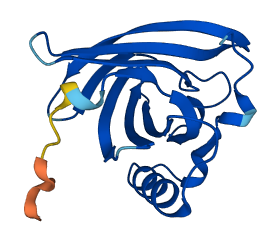
Autoinhibited structure

Activated structure
10 structures for P81245
| Entry ID | Method | Resolution | Chain | Position | Source |
|---|---|---|---|---|---|
| 1A3Y | X-ray | 225 A | A/B | 9-157 | PDB |
| 1DZJ | X-ray | 200 A | A/B | 1-157 | PDB |
| 1DZK | X-ray | 148 A | A/B | 1-157 | PDB |
| 1DZM | X-ray | 193 A | A/B | 1-157 | PDB |
| 1DZP | X-ray | 183 A | A/B | 1-157 | PDB |
| 1E00 | X-ray | 183 A | A/B | 1-157 | PDB |
| 1E02 | X-ray | 215 A | A/B | 1-157 | PDB |
| 1E06 | X-ray | 212 A | A/B | 1-157 | PDB |
| 1HQP | X-ray | 230 A | A | 1-157 | PDB |
| AF-P81245-F1 | Predicted | AlphaFoldDB |
No variants for P81245
| Variant ID(s) | Position | Change | Description | Diseaes Association | Provenance |
|---|---|---|---|---|---|
| No variants for P81245 | |||||
No associated diseases with P81245
6 regional properties for P81245
| Type | Name | Position | InterPro Accession |
|---|---|---|---|
| domain | Gelsolin-like domain | 22 - 103 | IPR007123-1 |
| domain | Gelsolin-like domain | 146 - 208 | IPR007123-2 |
| domain | Gelsolin-like domain | 271 - 339 | IPR007123-3 |
| domain | Gelsolin-like domain | 416 - 495 | IPR007123-4 |
| domain | Gelsolin-like domain | 550 - 584 | IPR007123-5 |
| domain | Gelsolin-like domain | 647 - 720 | IPR007123-6 |
1 GO annotations of cellular component
| Name | Definition |
|---|---|
| extracellular space | That part of a multicellular organism outside the cells proper, usually taken to be outside the plasma membranes, and occupied by fluid. |
2 GO annotations of molecular function
| Name | Definition |
|---|---|
| odorant binding | Binding to an odorant, any substance capable of stimulating the sense of smell. |
| small molecule binding | Binding to a small molecule, any low molecular weight, monomeric, non-encoded molecule. |
2 GO annotations of biological process
| Name | Definition |
|---|---|
| response to stimulus | Any process that results in a change in state or activity of a cell or an organism (in terms of movement, secretion, enzyme production, gene expression, etc.) as a result of a stimulus. The process begins with detection of the stimulus and ends with a change in state or activity or the cell or organism. |
| sensory perception of smell | The series of events required for an organism to receive an olfactory stimulus, convert it to a molecular signal, and recognize and characterize the signal. Olfaction involves the detection of chemical composition of an organism's ambient medium by chemoreceptors. This is a neurological process. |
No homologous proteins in AiPD
| UniProt AC | Gene Name | Protein Name | Species | Evidence Code |
|---|---|---|---|---|
| No homologous proteins | ||||
| 10 | 20 | 30 | 40 | 50 | 60 |
| QEPQPEQDPF | ELSGKWITSY | IGSSDLEKIG | ENAPFQVFMR | SIEFDDKESK | VYLNFFSKEN |
| 70 | 80 | 90 | 100 | 110 | 120 |
| GICEEFSLIG | TKQEGNTYDV | NYAGNNKFVV | SYASETALII | SNINVDEEGD | KTIMTGLLGK |
| 130 | 140 | 150 | |||
| GTDIEDQDLE | KFKEVTRENG | IPEENIVNII | ERDDCPA |