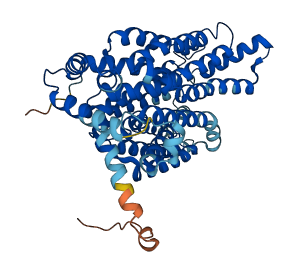
Descriptions
The autoinhibited protein was predicted that may have potential autoinhibitory elements via cis-regPred.
Autoinhibitory domains (AIDs)
Target domain |
|
Relief mechanism |
|
Assay |
cis-regPred |
Accessory elements
No accessory elements
Autoinhibited structure

Activated structure
1 structures for P79365
| Entry ID | Method | Resolution | Chain | Position | Source |
|---|---|---|---|---|---|
| AF-P79365-F1 | Predicted | AlphaFoldDB |
No variants for P79365
| Variant ID(s) | Position | Change | Description | Diseaes Association | Provenance |
|---|---|---|---|---|---|
| No variants for P79365 | |||||
No associated diseases with P79365
3 regional properties for P79365
| Type | Name | Position | InterPro Accession |
|---|---|---|---|
| conserved_site | Sugar transporter, conserved site | 128 - 153 | IPR005829-1 |
| conserved_site | Sugar transporter, conserved site | 324 - 340 | IPR005829-2 |
| domain | Major facilitator superfamily domain | 15 - 456 | IPR020846 |
14 GO annotations of cellular component
| Name | Definition |
|---|---|
| apical plasma membrane | The region of the plasma membrane located at the apical end of the cell. |
| basolateral plasma membrane | The region of the plasma membrane that includes the basal end and sides of the cell. Often used in reference to animal polarized epithelial membranes, where the basal membrane is the part attached to the extracellular matrix, or in plant cells, where the basal membrane is defined with respect to the zygotic axis. |
| cortical actin cytoskeleton | The portion of the actin cytoskeleton, comprising filamentous actin and associated proteins, that lies just beneath the plasma membrane. |
| cytosol | The part of the cytoplasm that does not contain organelles but which does contain other particulate matter, such as protein complexes. |
| female germ cell nucleus | The nucleus of the female germ cell, a reproductive cell in females. |
| female pronucleus | The pronucleus originating from the ovum that is being fertilized. |
| Golgi membrane | The lipid bilayer surrounding any of the compartments of the Golgi apparatus. |
| integral component of plasma membrane | The component of the plasma membrane consisting of the gene products and protein complexes having at least some part of their peptide sequence embedded in the hydrophobic region of the membrane. |
| membrane raft | Any of the small (10-200 nm), heterogeneous, highly dynamic, sterol- and sphingolipid-enriched membrane domains that compartmentalize cellular processes. Small rafts can sometimes be stabilized to form larger platforms through protein-protein and protein-lipid interactions. |
| midbody | A thin cytoplasmic bridge formed between daughter cells at the end of cytokinesis. The midbody forms where the contractile ring constricts, and may persist for some time before finally breaking to complete cytokinesis. |
| photoreceptor inner segment | The inner segment of a vertebrate photoreceptor containing mitochondria, ribosomes and membranes where opsin molecules are assembled and passed to be part of the outer segment discs. |
| plasma membrane | The membrane surrounding a cell that separates the cell from its external environment. It consists of a phospholipid bilayer and associated proteins. |
| presynapse | The part of a synapse that is part of the presynaptic cell. |
| vesicle | Any small, fluid-filled, spherical organelle enclosed by membrane. |
6 GO annotations of molecular function
| Name | Definition |
|---|---|
| D-glucose transmembrane transporter activity | Enables the transfer of the D-enantiomer of the hexose monosaccharide glucose from one side of a membrane to the other. |
| dehydroascorbic acid transmembrane transporter activity | Enables the transfer of dehydroascorbate, 5-(1,2-dihydroxyethyl)furan-2,3,4(5H)-trione, from one side of a membrane to the other. |
| glucose transmembrane transporter activity | Enables the transfer of the hexose monosaccharide glucose from one side of a membrane to the other. |
| identical protein binding | Binding to an identical protein or proteins. |
| long-chain fatty acid transporter activity | Enables the transfer of long-chain fatty acids from one side of a membrane to the other. A long-chain fatty acid is a fatty acid with a chain length between C13 and C22. |
| protein self-association | Binding to a domain within the same polypeptide. |
8 GO annotations of biological process
| Name | Definition |
|---|---|
| cellular response to glucose starvation | Any process that results in a change in state or activity of a cell (in terms of movement, secretion, enzyme production, gene expression, etc.) as a result of deprivation of glucose. |
| central nervous system development | The process whose specific outcome is the progression of the central nervous system over time, from its formation to the mature structure. The central nervous system is the core nervous system that serves an integrating and coordinating function. In vertebrates it consists of the brain and spinal cord. In those invertebrates with a central nervous system it typically consists of a brain, cerebral ganglia and a nerve cord. |
| glucose import across plasma membrane | The directed movement of glucose from outside of a cell, across the plasma membrane and into the cytosol. |
| glucose transmembrane transport | The process in which glucose is transported across a membrane. |
| long-chain fatty acid import across plasma membrane | The directed movement of long-chain fatty acids from outside of a cell, across the plasma membrane and into the cytosol. A long-chain fatty acid is a fatty acid with a chain length between C13 and C22. |
| photoreceptor cell maintenance | Any process preventing the degeneration of the photoreceptor, a specialized cell type that is sensitive to light. |
| protein-containing complex assembly | The aggregation, arrangement and bonding together of a set of macromolecules to form a protein-containing complex. |
| transport across blood-brain barrier | The directed movement of substances (e.g. macromolecules, small molecules, ions) through the blood-brain barrier. |
No homologous proteins in AiPD
| UniProt AC | Gene Name | Protein Name | Species | Evidence Code |
|---|---|---|---|---|
| No homologous proteins | ||||
| 10 | 20 | 30 | 40 | 50 | 60 |
| MEPTSKKLTG | RLMLAVGGAV | LGSLQFGYNT | GVINAPQKVI | EEFYNQTWMQ | RYGEPIPPAT |
| 70 | 80 | 90 | 100 | 110 | 120 |
| LTTLWSLSVA | IFSVGGMIGS | FSVGLFVNRF | GRRNSMLMMN | LLAFVSAVLM | GFSKLGKSFE |
| 130 | 140 | 150 | 160 | 170 | 180 |
| MLILGRFIIG | VYCGLTTGFV | PMYVGEVSPT | ELRGALGTLH | QLGIVVGILI | AQVFGLDSIM |
| 190 | 200 | 210 | 220 | 230 | 240 |
| GNQELWPLLL | SVIFIPALLQ | CILLPFCPES | PRFLLINRNE | ENRAKSVLKK | LRGTADVTRD |
| 250 | 260 | 270 | 280 | 290 | 300 |
| LQEMKEESRQ | MMREKKVTIL | ELFRSAAYRQ | PILIAVVLQL | SQQLSGINAV | FYYSTSIFEK |
| 310 | 320 | 330 | 340 | 350 | 360 |
| AGVQQPVYAT | IGSGIVNTAF | TVVSLFVVER | AGRRTLHLIG | LAGMAGCAVL | MTIALALLEQ |
| 370 | 380 | 390 | 400 | 410 | 420 |
| LPWMSYLSIV | AIFGFVAFFE | VGPGPIPWFI | VAELFSQGPR | PAAIAVAGFS | NWTSNFIVGM |
| 430 | 440 | 450 | 460 | 470 | 480 |
| CFQYVEQLCG | PYVFIIFTVL | LVLFFIFTYF | KVPETKGRTF | DEIASGFRQG | GASQSDKTPE |
| 490 | |||||
| ELFHPLGADS | QV |