P79051
Gene name |
rhp16 (SPCC330.01c, SPCC613.13c) |
Protein name |
ATP-dependent helicase rhp16 |
Names |
DNA repair protein rhp16, RAD16 homolog |
Species |
Schizosaccharomyces pombe (strain 972 / ATCC 24843) (Fission yeast) |
KEGG Pathway |
spo:SPCC330.01c |
EC number |
|
Protein Class |
|
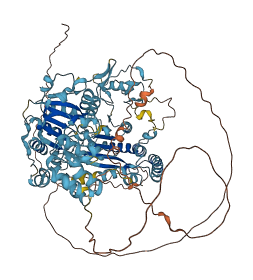
Descriptions
The autoinhibited protein was predicted that may have potential autoinhibitory elements via cis-regPred.
Autoinhibitory domains (AIDs)
Target domain |
|
Relief mechanism |
|
Assay |
cis-regPred |
Accessory elements
No accessory elements
Autoinhibited structure

Activated structure
1 structures for P79051
| Entry ID | Method | Resolution | Chain | Position | Source |
|---|---|---|---|---|---|
| AF-P79051-F1 | Predicted | AlphaFoldDB |
No variants for P79051
| Variant ID(s) | Position | Change | Description | Diseaes Association | Provenance |
|---|---|---|---|---|---|
| No variants for P79051 | |||||
No associated diseases with P79051
6 regional properties for P79051
| Type | Name | Position | InterPro Accession |
|---|---|---|---|
| domain | SNF2, N-terminal | 265 - 591 | IPR000330 |
| domain | Helicase, C-terminal | 691 - 848 | IPR001650 |
| domain | Zinc finger, RING-type | 609 - 651 | IPR001841 |
| domain | Helicase superfamily 1/2, ATP-binding domain | 251 - 460 | IPR014001 |
| conserved_site | Zinc finger, RING-type, conserved site | 624 - 633 | IPR017907 |
| domain | Zinc finger, C3HC4 RING-type | 609 - 651 | IPR018957 |
2 GO annotations of cellular component
| Name | Definition |
|---|---|
| nucleotide-excision repair complex | Any complex formed of proteins that act in nucleotide-excision repair. |
| nucleus | A membrane-bounded organelle of eukaryotic cells in which chromosomes are housed and replicated. In most cells, the nucleus contains all of the cell's chromosomes except the organellar chromosomes, and is the site of RNA synthesis and processing. In some species, or in specialized cell types, RNA metabolism or DNA replication may be absent. |
8 GO annotations of molecular function
| Name | Definition |
|---|---|
| ATP binding | Binding to ATP, adenosine 5'-triphosphate, a universally important coenzyme and enzyme regulator. |
| ATP-dependent activity, acting on DNA | Catalytic activity that acts to modify DNA, driven by ATP hydrolysis. |
| ATP-dependent chromatin remodeler activity | An activity, driven by ATP hydrolysis, that modulates the contacts between histones and DNA, resulting in a change in chromosome architecture within the nucleosomal array, leading to chromatin remodeling. |
| DNA binding | Any molecular function by which a gene product interacts selectively and non-covalently with DNA (deoxyribonucleic acid). |
| helicase activity | Catalysis of the reaction: ATP + H2O = ADP + phosphate, to drive the unwinding of a DNA or RNA helix. |
| hydrolase activity | Catalysis of the hydrolysis of various bonds, e.g. C-O, C-N, C-C, phosphoric anhydride bonds, etc. |
| ubiquitin protein ligase activity | Catalysis of the transfer of ubiquitin to a substrate protein via the reaction X-ubiquitin + S -> X + S-ubiquitin, where X is either an E2 or E3 enzyme, the X-ubiquitin linkage is a thioester bond, and the S-ubiquitin linkage is an amide bond: an isopeptide bond between the C-terminal glycine of ubiquitin and the epsilon-amino group of lysine residues in the substrate or, in the linear extension of ubiquitin chains, a peptide bond the between the C-terminal glycine and N-terminal methionine of ubiquitin residues. |
| zinc ion binding | Binding to a zinc ion (Zn). |
4 GO annotations of biological process
| Name | Definition |
|---|---|
| DNA repair | The process of restoring DNA after damage. Genomes are subject to damage by chemical and physical agents in the environment (e.g. UV and ionizing radiations, chemical mutagens, fungal and bacterial toxins, etc.) and by free radicals or alkylating agents endogenously generated in metabolism. DNA is also damaged because of errors during its replication. A variety of different DNA repair pathways have been reported that include direct reversal, base excision repair, nucleotide excision repair, photoreactivation, bypass, double-strand break repair pathway, and mismatch repair pathway. |
| nucleotide-excision repair | A DNA repair process in which a small region of the strand surrounding the damage is removed from the DNA helix as an oligonucleotide. The small gap left in the DNA helix is filled in by the sequential action of DNA polymerase and DNA ligase. Nucleotide excision repair recognizes a wide range of substrates, including damage caused by UV irradiation (pyrimidine dimers and 6-4 photoproducts) and chemicals (intrastrand cross-links and bulky adducts). |
| protein modification by small protein conjugation or removal | A protein modification process in which one or more groups of a small protein, such as ubiquitin or a ubiquitin-like protein, are covalently attached to or removed from a target protein. |
| pyrimidine dimer repair by nucleotide-excision repair | The repair of UV-induced T-T, C-T, and C-C dimers by the recognition and removal of the damaged DNA strand from the DNA helix as an oligonucleotide. The small gap left in the DNA helix is filled in by the sequential action of DNA polymerase and DNA ligase. |
No homologous proteins in AiPD
| UniProt AC | Gene Name | Protein Name | Species | Evidence Code |
|---|---|---|---|---|
| No homologous proteins | ||||
| 10 | 20 | 30 | 40 | 50 | 60 |
| MGTSCNKINS | NSNKGKENMH | FVLDDNGDSK | GNASNQQVER | DDKLDMETTR | WNGKEFEEPL |
| 70 | 80 | 90 | 100 | 110 | 120 |
| STNKKLIIQS | NNTSSQHSTP | PLSISDTSTH | TGSSTDNVEA | NPNTGFSSAR | KRSLRSSNLK |
| 130 | 140 | 150 | 160 | 170 | 180 |
| KKFVPLSSPE | ESNESEFIDD | DESDEVASII | DIKEDETFDS | KVEIPEAAPS | SSTESDEESI |
| 190 | 200 | 210 | 220 | 230 | 240 |
| PLSYQSKRRR | VSARASSSAS | SSSRTQAKSI | PSHERTHYRL | IRQHPELEHV | WEKLEEEAPR |
| 250 | 260 | 270 | 280 | 290 | 300 |
| EVKQIEQPKE | LVLNLLPFQR | EGVYWLKRQE | DSSFGGGILA | DEMGMGKTIQ | TIALLLSEPR |
| 310 | 320 | 330 | 340 | 350 | 360 |
| GKPTLVVAPV | VAIMQWKEEI | DTHTNKALST | YLYYGQARDI | SGEELSSYDV | VLTSYNVIES |
| 370 | 380 | 390 | 400 | 410 | 420 |
| VYRKERSGFR | RKNGVVKEKS | LLHQMEFYRI | ILDEAHGIKS | RTCNTARAVC | GLRTTRKICL |
| 430 | 440 | 450 | 460 | 470 | 480 |
| SGTPLQNRIG | ELFSLLRFLR | ADPFAYYYCL | QCECKSLHWR | FSDRSNCDEC | GHKPMSHTCY |
| 490 | 500 | 510 | 520 | 530 | 540 |
| FNAEMLKPIQ | KFGYEGPGKL | AFKKVHSLLK | HIMLRRTKLE | RADDLGLPPR | VVEVRKDLFN |
| 550 | 560 | 570 | 580 | 590 | 600 |
| EEEEDVYQSL | YMDSKRKFNT | YLAEGVVLNN | YANIFQLITR | MRQMADHPDL | VLASKRKTVD |
| 610 | 620 | 630 | 640 | 650 | 660 |
| IENQENIVCK | ICDEVAQDAI | ESRCHHTFCR | LCVTEYINAA | GDGENVNCPS | CFIPLSIDLS |
| 670 | 680 | 690 | 700 | 710 | 720 |
| APALEDFSEE | KFKNASILNR | IDMNSWRSST | KIEALVEELY | LLRKKDRTLK | SIVFSQFTSM |
| 730 | 740 | 750 | 760 | 770 | 780 |
| LDLIHWRLRK | AGFNCVKLDG | GMTPKARAAT | IEAFSNDINI | TIFLVSLKAG | GVALNLTEAS |
| 790 | 800 | 810 | 820 | 830 | 840 |
| QVFMMDPWWN | GAVQWQAMDR | IHRIGQKRPI | KVITLCIENS | IESKIIELQE | KKAQMIHATI |
| 850 | 860 | ||||
| DQDEKALNQL | SVEDMQFLFS | N |