P78955
Gene name |
hus1 (SPAC20G4.04c) |
Protein name |
Checkpoint protein hus1 |
Names |
|
Species |
Schizosaccharomyces pombe (strain 972 / ATCC 24843) (Fission yeast) |
KEGG Pathway |
spo:SPAC20G4.04c |
EC number |
|
Protein Class |
|
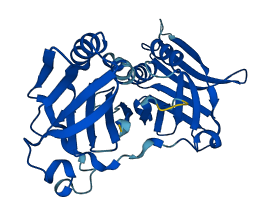
Descriptions
The autoinhibited protein was predicted that may have potential autoinhibitory elements via cis-regPred.
Autoinhibitory domains (AIDs)
Target domain |
|
Relief mechanism |
|
Assay |
cis-regPred |
Accessory elements
No accessory elements
Autoinhibited structure

Activated structure
1 structures for P78955
| Entry ID | Method | Resolution | Chain | Position | Source |
|---|---|---|---|---|---|
| AF-P78955-F1 | Predicted | AlphaFoldDB |
2 variants for P78955
| Variant ID(s) | Position | Change | Description | Diseaes Association | Provenance |
|---|---|---|---|---|---|
| I_4822180_T_C | 78 | I>V | No | Jeffares_SNPs | |
| I_4821870_G_A | 181 | S>L | No | Jeffares_SNPs |
No associated diseases with P78955
1 regional properties for P78955
| Type | Name | Position | InterPro Accession |
|---|---|---|---|
| domain | Peptidase M48 | 74 - 304 | IPR001915 |
7 GO annotations of cellular component
| Name | Definition |
|---|---|
| checkpoint clamp complex | Conserved heterotrimeric complex of PCNA-like proteins that is loaded onto DNA at sites of DNA damage. |
| chromosome, telomeric repeat region | A complex of DNA and protein that seals the end of a chromosome. The telomeric repeat DNA consists of simple tandemly repeated sequences specific for each species. Typically one strand is G-rich and the other C-rich. The G-rich strand forms a 3'-terminal overhang, the length of which varies with species. The single strand overhang is bound by a variety of proteins, including telomere capping proteins that bind to the single-stranded DNA and seal the telomeric loop. |
| cytosol | The part of the cytoplasm that does not contain organelles but which does contain other particulate matter, such as protein complexes. |
| mitotic spindle pole body | The microtubule organizing center that forms as part of the mitotic cell cycle; functionally homologous to the animal cell centrosome. |
| nucleolus | A small, dense body one or more of which are present in the nucleus of eukaryotic cells. It is rich in RNA and protein, is not bounded by a limiting membrane, and is not seen during mitosis. Its prime function is the transcription of the nucleolar DNA into 45S ribosomal-precursor RNA, the processing of this RNA into 5.8S, 18S, and 28S components of ribosomal RNA, and the association of these components with 5S RNA and proteins synthesized outside the nucleolus. This association results in the formation of ribonucleoprotein precursors; these pass into the cytoplasm and mature into the 40S and 60S subunits of the ribosome. |
| nucleus | A membrane-bounded organelle of eukaryotic cells in which chromosomes are housed and replicated. In most cells, the nucleus contains all of the cell's chromosomes except the organellar chromosomes, and is the site of RNA synthesis and processing. In some species, or in specialized cell types, RNA metabolism or DNA replication may be absent. |
| site of double-strand break | A region of a chromosome at which a DNA double-strand break has occurred. DNA damage signaling and repair proteins accumulate at the lesion to respond to the damage and repair the DNA to form a continuous DNA helix. |
No GO annotations of molecular function
| Name | Definition |
|---|---|
| No GO annotations for molecular function |
7 GO annotations of biological process
| Name | Definition |
|---|---|
| cell division | The process resulting in division and partitioning of components of a cell to form more cells; may or may not be accompanied by the physical separation of a cell into distinct, individually membrane-bounded daughter cells. |
| double-strand break repair via homologous recombination | The error-free repair of a double-strand break in DNA in which the broken DNA molecule is repaired using homologous sequences. A strand in the broken DNA searches for a homologous region in an intact chromosome to serve as the template for DNA synthesis. The restoration of two intact DNA molecules results in the exchange, reciprocal or nonreciprocal, of genetic material between the intact DNA molecule and the broken DNA molecule. |
| meiotic DNA integrity checkpoint signaling | A signal transduction process that controls cell cycle progression in response to changes in DNA structure by monitoring the integrity of the DNA during meiosis. The DNA integrity checkpoint begins with detection of DNA damage, defects in DNA structure or DNA replication, and ends with signal transduction. |
| mitotic DNA replication checkpoint signaling | A signal transduction process that contributes to a mitotic DNA replication checkpoint. |
| mitotic intra-S DNA damage checkpoint signaling | A mitotic cell cycle checkpoint that slows DNA synthesis in response to DNA damage by the prevention of new origin firing and the stabilization of slow replication fork progression. |
| nucleotide-excision repair | A DNA repair process in which a small region of the strand surrounding the damage is removed from the DNA helix as an oligonucleotide. The small gap left in the DNA helix is filled in by the sequential action of DNA polymerase and DNA ligase. Nucleotide excision repair recognizes a wide range of substrates, including damage caused by UV irradiation (pyrimidine dimers and 6-4 photoproducts) and chemicals (intrastrand cross-links and bulky adducts). |
| telomere maintenance | Any process that contributes to the maintenance of proper telomeric length and structure by affecting and monitoring the activity of telomeric proteins, the length of telomeric DNA and the replication and repair of the DNA. These processes includes those that shorten, lengthen, replicate and repair the telomeric DNA sequences. |
No homologous proteins in AiPD
| UniProt AC | Gene Name | Protein Name | Species | Evidence Code |
|---|---|---|---|---|
| No homologous proteins | ||||
| 10 | 20 | 30 | 40 | 50 | 60 |
| MRFKTRISNL | YTLTRLVQAL | DKIGRFCWLR | LMPETVNFVI | VPDFRMTQVW | SVLEVETIFE |
| 70 | 80 | 90 | 100 | 110 | 120 |
| DYVVQSNADN | VINLEVPIDN | FYKALRSAAN | ASDSTVRLSK | KNNQPLLSLS | TTWSGRAFGS |
| 130 | 140 | 150 | 160 | 170 | 180 |
| NIVTHNIPVR | VLSQSYVSVI | KEPTAPEPDC | HIFLPQLNFL | RHVVDKYKSL | SDRIIMSANM |
| 190 | 200 | 210 | 220 | 230 | 240 |
| SGELQLSVNI | PSARVSTKWK | GLENPELDPS | QVEDISRHPS | QTRAPEEFVH | MRLDSKDLVN |
| 250 | 260 | 270 | 280 | ||
| MLKISSVAKR | VIACFCEGHA | LVLYVYITDP | EDEHTAVLTY | YISTYVD |