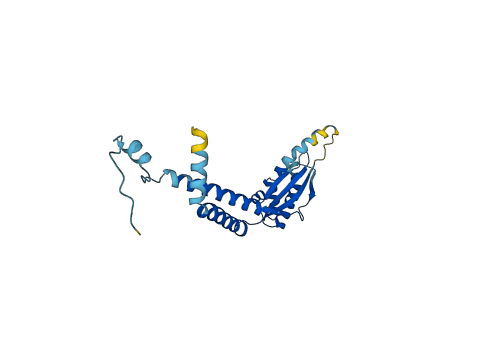
Descriptions
The autoinhibited protein was predicted that may have potential autoinhibitory elements via cis-regPred.
Autoinhibitory domains (AIDs)
Target domain |
|
Relief mechanism |
|
Assay |
cis-regPred |
Accessory elements
No accessory elements
Autoinhibited structure

Activated structure
2 structures for P72367
| Entry ID | Method | Resolution | Chain | Position | Source |
|---|---|---|---|---|---|
| 3BFV | X-ray | 180 A | A/B | 194-222 | PDB |
| AF-P72367-F1 | Predicted | AlphaFoldDB |
No variants for P72367
| Variant ID(s) | Position | Change | Description | Diseaes Association | Provenance |
|---|---|---|---|---|---|
| No variants for P72367 | |||||
No associated diseases with P72367
1 regional properties for P72367
| Type | Name | Position | InterPro Accession |
|---|---|---|---|
| domain | Polysaccharide chain length determinant N-terminal domain | 4 - 94 | IPR003856 |
2 GO annotations of cellular component
| Name | Definition |
|---|---|
| integral component of membrane | The component of a membrane consisting of the gene products and protein complexes having at least some part of their peptide sequence embedded in the hydrophobic region of the membrane. |
| plasma membrane | The membrane surrounding a cell that separates the cell from its external environment. It consists of a phospholipid bilayer and associated proteins. |
1 GO annotations of molecular function
| Name | Definition |
|---|---|
| carbohydrate:proton symporter activity | Enables the transfer of a solute or solutes from one side of a membrane to the other according to the reaction: carbohydrate(out) + H+(out) = carbohydrate(in) + H+(in). |
2 GO annotations of biological process
| Name | Definition |
|---|---|
| lipopolysaccharide biosynthetic process | The chemical reactions and pathways resulting in the formation of lipopolysaccharides, any of a group of related, structurally complex components of the outer membrane of Gram-negative bacteria. |
| polysaccharide transport | The directed movement of polysaccharides into, out of or within a cell, or between cells, by means of some agent such as a transporter or pore. A polysaccharide is a polymer of many (typically more than 10) monosaccharide residues linked glycosidically. |
No homologous proteins in AiPD
| UniProt AC | Gene Name | Protein Name | Species | Evidence Code |
|---|---|---|---|---|
| No homologous proteins | ||||
| 10 | 20 | 30 | 40 | 50 | 60 |
| MESTLELTKI | KEVLQKNLKI | LIILPLLFLI | ISAIVTFFVL | SPKYQANTQI | LVNQTKGDNP |
| 70 | 80 | 90 | 100 | 110 | 120 |
| QFMAQEVQSN | IQLVNTYKEI | VKSPRILDEV | SKDLNNKYSP | SKLSSMLTIT | NQENTQLINI |
| 130 | 140 | 150 | 160 | 170 | 180 |
| QVKSGHKQDS | EKIANSFAKV | TSKQIPKIMS | LDNVSILSKA | DGTAVKVAPK | TVVNLIGAFF |
| 190 | 200 | 210 | 220 | ||
| LGLVVALIYI | FFKVIFDKRI | KDEEDVEKEL | GLPVLGSIQK | FN |