P71073
Gene name |
adeR |
Protein name |
DNA-binding transcriptional activator AdeR |
Names |
PucR-type transcriptional activator AdeR |
Species |
Bacillus subtilis (strain 168) |
KEGG Pathway |
bsu:BSU31920 |
EC number |
|
Protein Class |
|
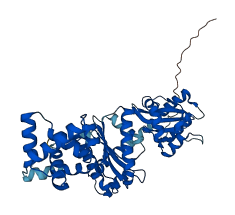
Descriptions
The autoinhibited protein was predicted that may have potential autoinhibitory elements via cis-regPred.
Autoinhibitory domains (AIDs)
Target domain |
|
Relief mechanism |
|
Assay |
cis-regPred |
Accessory elements
No accessory elements
Autoinhibited structure

Activated structure
1 structures for P71073
| Entry ID | Method | Resolution | Chain | Position | Source |
|---|---|---|---|---|---|
| AF-P71073-F1 | Predicted | AlphaFoldDB |
No variants for P71073
| Variant ID(s) | Position | Change | Description | Diseaes Association | Provenance |
|---|---|---|---|---|---|
| No variants for P71073 | |||||
No associated diseases with P71073
No GO annotations of cellular component
| Name | Definition |
|---|---|
| No GO annotations for cellular component |
2 GO annotations of molecular function
| Name | Definition |
|---|---|
| DNA binding | Any molecular function by which a gene product interacts selectively and non-covalently with DNA (deoxyribonucleic acid). |
| GTP binding | Binding to GTP, guanosine triphosphate. |
3 GO annotations of biological process
| Name | Definition |
|---|---|
| DNA-templated transcription | The synthesis of an RNA transcript from a DNA template. |
| sporulation | The process whose specific outcome is the progression of a spore over time, from its initiation to the mature structure. A spore is a structure that can be used for dissemination, for survival of adverse conditions because of its heat and dessication resistance, and/or for reproduction. |
| sporulation resulting in formation of a cellular spore | The process in which a relatively unspecialized cell acquires the specialized features of a cellular spore, a cell form that can be used for dissemination, for survival of adverse conditions because of its heat and dessication resistance, and/or for reproduction. |
No homologous proteins in AiPD
| UniProt AC | Gene Name | Protein Name | Species | Evidence Code |
|---|---|---|---|---|
| No homologous proteins | ||||
| 10 | 20 | 30 | 40 | 50 | 60 |
| MSKRNQARKV | GRFMTMPNDP | FKYSFDRLED | VADHISDVLR | CPITIEDVNH | KLLAYSTHSD |
| 70 | 80 | 90 | 100 | 110 | 120 |
| CTDPARTSTI | IGRRVPEKVI | NKLWKDGTIP | ALLKTDQPIR | VKQIDEVGLS | NRVAISIWKN |
| 130 | 140 | 150 | 160 | 170 | 180 |
| KQVLGFIWAL | EIQKTLSDED | LLTLQMAAKA | VKNKLLKLQI | RKTKNEERSQ | EFFWKMLTGH |
| 190 | 200 | 210 | 220 | 230 | 240 |
| IHQEDDMADG | FHKLGMAAPS | EFSVMIIRIN | GELTEKIEQQ | LQYLQETTQQ | VYVLLATVDS |
| 250 | 260 | 270 | 280 | 290 | 300 |
| NELIILTSPK | TDHPFQDLKQ | FALSTQKQLK | ERYKIEDVSI | AFGGIYNSIS | FVSRSYQEAL |
| 310 | 320 | 330 | 340 | 350 | 360 |
| SVLKTKERFA | EETKHLFSFS | ELGIYQYLDV | LNEKRKQAGH | YNYSLSKLEQ | YDRDHQSNMV |
| 370 | 380 | 390 | 400 | 410 | 420 |
| ETLERFIEAD | SNVNTASKLL | NIHVNTLNYR | LKRISQIAEI | DLKNVNQKFT | IYLDIKLRHM |
| DL |