P70270
Gene name |
Rad54l (Rad54) |
Protein name |
DNA repair and recombination protein RAD54-like |
Names |
RAD54 homolog, mHR54, mRAD54 |
Species |
Mus musculus (Mouse) |
KEGG Pathway |
mmu:19366 |
EC number |
3.6.4.12: Acting on ATP; involved in cellular and subcellular movement |
Protein Class |
|
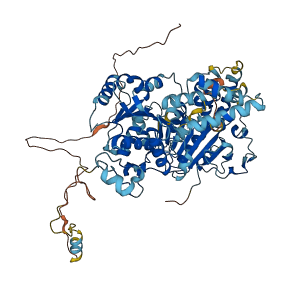
Descriptions
The autoinhibited protein was predicted that may have potential autoinhibitory elements via cis-regPred.
Autoinhibitory domains (AIDs)
Target domain |
|
Relief mechanism |
|
Assay |
cis-regPred |
Accessory elements
No accessory elements
Autoinhibited structure

Activated structure
1 structures for P70270
| Entry ID | Method | Resolution | Chain | Position | Source |
|---|---|---|---|---|---|
| AF-P70270-F1 | Predicted | AlphaFoldDB |
38 variants for P70270
| Variant ID(s) | Position | Change | Description | Diseaes Association | Provenance |
|---|---|---|---|---|---|
| rs3388682587 | 26 | Q>K | No | EVA | |
| rs3388705146 | 34 | K>* | No | EVA | |
| rs3388705147 | 54 | P>S | No | EVA | |
| rs27511282 | 57 | Q>P | No | EVA | |
| rs3412928481 | 68 | S>T | No | EVA | |
| rs27511300 | 103 | A>V | No | EVA | |
| rs3388706730 | 138 | K>T | No | EVA | |
| rs3388701477 | 146 | D>G | No | EVA | |
| rs228636316 | 197 | M>I | No | EVA | |
| rs3388703798 | 212 | E>V | No | EVA | |
| rs3388706732 | 246 | G>V | No | EVA | |
| rs3388697709 | 252 | D>N | No | EVA | |
| rs3388690106 | 377 | G>E* | No | EVA | |
| rs3388705143 | 380 | R>G | No | EVA | |
| rs3388701135 | 382 | R>G | No | EVA | |
| rs3388704182 | 429 | R>I | No | EVA | |
| rs3394734089 | 432 | K>* | No | EVA | |
| rs237586479 | 486 | N>S | No | EVA | |
| rs3394449701 | 491 | E>A | No | EVA | |
| rs3394734045 | 491 | E>D | No | EVA | |
| rs3394755272 | 492 | P>L | No | EVA | |
| rs3388698165 | 529 | F>Y | No | EVA | |
| rs3388701142 | 531 | K>R | No | EVA | |
| rs3388690162 | 533 | C>S | No | EVA | |
| rs3388701109 | 558 | R>C | No | EVA | |
| rs3394569231 | 587 | R>Q | No | EVA | |
| rs3388682646 | 609 | R>P | No | EVA | |
| rs3388703722 | 611 | G>D | No | EVA | |
| rs3388701083 | 615 | I>V | No | EVA | |
| rs3394776508 | 634 | R>L | No | EVA | |
| rs3388682599 | 655 | H>Q | No | EVA | |
| rs3410608160 | 656 | F>L | No | EVA | |
| rs3388696256 | 669 | E>G | No | EVA | |
| rs3388698136 | 693 | P>H | No | EVA | |
| rs3388703719 | 699 | C>S | No | EVA | |
| rs3388705093 | 705 | Q>* | No | EVA | |
| rs3388690129 | 715 | L>F | No | EVA | |
| rs3394711355 | 725 | D>G | No | EVA |
No associated diseases with P70270
Functions
| Description | ||
|---|---|---|
| EC Number | 3.6.4.12 | Acting on ATP; involved in cellular and subcellular movement |
| Subcellular Localization |
|
|
| PANTHER Family | ||
| PANTHER Subfamily | ||
| PANTHER Protein Class | ||
| PANTHER Pathway Category | No pathway information available | |
3 GO annotations of cellular component
| Name | Definition |
|---|---|
| nucleoplasm | That part of the nuclear content other than the chromosomes or the nucleolus. |
| nucleus | A membrane-bounded organelle of eukaryotic cells in which chromosomes are housed and replicated. In most cells, the nucleus contains all of the cell's chromosomes except the organellar chromosomes, and is the site of RNA synthesis and processing. In some species, or in specialized cell types, RNA metabolism or DNA replication may be absent. |
| protein-containing complex | A stable assembly of two or more macromolecules, i.e. proteins, nucleic acids, carbohydrates or lipids, in which at least one component is a protein and the constituent parts function together. |
7 GO annotations of molecular function
| Name | Definition |
|---|---|
| ATP binding | Binding to ATP, adenosine 5'-triphosphate, a universally important coenzyme and enzyme regulator. |
| ATP hydrolysis activity | Catalysis of the reaction: ATP + H2O = ADP + H+ phosphate. ATP hydrolysis is used in some reactions as an energy source, for example to catalyze a reaction or drive transport against a concentration gradient. |
| ATP-dependent chromatin remodeler activity | An activity, driven by ATP hydrolysis, that modulates the contacts between histones and DNA, resulting in a change in chromosome architecture within the nucleosomal array, leading to chromatin remodeling. |
| ATP-dependent DNA/DNA annealing activity | An ATP-dependent activity that facilitates the formation of a complementary double-stranded DNA molecule. |
| DNA helicase activity | Unwinding of a DNA helix, driven by ATP hydrolysis. |
| DNA translocase activity | Generation of movement along a single- or double-stranded DNA molecule, driven by ATP hydrolysis. |
| metal ion binding | Binding to a metal ion. |
9 GO annotations of biological process
| Name | Definition |
|---|---|
| cellular response to DNA damage stimulus | Any process that results in a change in state or activity of a cell (in terms of movement, secretion, enzyme production, gene expression, etc.) as a result of a stimulus indicating damage to its DNA from environmental insults or errors during metabolism. |
| chromosome organization | A process that is carried out at the cellular level that results in the assembly, arrangement of constituent parts, or disassembly of chromosomes, structures composed of a very long molecule of DNA and associated proteins that carries hereditary information. This term covers covalent modifications at the molecular level as well as spatial relationships among the major components of a chromosome. |
| determination of adult lifespan | The pathways that regulate the duration of the adult phase of the life-cycle of an animal. |
| double-strand break repair | The repair of double-strand breaks in DNA via homologous and nonhomologous mechanisms to reform a continuous DNA helix. |
| double-strand break repair via homologous recombination | The error-free repair of a double-strand break in DNA in which the broken DNA molecule is repaired using homologous sequences. A strand in the broken DNA searches for a homologous region in an intact chromosome to serve as the template for DNA synthesis. The restoration of two intact DNA molecules results in the exchange, reciprocal or nonreciprocal, of genetic material between the intact DNA molecule and the broken DNA molecule. |
| double-strand break repair via synthesis-dependent strand annealing | SDSA is a major mechanism of double-strand break repair in mitosis which allows for the error-free repair of a double-strand break without the exchange of adjacent sequences. The broken DNA searches for and base pairs with a homologous region in an intact chromosome. DNA synthesis initiates from the 3' end of the invading DNA strand, using the intact chromosome as the template. Newly synthesized DNA is then displaced from the template and anneal with its complement on the other side of the double-strand break. |
| reciprocal meiotic recombination | The cell cycle process in which double strand breaks are formed and repaired through a single or double Holliday junction intermediate. This results in the equal exchange of genetic material between non-sister chromatids in a pair of homologous chromosomes. These reciprocal recombinant products ensure the proper segregation of homologous chromosomes during meiosis I and create genetic diversity. |
| response to ionizing radiation | Any process that results in a change in state or activity of a cell or an organism (in terms of movement, secretion, enzyme production, gene expression, etc.) as a result of a ionizing radiation stimulus. Ionizing radiation is radiation with sufficient energy to remove electrons from atoms and may arise from spontaneous decay of unstable isotopes, resulting in alpha and beta particles and gamma rays. Ionizing radiation also includes X-rays. |
| response to xenobiotic stimulus | Any process that results in a change in state or activity of a cell or an organism (in terms of movement, secretion, enzyme production, gene expression, etc.) as a result of a stimulus from a xenobiotic, a compound foreign to the organim exposed to it. It may be synthesized by another organism (like ampicilin) or it can be a synthetic chemical. |
No homologous proteins in AiPD
| UniProt AC | Gene Name | Protein Name | Species | Evidence Code |
|---|---|---|---|---|
| No homologous proteins | ||||
| 10 | 20 | 30 | 40 | 50 | 60 |
| MRRSLAPSQL | ARRKPEDRSS | DDEDWQPGTV | TPKKRKSSSE | TQVQECFLSP | FRKPLTQLLN |
| 70 | 80 | 90 | 100 | 110 | 120 |
| RPPCLDSSQH | EAFIRSILSK | PFKVPIPNYQ | GPLGSRALGL | KRAGVRRALH | DPLEEGALVL |
| 130 | 140 | 150 | 160 | 170 | 180 |
| YEPPPLSAHD | QLKLDKEKLP | VHVVVDPILS | KVLRPHQREG | VKFLWECVTS | RRIPGSHGCI |
| 190 | 200 | 210 | 220 | 230 | 240 |
| MADEMGLGKT | LQCITLMWTL | LRQSPECKPE | IEKAVVVSPS | SLVKNWYNEV | EKWLGGRIQP |
| 250 | 260 | 270 | 280 | 290 | 300 |
| LAIDGGSKDE | IDRKLEGFMN | QRGARVPSPI | LIISYETFRL | HVGVLKKGNV | GLVICDEGHR |
| 310 | 320 | 330 | 340 | 350 | 360 |
| LKNSENQTYQ | ALDSLNTSRR | VLISGTPIQN | DLLEYFSLVH | FVNSGILGTA | HEFKKHFELP |
| 370 | 380 | 390 | 400 | 410 | 420 |
| ILKSRDAAAS | EADRQRGEER | LRELIGIVNR | CLIRRTSDIL | SKYLPVKIEQ | VVCCRLTPLQ |
| 430 | 440 | 450 | 460 | 470 | 480 |
| TELYKRFLRQ | AKPEEELREG | KMSVSSLSSI | TSLKKLCNHP | ALIYDKCVAE | EDGFEGTLGI |
| 490 | 500 | 510 | 520 | 530 | 540 |
| FPPGYNSKAV | EPQLSGKMLV | LDYILAVTRS | RSSDKVVLVS | NYTQTLDLFE | KLCRVRRYLY |
| 550 | 560 | 570 | 580 | 590 | 600 |
| VRLDGTMSIK | KRAKVVERFN | SPSSPDFVFM | LSSKAGGCGL | NLIGANRLVM | FDPDWNPAND |
| 610 | 620 | 630 | 640 | 650 | 660 |
| EQAMARVWRD | GQKKICYIYR | LLSAGTIEEK | IFQRQSHKKA | LSSCVVDEEQ | DVERHFSLGE |
| 670 | 680 | 690 | 700 | 710 | 720 |
| LKELFTLDEA | SLSDTHDRLH | CRRCVNNRQV | WPPPDGSDCT | SDLAQWNHST | DKRGLQDEVL |
| 730 | 740 | ||||
| QAAWDASSTA | ITFVFHQRSH | EEQRGLH |