P70255
Gene name |
Nfic |
Protein name |
Nuclear factor 1 C-type |
Names |
NF1-C, Nuclear factor 1/C, CCAAT-box-binding transcription factor, CTF, Nuclear factor I/C, NF-I/C, NFI-C, TGGCA-binding protein |
Species |
Mus musculus (Mouse) |
KEGG Pathway |
mmu:18029 |
EC number |
|
Protein Class |
|
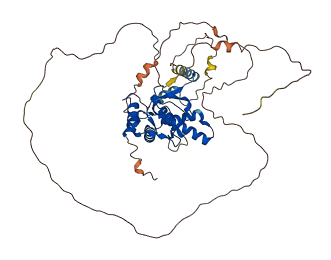
Descriptions
The autoinhibited protein was predicted that may have potential autoinhibitory elements via cis-regPred.
Autoinhibitory domains (AIDs)
Target domain |
|
Relief mechanism |
|
Assay |
cis-regPred |
Accessory elements
No accessory elements
Autoinhibited structure

Activated structure
1 structures for P70255
| Entry ID | Method | Resolution | Chain | Position | Source |
|---|---|---|---|---|---|
| AF-P70255-F1 | Predicted | AlphaFoldDB |
13 variants for P70255
| Variant ID(s) | Position | Change | Description | Diseaes Association | Provenance |
|---|---|---|---|---|---|
| rs864308481 | 143 | L>Q | No | EVA | |
| rs3389122253 | 189 | A>T | No | EVA | |
| rs3389059493 | 203 | Q>H | No | EVA | |
| rs3389116190 | 206 | S>R | No | EVA | |
| rs3389122322 | 212 | D>V | No | EVA | |
| rs3389105608 | 261 | N>D | No | EVA | |
| rs3389118904 | 265 | A>V | No | EVA | |
| rs864307060 | 291 | V>A | No | EVA | |
| rs3389113674 | 392 | T>M | No | EVA | |
| rs3389105657 | 393 | A>D | No | EVA | |
| rs3389122244 | 399 | H>Q | No | EVA | |
| rs3389095362 | 399 | H>R | No | EVA | |
| rs3389084388 | 431 | P>S | No | EVA |
No associated diseases with P70255
4 regional properties for P70255
| Type | Name | Position | InterPro Accession |
|---|---|---|---|
| domain | MAD homology 1, Dwarfin-type | 68 - 176 | IPR003619 |
| domain | CTF transcription factor/nuclear factor 1, N-terminal | 9 - 47 | IPR019548 |
| conserved_site | CTF transcription factor/nuclear factor 1, conserved site | 37 - 48 | IPR019739 |
| domain | CTF transcription factor/nuclear factor 1, DNA-binding domain | 2 - 195 | IPR020604 |
3 GO annotations of cellular component
| Name | Definition |
|---|---|
| fibrillar center | A structure found most metazoan nucleoli, but not usually found in lower eukaryotes; surrounded by the dense fibrillar component; the zone of transcription from multiple copies of the pre-rRNA genes is in the border region between these two structures. |
| nucleoplasm | That part of the nuclear content other than the chromosomes or the nucleolus. |
| nucleus | A membrane-bounded organelle of eukaryotic cells in which chromosomes are housed and replicated. In most cells, the nucleus contains all of the cell's chromosomes except the organellar chromosomes, and is the site of RNA synthesis and processing. In some species, or in specialized cell types, RNA metabolism or DNA replication may be absent. |
8 GO annotations of molecular function
| Name | Definition |
|---|---|
| cis-regulatory region sequence-specific DNA binding | Binding to a specific upstream regulatory DNA sequence (transcription factor recognition sequence or binding site) located in cis relative to the transcription start site (i.e., on the same strand of DNA) of a gene transcribed by some RNA polymerase. The proximal promoter is in cis with and relatively close to the core promoter. |
| DNA binding | Any molecular function by which a gene product interacts selectively and non-covalently with DNA (deoxyribonucleic acid). |
| DNA-binding transcription activator activity, RNA polymerase II-specific | A DNA-binding transcription factor activity that activates or increases transcription of specific gene sets transcribed by RNA polymerase II. |
| DNA-binding transcription factor activity | A transcription regulator activity that modulates transcription of gene sets via selective and non-covalent binding to a specific double-stranded genomic DNA sequence (sometimes referred to as a motif) within a cis-regulatory region. Regulatory regions include promoters (proximal and distal) and enhancers. Genes are transcriptional units, and include bacterial operons. |
| DNA-binding transcription factor activity, RNA polymerase II-specific | A DNA-binding transcription factor activity that modulates the transcription of specific gene sets transcribed by RNA polymerase II. |
| double-stranded DNA binding | Binding to double-stranded DNA. |
| RNA polymerase II cis-regulatory region sequence-specific DNA binding | Binding to a specific upstream regulatory DNA sequence (transcription factor recognition sequence or binding site) located in cis relative to the transcription start site (i.e., on the same strand of DNA) of a gene transcribed by RNA polymerase II. |
| sequence-specific double-stranded DNA binding | Binding to double-stranded DNA of a specific nucleotide composition, e.g. GC-rich DNA binding, or with a specific sequence motif or type of DNA, e.g. promotor binding or rDNA binding. |
6 GO annotations of biological process
| Name | Definition |
|---|---|
| DNA replication | The cellular metabolic process in which a cell duplicates one or more molecules of DNA. DNA replication begins when specific sequences, known as origins of replication, are recognized and bound by initiation proteins, and ends when the original DNA molecule has been completely duplicated and the copies topologically separated. The unit of replication usually corresponds to the genome of the cell, an organelle, or a virus. The template for replication can either be an existing DNA molecule or RNA. |
| negative regulation of DNA-templated transcription | Any process that stops, prevents, or reduces the frequency, rate or extent of cellular DNA-templated transcription. |
| negative regulation of transcription by RNA polymerase II | Any process that stops, prevents, or reduces the frequency, rate or extent of transcription mediated by RNA polymerase II. |
| odontogenesis of dentin-containing tooth | The process whose specific outcome is the progression of a dentin-containing tooth over time, from its formation to the mature structure. A dentin-containing tooth is a hard, bony organ borne on the jaw or other bone of a vertebrate, and is composed mainly of dentin, a dense calcified substance, covered by a layer of enamel. |
| positive regulation of transcription by RNA polymerase II | Any process that activates or increases the frequency, rate or extent of transcription from an RNA polymerase II promoter. |
| regulation of transcription by RNA polymerase II | Any process that modulates the frequency, rate or extent of transcription mediated by RNA polymerase II. |
No homologous proteins in AiPD
| UniProt AC | Gene Name | Protein Name | Species | Evidence Code |
|---|---|---|---|---|
| No homologous proteins | ||||
| 10 | 20 | 30 | 40 | 50 | 60 |
| MYSSPLCLTQ | DEFHPFIEAL | LPHVRAFAYT | WFNLQARKRK | YFKKHEKRMS | KDEERAVKDE |
| 70 | 80 | 90 | 100 | 110 | 120 |
| LLGEKAEVKQ | KWASRLLAKL | RKDIRPECRE | DFVLAVTGKK | APGCVLSNPD | QKGKMRRIDC |
| 130 | 140 | 150 | 160 | 170 | 180 |
| LRQADKVWRL | DLVMVILFKG | IPLESTDGER | LVKAAACAHP | VLCVQPHHIG | VAVKELDLYL |
| 190 | 200 | 210 | 220 | 230 | 240 |
| AYFVRERDAE | QSSSPRTGVG | SDQEDSKPIT | LDTTDFQESF | VTSGVFSVTE | LIQVSRTPVV |
| 250 | 260 | 270 | 280 | 290 | 300 |
| TGTGPNFSLG | ELQGHLAYDL | NPASAGMRRT | LPSTSSSGSK | RHKSGSMEED | VDTSPGGDYY |
| 310 | 320 | 330 | 340 | 350 | 360 |
| TSPNSPTSSS | RNWTEDIEGG | ISSPVKKTEM | DKSPFNSPSP | QDSPRLSSFT | QHHRPVIAVH |
| 370 | 380 | 390 | 400 | 410 | 420 |
| SGIARSPHPT | SALHFPATPI | LPQTASTYFP | HTAIRYPPHL | NPQDPLKDLV | SLACDPATQQ |
| 430 | |||||
| PGPPALRPTR | PLQTVPLWD |