P70032
Gene name |
plk1 (plx1) |
Protein name |
Serine/threonine-protein kinase PLK1 |
Names |
Plx1, Polo-like kinase 1, PLK-1 |
Species |
Xenopus laevis (African clawed frog) |
KEGG Pathway |
xla:380481 |
EC number |
|
Protein Class |
|
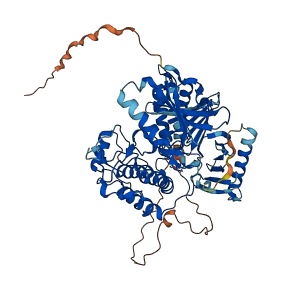
Descriptions
The autoinhibited protein was predicted that may have potential autoinhibitory elements via cis-regPred.
Autoinhibitory domains (AIDs)
Target domain |
|
Relief mechanism |
|
Assay |
cis-regPred |
Accessory elements
184-207 (Activation loop from InterPro)
Target domain |
44-296 (Protein kinase domain) |
Relief mechanism |
|
Assay |
|
Autoinhibited structure

Activated structure
1 structures for P70032
| Entry ID | Method | Resolution | Chain | Position | Source |
|---|---|---|---|---|---|
| AF-P70032-F1 | Predicted | AlphaFoldDB |
No variants for P70032
| Variant ID(s) | Position | Change | Description | Diseaes Association | Provenance |
|---|---|---|---|---|---|
| No variants for P70032 | |||||
No associated diseases with P70032
8 regional properties for P70032
| Type | Name | Position | InterPro Accession |
|---|---|---|---|
| domain | Protein kinase domain | 44 - 296 | IPR000719 |
| domain | POLO box domain | 411 - 474 | IPR000959-1 |
| domain | POLO box domain | 509 - 578 | IPR000959-2 |
| active_site | Serine/threonine-protein kinase, active site | 163 - 175 | IPR008271 |
| binding_site | Protein kinase, ATP binding site | 50 - 73 | IPR017441 |
| domain | Second polo-box domain | 503 - 584 | IPR033695 |
| domain | First polo-box domain | 401 - 488 | IPR033701 |
| domain | Polo-like kinase 1, catalytic domain | 36 - 300 | IPR033702 |
Functions
7 GO annotations of cellular component
| Name | Definition |
|---|---|
| centrosome | A structure comprised of a core structure (in most organisms, a pair of centrioles) and peripheral material from which a microtubule-based structure, such as a spindle apparatus, is organized. Centrosomes occur close to the nucleus during interphase in many eukaryotic cells, though in animal cells it changes continually during the cell-division cycle. |
| cytoplasm | The contents of a cell excluding the plasma membrane and nucleus, but including other subcellular structures. |
| kinetochore | A multisubunit complex that is located at the centromeric region of DNA and provides an attachment point for the spindle microtubules. |
| midbody | A thin cytoplasmic bridge formed between daughter cells at the end of cytokinesis. The midbody forms where the contractile ring constricts, and may persist for some time before finally breaking to complete cytokinesis. |
| nucleus | A membrane-bounded organelle of eukaryotic cells in which chromosomes are housed and replicated. In most cells, the nucleus contains all of the cell's chromosomes except the organellar chromosomes, and is the site of RNA synthesis and processing. In some species, or in specialized cell types, RNA metabolism or DNA replication may be absent. |
| spindle | The array of microtubules and associated molecules that forms between opposite poles of a eukaryotic cell during mitosis or meiosis and serves to move the duplicated chromosomes apart. |
| spindle midzone | The area in the center of the spindle where the spindle microtubules from opposite poles overlap. |
5 GO annotations of molecular function
| Name | Definition |
|---|---|
| ATP binding | Binding to ATP, adenosine 5'-triphosphate, a universally important coenzyme and enzyme regulator. |
| microtubule binding | Binding to a microtubule, a filament composed of tubulin monomers. |
| protein kinase binding | Binding to a protein kinase, any enzyme that catalyzes the transfer of a phosphate group, usually from ATP, to a protein substrate. |
| protein serine kinase activity | Catalysis of the reactions: ATP + protein serine = ADP + protein serine phosphate. |
| protein serine/threonine kinase activity | Catalysis of the reactions: ATP + protein serine = ADP + protein serine phosphate, and ATP + protein threonine = ADP + protein threonine phosphate. |
12 GO annotations of biological process
| Name | Definition |
|---|---|
| centrosome cycle | The cell cycle process in which centrosome duplication and separation takes place. The centrosome cycle can operate with a considerable degree of independence from other processes of the cell cycle. |
| G2/M transition of mitotic cell cycle | The mitotic cell cycle transition by which a cell in G2 commits to M phase. The process begins when the kinase activity of M cyclin/CDK complex reaches a threshold high enough for the cell cycle to proceed. This is accomplished by activating a positive feedback loop that results in the accumulation of unphosphorylated and active M cyclin/CDK complex. |
| microtubule bundle formation | A process that results in a parallel arrangement of microtubules. |
| mitotic cell cycle | Progression through the phases of the mitotic cell cycle, the most common eukaryotic cell cycle, which canonically comprises four successive phases called G1, S, G2, and M and includes replication of the genome and the subsequent segregation of chromosomes into daughter cells. In some variant cell cycles nuclear replication or nuclear division may not be followed by cell division, or G1 and G2 phases may be absent. |
| mitotic cytokinesis | A cell cycle process that results in the division of the cytoplasm of a cell after mitosis, resulting in the separation of the original cell into two daughter cells. |
| mitotic G2 DNA damage checkpoint signaling | A mitotic cell cycle checkpoint that detects and negatively regulates progression through the G2/M transition of the cell cycle in response to DNA damage. |
| negative regulation of apoptotic process | Any process that stops, prevents, or reduces the frequency, rate or extent of cell death by apoptotic process. |
| negative regulation of transcription by RNA polymerase II | Any process that stops, prevents, or reduces the frequency, rate or extent of transcription mediated by RNA polymerase II. |
| oocyte maturation | A developmental process, independent of morphogenetic (shape) change, that is required for an oocyte to attain its fully functional state. Oocyte maturation commences after reinitiation of meiosis commonly starting with germinal vesicle breakdown, and continues up to the second meiotic arrest prior to fertilization. |
| positive regulation of ubiquitin protein ligase activity | Any process that activates or increases the frequency, rate or extent of ubiquitin protein ligase activity. |
| protein localization to chromatin | Any process in which a protein is transported to, or maintained at, a part of a chromosome that is organized into chromatin. |
| protein phosphorylation | The process of introducing a phosphate group on to a protein. |
No homologous proteins in AiPD
| UniProt AC | Gene Name | Protein Name | Species | Evidence Code |
|---|---|---|---|---|
| No homologous proteins | ||||
| 10 | 20 | 30 | 40 | 50 | 60 |
| MAQVAGKKLT | VAPEAAKPPG | IPGSSSAVKE | IPEILVDPRT | RRRYLRGRFL | GKGGFAKCYE |
| 70 | 80 | 90 | 100 | 110 | 120 |
| ITDLESREVF | AGKIVPKTML | LKPHQKDKMT | MEIAIQRSLD | HRHVVGFHGF | FEDNDFVYVV |
| 130 | 140 | 150 | 160 | 170 | 180 |
| LELCRRRSLL | ELHKRRKAVT | EPEARYYLKQ | TISGCQYLHS | NRVIHRDLKL | GNLFLNDEME |
| 190 | 200 | 210 | 220 | 230 | 240 |
| VKIGDFGLAT | KVEYDGERKK | TLCGTPNYIA | PEVLGKKGHS | FEVDIWSIGC | IMYTLLVGKP |
| 250 | 260 | 270 | 280 | 290 | 300 |
| PFETSCLKET | YMRIKKNEYS | IPKHINPVAA | ALIQKMLRSD | PTSRPTIDDL | LNDEFFTSGY |
| 310 | 320 | 330 | 340 | 350 | 360 |
| IPSRLPTTCL | TVPPRFSIAP | STIDQSLRKP | LTAINKGQDS | PLVEKQVAPA | KEEEMQQPEF |
| 370 | 380 | 390 | 400 | 410 | 420 |
| TEPADCYLSE | MLQQLTCLNA | VKPSERALIR | QEEAEDPASI | PIFWISKWVD | YSDKYGLGYQ |
| 430 | 440 | 450 | 460 | 470 | 480 |
| LCDNSVGVLF | NDSTRLIMYN | DGDSLQYIER | NNTESYLNVR | SYPTTLTKKI | TLLKYFRNYM |
| 490 | 500 | 510 | 520 | 530 | 540 |
| SEHLLKAGAN | TTPREGDELA | RLPFLRTWFR | TRSAIILHLS | NGTVQINFFQ | DHTKIILCPL |
| 550 | 560 | 570 | 580 | 590 | |
| MAAVSYIDEK | REFRTYKLSL | IQEFGCCKEL | ASRLRYARTM | VEKLQSSKSA | VAHVKASA |