P69797
Gene name |
manX |
Protein name |
PTS system mannose-specific EIIAB component |
Names |
EIIAB-Man, EIII-Man |
Species |
Escherichia coli (strain K12) |
KEGG Pathway |
eco:b1817 |
EC number |
2.7.1.191: Phosphotransferases with an alcohol group as acceptor |
Protein Class |
|
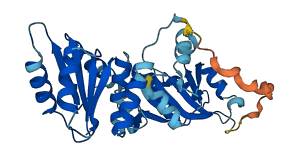
Descriptions
The autoinhibited protein was predicted that may have potential autoinhibitory elements via cis-regPred.
Autoinhibitory domains (AIDs)
Target domain |
|
Relief mechanism |
|
Assay |
cis-regPred |
Accessory elements
No accessory elements

No variants for P69797
| Variant ID(s) | Position | Change | Description | Diseaes Association | Provenance |
|---|---|---|---|---|---|
| No variants for P69797 | |||||
No associated diseases with P69797
4 regional properties for P69797
| Type | Name | Position | InterPro Accession |
|---|---|---|---|
| domain | Phosphotransferase system, mannose-type IIA component | 2 - 126 | IPR004701 |
| domain | Phosphotransferase system, sorbose subfamily IIB component | 160 - 323 | IPR004720 |
| domain | Phosphotransferase system, mannose family IIA component | 2 - 117 | IPR013789 |
| domain | PTS system mannose/sorbose specific IIA subunit | 3 - 124 | IPR033887 |
Functions
| Description | ||
|---|---|---|
| EC Number | 2.7.1.191 | Phosphotransferases with an alcohol group as acceptor |
| Subcellular Localization |
|
|
| PANTHER Family | ||
| PANTHER Subfamily | ||
| PANTHER Protein Class | ||
| PANTHER Pathway Category | No pathway information available | |
5 GO annotations of cellular component
| Name | Definition |
|---|---|
| cytoplasm | The contents of a cell excluding the plasma membrane and nucleus, but including other subcellular structures. |
| cytosol | The part of the cytoplasm that does not contain organelles but which does contain other particulate matter, such as protein complexes. |
| integral component of plasma membrane | The component of the plasma membrane consisting of the gene products and protein complexes having at least some part of their peptide sequence embedded in the hydrophobic region of the membrane. |
| membrane | A lipid bilayer along with all the proteins and protein complexes embedded in it an attached to it. |
| transmembrane transporter complex | A transmembrane protein complex which enables the transfer of a substance from one side of a membrane to the other. |
2 GO annotations of molecular function
| Name | Definition |
|---|---|
| kinase activity | Catalysis of the transfer of a phosphate group, usually from ATP, to a substrate molecule. |
| protein-N(PI)-phosphohistidine-mannose phosphotransferase system transporter activity | Catalysis of the PEP-dependent, phosphoryl transfer-driven transport of substances across a membrane. The transport happens by catalysis of the reaction: protein N-phosphohistidine + mannose(out) = protein histidine + mannose phosphate(in). This differs from primary and secondary active transport in that the solute is modified during transport. |
4 GO annotations of biological process
| Name | Definition |
|---|---|
| glucose import across plasma membrane | The directed movement of glucose from outside of a cell, across the plasma membrane and into the cytosol. |
| mannose transmembrane transport | The process in which mannose is transported across a lipid bilayer, from one side of a membrane to the other. Mannose is the aldohexose manno-hexose, the C-2 epimer of glucose. The D-(+)-form is widely distributed in mannans and hemicelluloses and is of major importance in the core oligosaccharide of N-linked oligosaccharides of glycoproteins. |
| phosphoenolpyruvate-dependent sugar phosphotransferase system | The uptake and phosphorylation of specific carbohydrates from the extracellular environment; uptake and phosphorylation are coupled, making the PTS a link between the uptake and metabolism of sugars; phosphoenolpyruvate is the original phosphate donor; phosphoenolpyruvate passes the phosphate via a signal transduction pathway, to enzyme 1 (E1), which in turn passes it on to the histidine protein, HPr; the next step in the system involves sugar-specific membrane-bound complex, enzyme 2 (EII), which transports the sugar into the cell; it includes the sugar permease, which catalyzes the transport reactions; EII is usually divided into three different domains, EIIA, EIIB, and EIIC. |
| phosphorylation | The process of introducing a phosphate group into a molecule, usually with the formation of a phosphoric ester, a phosphoric anhydride or a phosphoric amide. |
No homologous proteins in AiPD
| UniProt AC | Gene Name | Protein Name | Species | Evidence Code |
|---|---|---|---|---|
| No homologous proteins | ||||
| 10 | 20 | 30 | 40 | 50 | 60 |
| MTIAIVIGTH | GWAAEQLLKT | AEMLLGEQEN | VGWIDFVPGE | NAETLIEKYN | AQLAKLDTTK |
| 70 | 80 | 90 | 100 | 110 | 120 |
| GVLFLVDTWG | GSPFNAASRI | VVDKEHYEVI | AGVNIPMLVE | TLMARDDDPS | FDELVALAVE |
| 130 | 140 | 150 | 160 | 170 | 180 |
| TGREGVKALK | AKPVEKAAPA | PAAAAPKAAP | TPAKPMGPND | YMVIGLARID | DRLIHGQVAT |
| 190 | 200 | 210 | 220 | 230 | 240 |
| RWTKETNVSR | IIVVSDEVAA | DTVRKTLLTQ | VAPPGVTAHV | VDVAKMIRVY | NNPKYAGERV |
| 250 | 260 | 270 | 280 | 290 | 300 |
| MLLFTNPTDV | ERLVEGGVKI | TSVNVGGMAF | RQGKTQVNNA | VSVDEKDIEA | FKKLNARGIE |
| 310 | 320 | ||||
| LEVRKVSTDP | KLKMMDLISK | IDK |