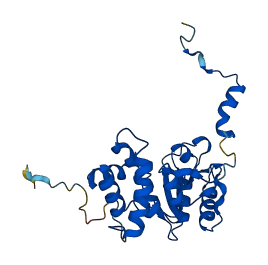
Descriptions
The autoinhibited protein was predicted that may have potential autoinhibitory elements via cis-regPred.
Autoinhibitory domains (AIDs)
Target domain |
|
Relief mechanism |
|
Assay |
cis-regPred |
Accessory elements
No accessory elements
Autoinhibited structure

Activated structure
1 structures for P65574
| Entry ID | Method | Resolution | Chain | Position | Source |
|---|---|---|---|---|---|
| AF-P65574-F1 | Predicted | AlphaFoldDB |
No variants for P65574
| Variant ID(s) | Position | Change | Description | Diseaes Association | Provenance |
|---|---|---|---|---|---|
| No variants for P65574 | |||||
No associated diseases with P65574
1 regional properties for P65574
| Type | Name | Position | InterPro Accession |
|---|---|---|---|
| domain | NuoE domain | 108 - 187 | IPR042128 |
No GO annotations of cellular component
| Name | Definition |
|---|---|
| No GO annotations for cellular component |
4 GO annotations of molecular function
| Name | Definition |
|---|---|
| 2 iron, 2 sulfur cluster binding | Binding to a 2 iron, 2 sulfur (2Fe-2S) cluster; this cluster consists of two iron atoms, with two inorganic sulfur atoms found between the irons and acting as bridging ligands. |
| metal ion binding | Binding to a metal ion. |
| oxidoreductase activity | Catalysis of an oxidation-reduction (redox) reaction, a reversible chemical reaction in which the oxidation state of an atom or atoms within a molecule is altered. One substrate acts as a hydrogen or electron donor and becomes oxidized, while the other acts as hydrogen or electron acceptor and becomes reduced. |
| quinone binding | Binding to a quinone, any member of a class of diketones derivable from aromatic compounds by conversion of two CH groups into CO groups with any necessary rearrangement of double bonds. |
No GO annotations of biological process
| Name | Definition |
|---|---|
| No GO annotations for biological process |
No homologous proteins in AiPD
| UniProt AC | Gene Name | Protein Name | Species | Evidence Code |
|---|---|---|---|---|
| No homologous proteins | ||||
| 10 | 20 | 30 | 40 | 50 | 60 |
| MTQPPGQPVF | IRLGPPPDEP | NQFVVEGAPR | SYPPDVLARL | EVDAKEIIGR | YPDRRSALLP |
| 70 | 80 | 90 | 100 | 110 | 120 |
| LLHLVQGEDS | YLTPAGLRFC | ADQLGLTGAE | VSAVASFYTM | YRRRPTGEYL | VGVCTNTLCA |
| 130 | 140 | 150 | 160 | 170 | 180 |
| VMGGDAIFDR | LKEHLGVGHD | ETTSDGVVTL | QHIECNAACD | YAPVVMVNWE | FFDNQTPESA |
| 190 | 200 | 210 | 220 | 230 | 240 |
| RELVDSLRSD | TPKAPTRGAP | LCGFRQTSRI | LAGLPDQRPD | EGQGGPGAPT | LAGLQVARKN |
| 250 | |||||
| DMQAPPTPGA | DE |