P64176
Gene name |
macA (Z1115, ECs0964) |
Protein name |
Macrolide export protein MacA |
Names |
|
Species |
Escherichia coli O157:H7 |
KEGG Pathway |
ecs:ECs_0964 |
EC number |
|
Protein Class |
|
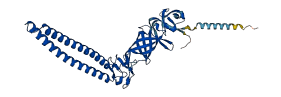
Descriptions
The autoinhibited protein was predicted that may have potential autoinhibitory elements via cis-regPred.
Autoinhibitory domains (AIDs)
Target domain |
|
Relief mechanism |
|
Assay |
cis-regPred |
Accessory elements
No accessory elements
Autoinhibited structure

Activated structure
1 structures for P64176
| Entry ID | Method | Resolution | Chain | Position | Source |
|---|---|---|---|---|---|
| AF-P64176-F1 | Predicted | AlphaFoldDB |
No variants for P64176
| Variant ID(s) | Position | Change | Description | Diseaes Association | Provenance |
|---|---|---|---|---|---|
| No variants for P64176 | |||||
No associated diseases with P64176
1 regional properties for P64176
| Type | Name | Position | InterPro Accession |
|---|---|---|---|
| domain | RND efflux pump, membrane fusion protein, barrel-sandwich domain | 47 - 294 | IPR032317 |
3 GO annotations of cellular component
| Name | Definition |
|---|---|
| extrinsic component of membrane | The component of a membrane consisting of gene products and protein complexes that are loosely bound to one of its surfaces, but not integrated into the hydrophobic region. |
| macrolide transmembrane transporter complex | A bacterial transmembrane transporter complex that spans the entire cell membrane system and possesses ATP-dependent xenobiotic transport activity pumping drugs (typically antibiotics) and other toxins directly from the cytosol out of the bacterial cell. Typically, it is trimeric consisting of a inner membrane ATPase (IMP), a periplasmic membrane fusion protein (MFP) and an outer membrane factor (OMF). In E. coli, macrolide transporter complexes may consists of MacB (IMP), MacA (MFP) and TolC (OMF) or AcrB (IMP), AcrA (MFP) and TolC (OMF). Trimeric TolC is a common OMF found in many macrolide transporter complexes. |
| plasma membrane | The membrane surrounding a cell that separates the cell from its external environment. It consists of a phospholipid bilayer and associated proteins. |
1 GO annotations of molecular function
| Name | Definition |
|---|---|
| transmembrane transporter activity | Enables the transfer of a substance, usually a specific substance or a group of related substances, from one side of a membrane to the other. |
2 GO annotations of biological process
| Name | Definition |
|---|---|
| response to antibiotic | Any process that results in a change in state or activity of a cell or an organism (in terms of movement, secretion, enzyme production, gene expression, etc.) as a result of an antibiotic stimulus. An antibiotic is a chemical substance produced by a microorganism which has the capacity to inhibit the growth of or to kill other microorganisms. |
| xenobiotic detoxification by transmembrane export across the plasma membrane | A process that reduces or removes the toxicity of a xenobiotic by exporting it outside the cell. |
No homologous proteins in AiPD
| UniProt AC | Gene Name | Protein Name | Species | Evidence Code |
|---|---|---|---|---|
| No homologous proteins | ||||
| 10 | 20 | 30 | 40 | 50 | 60 |
| MKKRKTVKKR | YVIALVIVIA | GLITLWRILN | APVPTYQTLI | VRPGDLQQSV | LATGKLDALR |
| 70 | 80 | 90 | 100 | 110 | 120 |
| KVDVGAQVSG | QLKTLSVAIG | DKVKKDQLLG | VIDPEQAENQ | IKEVEATLME | LRAQRQQAEA |
| 130 | 140 | 150 | 160 | 170 | 180 |
| ELKLARVTYS | RQQRLAQTQA | VSLQDLDTAA | TEMAVKQAQI | GTIDAQIKRN | QASLDTAKTN |
| 190 | 200 | 210 | 220 | 230 | 240 |
| LDYTRIVAPM | AGEVTQITTL | QGQTVIAAQQ | APNILTLADM | STMLVKAQVS | EADVIHLKPG |
| 250 | 260 | 270 | 280 | 290 | 300 |
| QKAWFTVLGD | PLTRYEGQIK | DVLPTPEKVN | DAIFYYARFE | VPNPNGLLRL | DMTAQVHIQL |
| 310 | 320 | 330 | 340 | 350 | 360 |
| TDVKNVLTIP | LSALGDPVGD | NRYKVKLLRN | GETREREVTI | GARNDTDVEI | VKGLEAGDEV |
| 370 | |||||
| VIGEAKPGAA | Q |