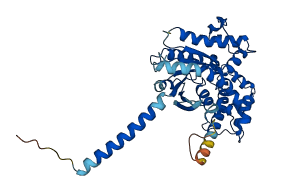
Descriptions
The autoinhibited protein was predicted that may have potential autoinhibitory elements via cis-regPred.
Autoinhibitory domains (AIDs)
Target domain |
|
Relief mechanism |
|
Assay |
cis-regPred |
Accessory elements
No accessory elements
Autoinhibited structure

Activated structure
1 structures for P63093
| Entry ID | Method | Resolution | Chain | Position | Source |
|---|---|---|---|---|---|
| AF-P63093-F1 | Predicted | AlphaFoldDB |
No variants for P63093
| Variant ID(s) | Position | Change | Description | Diseaes Association | Provenance |
|---|---|---|---|---|---|
| No variants for P63093 | |||||
No associated diseases with P63093
No regional properties for P63093
| Type | Name | Position | InterPro Accession |
|---|---|---|---|
| No domain, repeats, and functional sites for P63093 | |||
4 GO annotations of cellular component
| Name | Definition |
|---|---|
| cytosol | The part of the cytoplasm that does not contain organelles but which does contain other particulate matter, such as protein complexes. |
| intrinsic component of membrane | The component of a membrane consisting of the gene products having some covalently attached portion, for example part of a peptide sequence or some other covalently attached group such as a GPI anchor, which spans or is embedded in one or both leaflets of the membrane. |
| plasma membrane | The membrane surrounding a cell that separates the cell from its external environment. It consists of a phospholipid bilayer and associated proteins. |
| trans-Golgi network membrane | The lipid bilayer surrounding any of the compartments that make up the trans-Golgi network. |
5 GO annotations of molecular function
| Name | Definition |
|---|---|
| adenylate cyclase activator activity | Increases the activity of the enzyme that catalyzes the reaction: ATP = 3',5'-cyclic AMP + diphosphate. |
| G-protein beta/gamma-subunit complex binding | Binding to a complex of G-protein beta/gamma subunits. |
| GTP binding | Binding to GTP, guanosine triphosphate. |
| GTPase activity | Catalysis of the reaction: GTP + H2O = GDP + H+ + phosphate. |
| metal ion binding | Binding to a metal ion. |
9 GO annotations of biological process
| Name | Definition |
|---|---|
| adenylate cyclase-activating adrenergic receptor signaling pathway | An adenylate cyclase-activating G protein-coupled receptor signaling pathway initiated by a ligand binding to an adrenergic receptor on the surface of the target cell, and ending with the regulation of a downstream cellular process. |
| adenylate cyclase-activating G protein-coupled receptor signaling pathway | A G protein-coupled receptor signaling pathway in which the signal is transmitted via the activation of adenylyl cyclase activity and a subsequent increase in the intracellular concentration of cyclic AMP (cAMP). |
| bone development | The process whose specific outcome is the progression of bone over time, from its formation to the mature structure. Bone is the hard skeletal connective tissue consisting of both mineral and cellular components. |
| cognition | The operation of the mind by which an organism becomes aware of objects of thought or perception; it includes the mental activities associated with thinking, learning, and memory. |
| developmental growth | The increase in size or mass of an entire organism, a part of an organism or a cell, where the increase in size or mass has the specific outcome of the progression of the organism over time from one condition to another. |
| hair follicle placode formation | The developmental process in which a hair placode forms. An hair follicle placode is a thickening of the ectoderm that will give rise to the hair follicle bud. |
| platelet aggregation | The adhesion of one platelet to one or more other platelets via adhesion molecules. |
| positive regulation of cAMP-mediated signaling | Any process which activates, maintains or increases the frequency, rate or extent of cAMP-mediated signaling. |
| positive regulation of GTPase activity | Any process that activates or increases the activity of a GTPase. |
No homologous proteins in AiPD
| UniProt AC | Gene Name | Protein Name | Species | Evidence Code |
|---|---|---|---|---|
| No homologous proteins | ||||
| 10 | 20 | 30 | 40 | 50 | 60 |
| MGCLGNSKTE | DQRNEEKAQR | EANKKIEKQL | QKDKQVYRAT | HRLLLLGAGE | SGKSTIVKQM |
| 70 | 80 | 90 | 100 | 110 | 120 |
| RILHVNGFNG | EGGEEDPQAA | RSNSDGEKAT | KVQDIKNNLK | EAIETIVAAM | SNLVPPVELA |
| 130 | 140 | 150 | 160 | 170 | 180 |
| NPENQFRVDY | ILSVMNVPNF | DFPPEFYEHA | KALWEDEGVR | ACYERSNEYQ | LIDCAQYFLD |
| 190 | 200 | 210 | 220 | 230 | 240 |
| KIDVIKQADY | VPSDQDLLRC | RVLTSGIFET | KFQVDKVNFH | MFDVGGQRDE | RRKWIQCFND |
| 250 | 260 | 270 | 280 | 290 | 300 |
| VTAIIFVVAS | SSYNMVIRED | NQTNRLQEAL | NLFKSIWNNR | WLRTISVILF | LNKQDLLAEK |
| 310 | 320 | 330 | 340 | 350 | 360 |
| VLAGKSKIED | YFPEFARYTT | PEDATPEPGE | DPRVTRAKYF | IRDEFLRIST | ASGDGRHYCY |
| 370 | 380 | 390 | |||
| PHFTCAVDTE | NIRRVFNDCR | DIIQRMHLRQ | YELL |