P62583
Gene name |
VPS74 (ACL165C) |
Protein name |
Vacuolar protein sorting-associated protein 74 |
Names |
|
Species |
Ashbya gossypii (strain ATCC 10895 / CBS 109.51 / FGSC 9923 / NRRL Y-1056) (Yeast) (Eremothecium gossypii) |
KEGG Pathway |
ago:AGOS_ACL165C |
EC number |
|
Protein Class |
|
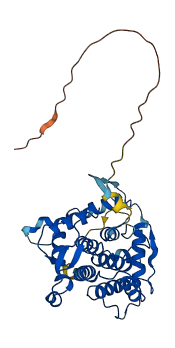
Descriptions
The autoinhibited protein was predicted that may have potential autoinhibitory elements via cis-regPred.
Autoinhibitory domains (AIDs)
Target domain |
|
Relief mechanism |
|
Assay |
cis-regPred |
Accessory elements
No accessory elements
Autoinhibited structure

Activated structure
1 structures for P62583
| Entry ID | Method | Resolution | Chain | Position | Source |
|---|---|---|---|---|---|
| AF-P62583-F1 | Predicted | AlphaFoldDB |
No variants for P62583
| Variant ID(s) | Position | Change | Description | Diseaes Association | Provenance |
|---|---|---|---|---|---|
| No variants for P62583 | |||||
No associated diseases with P62583
No regional properties for P62583
| Type | Name | Position | InterPro Accession |
|---|---|---|---|
| No domain, repeats, and functional sites for P62583 | |||
Functions
7 GO annotations of cellular component
| Name | Definition |
|---|---|
| cytosol | The part of the cytoplasm that does not contain organelles but which does contain other particulate matter, such as protein complexes. |
| extrinsic component of membrane | The component of a membrane consisting of gene products and protein complexes that are loosely bound to one of its surfaces, but not integrated into the hydrophobic region. |
| Golgi cisterna | Any of the thin, flattened membrane-bounded compartments that form the central portion of the Golgi complex. |
| Golgi cisterna membrane | The lipid bilayer surrounding any of the thin, flattened compartments that form the central portion of the Golgi complex. |
| Golgi medial cisterna | The middle Golgi cisterna (or cisternae). |
| Golgi membrane | The lipid bilayer surrounding any of the compartments of the Golgi apparatus. |
| trans-Golgi network | The network of interconnected tubular and cisternal structures located within the Golgi apparatus on the side distal to the endoplasmic reticulum, from which secretory vesicles emerge. The trans-Golgi network is important in the later stages of protein secretion where it is thought to play a key role in the sorting and targeting of secreted proteins to the correct destination. |
2 GO annotations of molecular function
| Name | Definition |
|---|---|
| enzyme binding | Binding to an enzyme, a protein with catalytic activity. |
| phosphatidylinositol-4-phosphate binding | Binding to phosphatidylinositol-4-phosphate, a derivative of phosphatidylinositol in which the inositol ring is phosphorylated at the 4' position. |
9 GO annotations of biological process
| Name | Definition |
|---|---|
| endoplasmic reticulum unfolded protein response | The series of molecular signals generated as a consequence of the presence of unfolded proteins in the endoplasmic reticulum (ER) or other ER-related stress; results in changes in the regulation of transcription and translation. |
| Golgi organization | A process that is carried out at the cellular level which results in the assembly, arrangement of constituent parts, or disassembly of the Golgi apparatus. |
| Golgi to plasma membrane protein transport | The directed movement of proteins from the Golgi to the plasma membrane in transport vesicles that move from the trans-Golgi network to the plasma membrane. |
| Golgi vesicle budding | The evagination of the Golgi membrane, resulting in formation of a vesicle. |
| protein N-linked glycosylation | A protein glycosylation process in which a carbohydrate or carbohydrate derivative unit is added to a protein via the N4 atom of peptidyl-asparagine, the omega-N of arginine, or the N1' atom peptidyl-tryptophan. |
| protein O-linked mannosylation | The transfer of mannose from dolichyl activated mannose to the hydroxyl group of a seryl or threonyl residue of a protein acceptor molecule, to form an O-linked protein-sugar linkage. |
| protein retention in Golgi apparatus | The retention of proteins within the Golgi apparatus. Golgi-localized carbohydrate-modifying enzymes have a short N-terminal domain that faces the cytosol, a single transmembrane alpha helix, and a large C-terminal domain that faces the Golgi lumen and that contains the catalytic site. How the membrane-spanning alpha helix in a Golgi enzyme causes its localization and prevents its movement to the plasma membrane is not known. |
| regulation of phosphatidylinositol dephosphorylation | Any process that modulates the frequency, rate or extent of the chemical reaction involving the removal of one or more phosphate groups from a phosphatidylinositol. |
| retrograde vesicle-mediated transport, Golgi to endoplasmic reticulum | The directed movement of substances from the Golgi back to the endoplasmic reticulum, mediated by vesicles bearing specific protein coats such as COPI or COG. |
No homologous proteins in AiPD
| UniProt AC | Gene Name | Protein Name | Species | Evidence Code |
|---|---|---|---|---|
| No homologous proteins | ||||
| 10 | 20 | 30 | 40 | 50 | 60 |
| MSLQRRRVNK | TAGNETVGGA | SLNRSDEEEG | MTHKVAYDPE | EQKLRENTRE | PTLTLMEEVL |
| 70 | 80 | 90 | 100 | 110 | 120 |
| LMGLKDKEGY | LSFLNENISY | ALRGCILIEL | ALRGRIQVVD | DAMRRRFDPS | ERLIEVVDGS |
| 130 | 140 | 150 | 160 | 170 | 180 |
| KTGEALLDEA | LTLMKGSEPL | TIVNWMDLLS | GETWNFLKIN | YQLRQVRERL | AKGLVDKGVL |
| 190 | 200 | 210 | 220 | 230 | 240 |
| RTEMKNFFLF | DMPTHPVADT | SCKESIKRRI | LSVLVPRNVE | LQYTELFPET | VAFKYLRTIA |
| 250 | 260 | 270 | 280 | 290 | 300 |
| LICSAHGANV | LEKVLSTLDY | EKRDRGFSRA | EELLVQFSQY | PFALDKDIET | GISVNLNRLV |
| 310 | 320 | 330 | |||
| QEELDRNPGT | ALNLEVVAGV | LKVYSRMDDL | L |