P62493
Gene name |
RAB11A |
Protein name |
Ras-related protein Rab-11A |
Names |
Rab-11 |
Species |
Oryctolagus cuniculus (Rabbit) |
KEGG Pathway |
ocu:100009072 |
EC number |
3.6.5.2: Acting on GTP; involved in cellular and subcellular movement |
Protein Class |
|
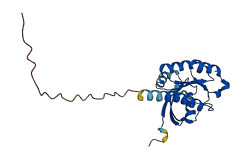
Descriptions
The autoinhibited protein was predicted that may have potential autoinhibitory elements via cis-regPred.
Autoinhibitory domains (AIDs)
Target domain |
|
Relief mechanism |
|
Assay |
cis-regPred |
Accessory elements
No accessory elements
Autoinhibited structure

Activated structure
1 structures for P62493
| Entry ID | Method | Resolution | Chain | Position | Source |
|---|---|---|---|---|---|
| AF-P62493-F1 | Predicted | AlphaFoldDB |
No variants for P62493
| Variant ID(s) | Position | Change | Description | Diseaes Association | Provenance |
|---|---|---|---|---|---|
| No variants for P62493 | |||||
No associated diseases with P62493
1 regional properties for P62493
| Type | Name | Position | InterPro Accession |
|---|---|---|---|
| domain | Small GTP-binding protein domain | 10 - 168 | IPR005225 |
Functions
| Description | ||
|---|---|---|
| EC Number | 3.6.5.2 | Acting on GTP; involved in cellular and subcellular movement |
| Subcellular Localization |
|
|
| PANTHER Family | ||
| PANTHER Subfamily | ||
| PANTHER Protein Class | ||
| PANTHER Pathway Category | No pathway information available | |
15 GO annotations of cellular component
| Name | Definition |
|---|---|
| centriolar satellite | A small (70-100 nm) cytoplasmic granule that contains a number of centrosomal proteins; centriolar satellites traffic toward microtubule minus ends and are enriched near the centrosome. |
| centriole | A cellular organelle, found close to the nucleus in many eukaryotic cells, consisting of a small cylinder with microtubular walls, 300-500 nm long and 150-250 nm in diameter. It contains nine short, parallel, peripheral microtubular fibrils, each fibril consisting of one complete microtubule fused to two incomplete microtubules. Cells usually have two centrioles, lying at right angles to each other. At division, each pair of centrioles generates another pair and the twin pairs form the pole of the mitotic spindle. |
| centrosome | A structure comprised of a core structure (in most organisms, a pair of centrioles) and peripheral material from which a microtubule-based structure, such as a spindle apparatus, is organized. Centrosomes occur close to the nucleus during interphase in many eukaryotic cells, though in animal cells it changes continually during the cell-division cycle. |
| cleavage furrow | The cleavage furrow is a plasma membrane invagination at the cell division site. The cleavage furrow begins as a shallow groove and eventually deepens to divide the cytoplasm. |
| extracellular exosome | A vesicle that is released into the extracellular region by fusion of the limiting endosomal membrane of a multivesicular body with the plasma membrane. Extracellular exosomes, also simply called exosomes, have a diameter of about 40-100 nm. |
| glutamatergic synapse | A synapse that uses glutamate as a neurotransmitter. |
| kinetochore microtubule | Any of the spindle microtubules that attach to the kinetochores of chromosomes by their plus ends, and maneuver the chromosomes during mitotic or meiotic chromosome segregation. |
| multivesicular body | A type of endosome in which regions of the limiting endosomal membrane invaginate to form internal vesicles; membrane proteins that enter the internal vesicles are sequestered from the cytoplasm. |
| phagocytic vesicle | A membrane-bounded intracellular vesicle that arises from the ingestion of particulate material by phagocytosis. |
| postsynaptic recycling endosome | A recycling endosome of the postsynapse. In postsynaptic terminals with dendritic spines, it is typically located at the base of a dendritic spine. It is involved in recycling of neurotransmitter receptors to the postsynaptic membrane. In some cases at least, this recycling is activated by postsynaptic signalling and so can play a role in long term potentiation. |
| protein-containing complex | A stable assembly of two or more macromolecules, i.e. proteins, nucleic acids, carbohydrates or lipids, in which at least one component is a protein and the constituent parts function together. |
| recycling endosome | An organelle consisting of a network of tubules that functions in targeting molecules, such as receptors transporters and lipids, to the plasma membrane. |
| recycling endosome membrane | The lipid bilayer surrounding a recycling endosome. |
| spindle pole | Either of the ends of a spindle, where spindle microtubules are organized; usually contains a microtubule organizing center and accessory molecules, spindle microtubules and astral microtubules. |
| trans-Golgi network | The network of interconnected tubular and cisternal structures located within the Golgi apparatus on the side distal to the endoplasmic reticulum, from which secretory vesicles emerge. The trans-Golgi network is important in the later stages of protein secretion where it is thought to play a key role in the sorting and targeting of secreted proteins to the correct destination. |
5 GO annotations of molecular function
| Name | Definition |
|---|---|
| G protein activity | A molecular function regulator that cycles between active GTP-bound and inactive GDP-bound states. In its active state, binds to a variety of effector proteins to regulate cellular processes. Intrinsic GTPase activity returns the G protein to its GDP-bound state. The return to the GDP-bound state can be accelerated by the action of a GTPase-activating protein (GAP). |
| GTP binding | Binding to GTP, guanosine triphosphate. |
| GTPase activity | Catalysis of the reaction: GTP + H2O = GDP + H+ + phosphate. |
| microtubule binding | Binding to a microtubule, a filament composed of tubulin monomers. |
| myosin V binding | Binding to a class V myosin; myosin V is a dimeric molecule involved in intracellular transport. |
18 GO annotations of biological process
| Name | Definition |
|---|---|
| amyloid-beta clearance by transcytosis | The process in which amyloid-beta is removed from extracellular brain regions by cell surface receptor-mediated endocytosis, followed by transcytosis across the blood-brain barrier. |
| astral microtubule organization | A process that is carried out at the cellular level which results in the assembly, arrangement of constituent parts, or disassembly of astral microtubules, any of the spindle microtubules that radiate in all directions from the spindle poles. |
| establishment of protein localization to membrane | The directed movement of a protein to a specific location in a membrane. |
| establishment of protein localization to organelle | The directed movement of a protein to a specific location on or in an organelle. Encompasses establishment of localization in the membrane or lumen of a membrane-bounded organelle. |
| exosomal secretion | The process whereby a membrane-bounded vesicle is released into the extracellular region by fusion of the limiting endosomal membrane of a multivesicular body with the plasma membrane. |
| melanosome transport | The directed movement of melanosomes into, out of or within a cell, or between cells, by means of some agent such as a transporter or pore. |
| mitotic metaphase plate congression | The cell cycle process in which chromosomes are aligned at the metaphase plate, a plane halfway between the poles of the mitotic spindle, during mitosis. |
| mitotic spindle assembly | Mitotic bipolar spindle assembly begins with spindle microtubule nucleation from the separated spindle pole body, includes spindle elongation during prometaphase, and is complete when all kinetochores are stably attached the spindle, and the spindle assembly checkpoint is satisfied. |
| multivesicular body assembly | The aggregation, arrangement and bonding together of a set of components to form a multivesicular body, a type of late endosome in which regions of the limiting endosomal membrane invaginate to form internal vesicles; membrane proteins that enter the internal vesicles are sequestered from the cytoplasm. |
| neuron projection development | The process whose specific outcome is the progression of a neuron projection over time, from its formation to the mature structure. A neuron projection is any process extending from a neural cell, such as axons or dendrites (collectively called neurites). |
| positive regulation of epithelial cell migration | Any process that activates or increases the frequency, rate or extent of epithelial cell migration. |
| positive regulation of G2/M transition of mitotic cell cycle | Any signalling pathway that activates or increases the activity of a cell cycle cyclin-dependent protein kinase to modulate the switch from G2 phase to M phase of the mitotic cell cycle. |
| protein localization to cell surface | A process in which a protein is transported to, or maintained in, a location within the external part of the cell wall and/or plasma membrane. |
| protein localization to plasma membrane | A process in which a protein is transported to, or maintained in, a specific location in the plasma membrane. |
| protein transport | The directed movement of proteins into, out of or within a cell, or between cells, by means of some agent such as a transporter or pore. |
| regulation of cytokinesis | Any process that modulates the frequency, rate or extent of the division of the cytoplasm of a cell and its separation into two daughter cells. |
| regulation of multivesicular body size | Any process that modulates the volume of a multivesicular body, a type of late endosome in which regions of the limiting endosomal membrane invaginate to form internal vesicles. |
| regulation of vesicle-mediated transport | Any process that modulates the rate, frequency, or extent of vesicle-mediated transport, the directed movement of substances, either within a vesicle or in the vesicle membrane, into, out of or within a cell. |
No homologous proteins in AiPD
| UniProt AC | Gene Name | Protein Name | Species | Evidence Code |
|---|---|---|---|---|
| No homologous proteins | ||||
| 10 | 20 | 30 | 40 | 50 | 60 |
| MGTRDDEYDY | LFKVVLIGDS | GVGKSNLLSR | FTRNEFNLES | KSTIGVEFAT | RSIQVDGKTI |
| 70 | 80 | 90 | 100 | 110 | 120 |
| KAQIWDTAGQ | ERYRAITSAY | YRGAVGALLV | YDIAKHLTYE | NVERWLKELR | DHADSNIVIM |
| 130 | 140 | 150 | 160 | 170 | 180 |
| LVGNKSDLRH | LRAVPTDEAR | AFAEKNGLSF | IETSALDSTN | VEAAFQTILT | EIYRIVSQKQ |
| 190 | 200 | 210 | |||
| MSDRRENDMS | PSNNVVPIHV | PPTTENKPKV | QCCQNI |